• HOME
  • NEWS
  • EXPLORE
    • CAREER
      • Companies
      • Jobs
    • EVENTS
    • iGEM
      • News
      • Team
    • PHOTOS
    • VIDEO
    • WIKI
  • BLOG
  • COMMUNITY
    • FACEBOOK
    • INSTAGRAM
    • TWITTER
Friday, August 28, 2026
BIOENGINEER.ORG
No Result
View All Result
  • Login
  • HOME
  • NEWS
  • EXPLORE
    • CAREER
      • Companies
      • Jobs
        • Lecturer
        • PhD Studentship
        • Postdoc
        • Research Assistant
    • EVENTS
    • iGEM
      • News
      • Team
    • PHOTOS
    • VIDEO
    • WIKI
  • BLOG
  • COMMUNITY
    • FACEBOOK
    • INSTAGRAM
    • TWITTER
  • HOME
  • NEWS
  • EXPLORE
    • CAREER
      • Companies
      • Jobs
        • Lecturer
        • PhD Studentship
        • Postdoc
        • Research Assistant
    • EVENTS
    • iGEM
      • News
      • Team
    • PHOTOS
    • VIDEO
    • WIKI
  • BLOG
  • COMMUNITY
    • FACEBOOK
    • INSTAGRAM
    • TWITTER
No Result
View All Result
Bioengineer.org
No Result
View All Result
Home NEWS Science News Health

New ultra-miniaturized scope less invasive, produces higher quality images

Bioengineer by Bioengineer
December 6, 2019
in Health
Reading Time: 2 mins read
0
IMAGE
Share on FacebookShare on TwitterShare on LinkedinShare on RedditShare on Telegram

IMAGE

Credit: Mark Foster


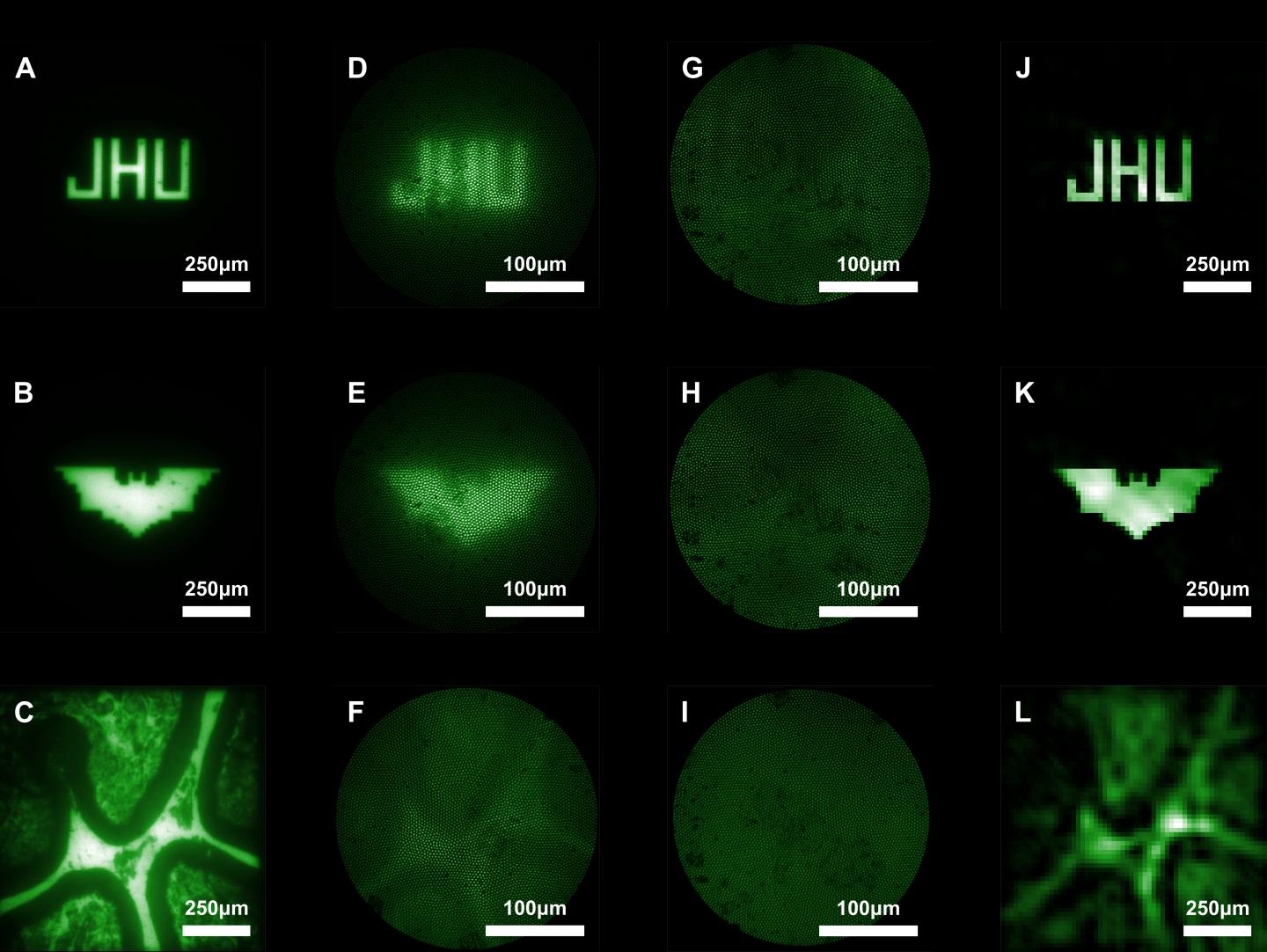
Johns Hopkins engineers have created a new lens-free ultra-miniaturized endoscope, the size of a few human hairs in width, that is less bulky and can produce higher quality images.

Their findings were published today in Science Advances.

“Usually, you have sacrifice either size or image quality. We’ve been able to achieve both with our microendoscope,” says Mark Foster, an associate professor of electrical and computer engineering at The Johns Hopkins University and the study’s corresponding author.

Intended for examining neurons firing off in the brains of animals such as mice and rats, an ideal microendoscope should be small to minimize brain tissue damage yet powerful enough to produce a clear image.

Currently, standard microendoscopes are about half a millimeter to a few millimeters in diameter, and require larger, more invasive lenses for better imaging. While lensless microendoscopes exist, the optical fiber within that scans an area pixel by pixel frequently bends and loses imaging ability when moved.

In their new study, Foster and colleagues created a lens-free ultra-miniaturized microendoscope that, compared to a conventional lens-based microendoscope, increases the amount researchers can see and improves image quality.

The researchers achieved this by using a coded aperture, or a flat grid that randomly blocks light creating a projection in a known pattern akin to randomly poking a piece of aluminum foil and letting light through all of the small holes. This creates a messy image, but one that provides a bounty of information about where the light originates, and that information can be computationally reconstructed into a clearer image. In their experiments, Foster’s team looked at beads in different patterns on a slide.

“For thousands of years, the goal has been to make an image as clear as possible. Now, thanks to computational reconstruction, we can purposefully capture something that looks awful and counterintuitively end up with a clearer final image,” says Foster.

Additionally, Foster and team’s microendoscope doesn’t require movement to focus on objects at different depths; they use computational refocusing to determine where the light originated from in 3 dimensions. This allows the endoscope to be much smaller than a traditional one that requires moving the endoscope around to focus.

Looking forward, the research team will test their microendoscope with fluorescent labeling procedures in which active brain neurons would be tagged and illuminated, to determine how accurately the endoscope can image neural activity.

###

Other authors on the study include Jaewook Shin, Dung N. Tran, Jasper R. Stroud, Sang Chin and Trac D. Tran, all of The Johns Hopkins University.

Media Contact
Chanapa Tantibanchachai
[email protected]
928-458-9656

Tags: Electrical Engineering/ElectronicsneurobiologyResearch/DevelopmentTechnology/Engineering/Computer Science
Share12Tweet8Share2ShareShareShare2

Related Posts

Fabry Disease Linked to Giant Coronary Aneurysms in a Seven-Month-Old Infant

August 28, 2026

Online Weight-Loss Program Helps Mexican Adults, Randomized Trial Finds

August 28, 2026

Sex-Specific Liver Effects of Sweetened Alcohol and Tannic Acid in Adolescent Rats

August 28, 2026

Trial tests pancreatic enzymes, bile acids in severely malnourished acutely ill children

August 28, 2026
Please login to join discussion

POPULAR NEWS

  • One Health Lessons from Pteropus medius: Nipah Spillover, Microbiota, and Antimicrobial Resistance

    29 shares
    Share 12 Tweet 7
  • Diet and micronutrients linked to cardiovascular events, mortality in CKM syndrome

    29 shares
    Share 12 Tweet 7
  • Beijing’s Chaoyang District Urban Parks Provide Refuges for Diverse Birdlife

    29 shares
    Share 12 Tweet 7
  • Noninvasive Physical Stimulation Reprograms Tumor Macrophages for Cancer Immunotherapy

    29 shares
    Share 12 Tweet 7

About

We bring you the latest biotechnology news from best research centers and universities around the world. Check our website.

Follow us

Recent News

One Health Lessons from Pteropus medius: Nipah Spillover, Microbiota, and Antimicrobial Resistance

Diet and micronutrients linked to cardiovascular events, mortality in CKM syndrome

Beijing’s Chaoyang District Urban Parks Provide Refuges for Diverse Birdlife

Subscribe to Blog via Email

Enter your email address to subscribe to this blog and receive notifications of new posts by email.

Join 85 other subscribers
  • Contact Us

Bioengineer.org © Copyright 2023 All Rights Reserved.

Welcome Back!

Login to your account below

Forgotten Password?

Retrieve your password

Please enter your username or email address to reset your password.

Log In
No Result
View All Result
  • Homepages
    • Home Page 1
    • Home Page 2
  • News
  • National
  • Business
  • Health
  • Lifestyle
  • Science

Bioengineer.org © Copyright 2023 All Rights Reserved.