Credit: Marina Freitag
In a future where most things in our everyday life are connected through the internet, devices and sensors will need to run without wires or batteries. In a new article in Chemical Science, researchers from Uppsala University present a new type of dye-sensitised solar cells that harvest light from indoor lamps.
The Internet of Things, or IoT, refers to a network of physical devices and applications connected through the internet. It is estimated that by 2025, many facets of our lives will be mediated through 75 billion IoT devices, a majority of which will be located indoors. Broad installation of such IoT devices requires the devices to become autonomous, meaning that they should no longer need batteries or a grid connection to operate. To achieve this, it is crucial to identify a local low-maintenance energy source that can provide local power to IoT devices, especially in ambient conditions.
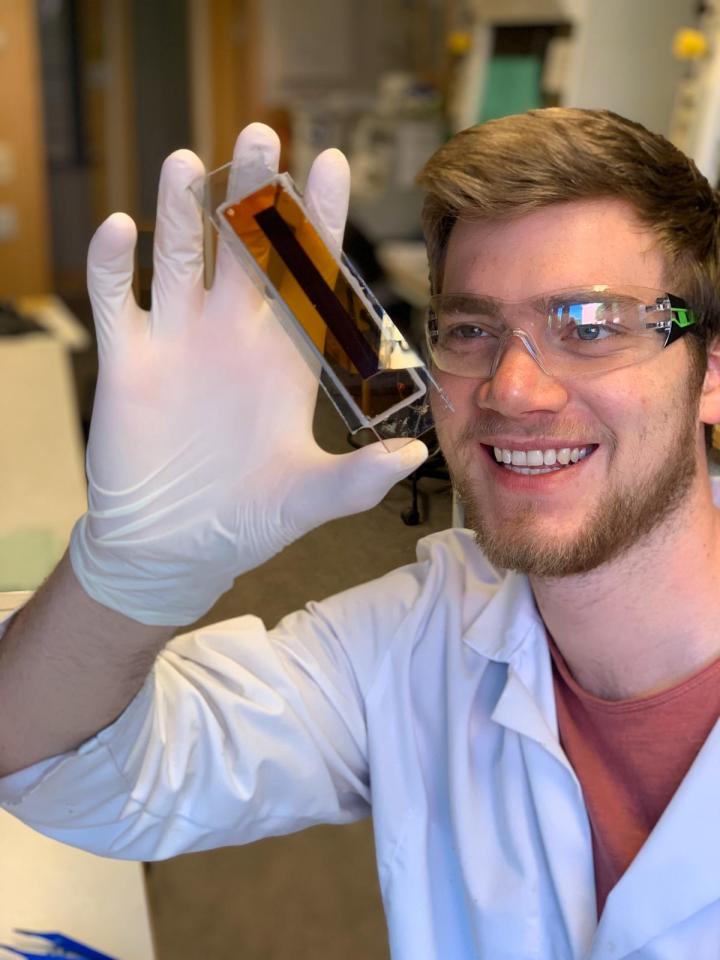
Towards this goal, a research team led by Marina Freitag, assistant professor at the Department of Chemistry, Uppsala University, has developed new indoor photovoltaic cells that can convert up to 34 per cent of visible light into electricity to power a wide range of IoT sensors. The team has designed novel dye-sensitised photovoltaic cells based on a copper-complex electrolyte, which makes them ideal for harvesting indoor light from fluorescent lamps and LEDs. The latest promising results establish dye-sensitised solar cells as leaders in power conversion efficiency for ambient lighting conditions, outperforming conventional silicon and solar cells made from exotic materials.
The research promises to revolutionise indoor digital sensing for smart greenhouses, offices, shelves, packages and many other smart everyday objects for the Internet of Things.
“Knowing the spectra of these light sources makes it possible to tune special dyes to absorb indoor light. While generating large amounts of energy, these indoor photovoltaics also maintain a high voltage under low light, which is important to power IoT devices,” says Freitag.
In cooperation with the Technical University of Munich, the researchers have further designed an adaptive ‘power management’ system for solar-powered IoT sensors. In contrast to their battery-limited counterparts, the light-driven devices intelligently feed from the amount of light available. Computational workloads are executed according to the level of illumination, minimising energy losses during storage and thus using all light energy to the maximum of its availability. Combining artificial intelligence and automated learning, the solar cell system can thus reduce energy consumption, battery waste and help to improve general living conditions.
In the future, scientists expect that billions of IoT devices self-powered by indoor solar cells will provide everything from environmental information to human-machine and machine-machine communications. Such advanced sensors can further enhance the next wave of robotics and autonomous systems currently in development.
“Ambient light harvesters provide a new generation of self-powered and smart IoT devices powered by an energy source that is largely untapped. The combination of high efficiency and low cost with non-toxic materials for indoor photovoltaics is of paramount importance to IoT sustainability,” says Freitag.
###
Media Contact
Marina Freitag
[email protected]
46-790-333-382
Original Source
https:/
Related Journal Article
http://dx.