Researchers from North Carolina State University and Texas Tech University have developed a straightforward questionnaire that older adults can use to assess their “attentional performance” during driving. In proof-of-concept testing, the researchers have demonstrated the tool can predict which drivers are at increased risk of having accidents.
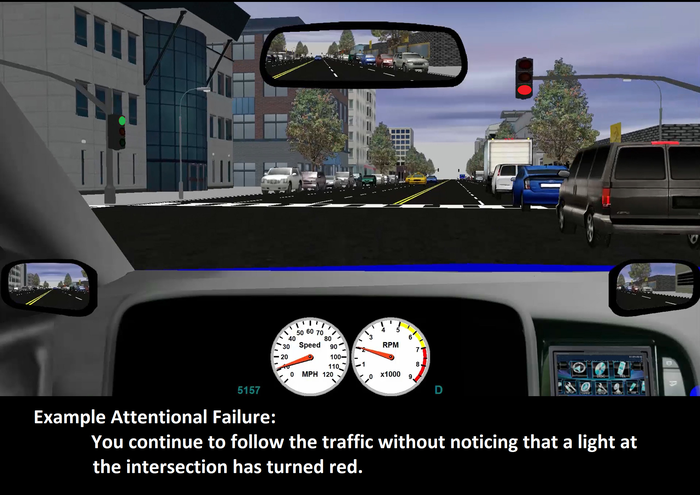
Credit: Jing Feng, NC State University
Researchers from North Carolina State University and Texas Tech University have developed a straightforward questionnaire that older adults can use to assess their “attentional performance” during driving. In proof-of-concept testing, the researchers have demonstrated the tool can predict which drivers are at increased risk of having accidents.
“We developed the tool, called the Attentional Failure during Driving Questionnaire (AFDQ), so that older drivers can recognize and monitor their ability to drive safely,” says Jing Feng, co-author of the study and an associate professor of psychology at NC State. “This study was focused on determining how effective the technique is at assessing attentional performance, and what it can tell us about actual driving performance.
As a group, older adults are more likely to get into fatal crashes – particularly past the age of 70. One reason is that, as we age, our attentional capabilities decline. For example, it becomes more difficult to monitor peripheral activities, such as what is happening to either side of the vehicle.
“In addition, many older adults have limited access to professional assessments of their attentional performance, making a freely available self-monitoring technique particularly valuable,” Feng says.
To test the AFDQ, the researchers recruited 411 middle-aged drivers, between the ages of 25 and 64; and 248 older drivers, all of whom were 65 or older. All of the study participants took the AFDQ, which consists of 19 questions asking users to rate how frequently they are experiencing a range of attentional problems while driving. Participants also completed a survey that included questions related to their driving history over the previous five years. This allowed the researchers to determine how predictive the AFDQ scores were in terms of each study participant’s driving record.
In addition, 54 of the older study participants also came into the lab to navigate a series of urban and rural neighborhoods in a driving simulator.
The first major finding was that having a wide range of attentional challenges was not always a good predictor of whether older drivers had been involved in crashes. However, older study participants who reported having the same attentional challenges repeatedly were significantly more likely to have been in crashes in recent years.
“It didn’t matter if older drivers had occasional challenges,” says HeeSun Choi, corresponding author of the study. “The key predictor was whether someone reported having the same challenge frequently.” Choi started work on the study while a Ph.D. student at NC State; she is now an assistant professor of psychological sciences at Texas Tech.
This finding was reinforced by what the researchers observed in the driving simulator experiments: study participants who encountered the same attentional failures repeatedly had more accidents.
“Among older adults, chronological age was not predictive of driving safety,” says Daniel Grühn, co-author of the study and an associate professor of psychology at NC State. “What mattered most was each driver’s attentional capability. In other words, an 80-year-old driver could be a safer driver than someone who is 65, if the 80-year-old had better attentional capabilities.”
“Overall, this study tells us that the AFDQ can be a valuable tool for helping older drivers monitor their attentional capabilities when driving,” says Feng. “Specifically, older drivers who are experiencing repeated challenges with any of the attentional measures may want to seek out professional assessment or help to ensure that they can drive safely.
“The AFDQ is available on my website, for anyone who wants to use it. And we’re interested in working with organizations that serve drivers or older adults to help people access the AFDQ and make use of it.”
The study, “A Two-Part Approach Distinguishing the Occurrence and Frequency of Self-Reported Attentional Failures during Driving to Predict Crash Risks Among Older Drivers,” appears in The Journals of Gerontology: Series B.
Feng is comfortable conducting interviews in English, Mandarin and Wu.
Journal
Journal of Gerontology
DOI
10.1093/geronb/gbac077
Method of Research
Observational study
Subject of Research
People
Article Title
A Two-Part Approach Distinguishing the Occurrence and Frequency of Self-Reported Attentional Failures during Driving to Predict Crash Risks Among Older Drivers
Article Publication Date
21-May-2022
COI Statement
none