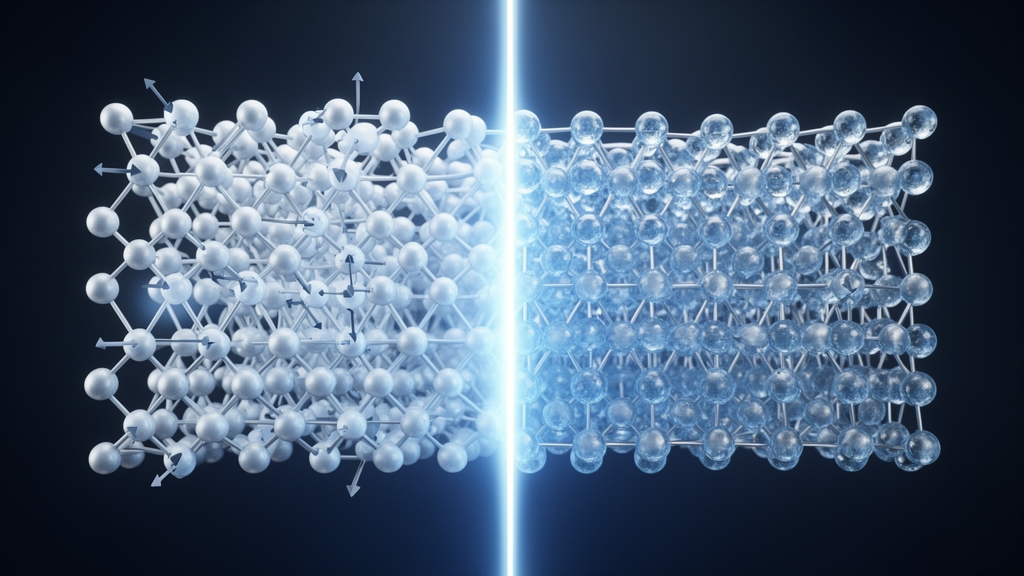
Physicists at The Hong Kong University of Science and Technology (HKUST), working with collaborators at the University of Tokyo, have produced a sweeping theoretical result that answers one of the oldest questions in their field: when are two states of matter genuinely different, and when are they merely two faces of the same underlying phase? The team, led by Professor Haruki Watanabe of the Department of Physics and the Jockey Club Institute for Advanced Study at HKUST, together with Professor Yukitoshi Motome and graduate student Sena Watanabe of the University of Tokyo, has built a unified framework that classifies phases and phase transitions in a broad and important family of magnetic materials. In doing so, the work also settles a decades-long debate about the behavior of water ice squeezed to extraordinary pressures. The research was published in the journal Physical Review X under the title “Topological phase transitions and their thermodynamic fate in arbitrary-S classical pyrochlore spin ice.”
The starting point of the study is a principle that physicists have relied on for more than a century: the identity of a phase of matter is tied to its symmetries. The everyday example is water. Liquid water and steam look and behave very differently, yet at the level of fundamental symmetry they are the same. In both states the molecules have no preferred position and no preferred direction, so nothing in principle forbids one from being continuously deformed into the other. Indeed, if water is heated under high pressure, beyond a specific critical point the boundary between liquid and gas simply disappears, and the two states merge into a single thermodynamic phase. Ice is a different story. When water freezes, the molecules lock into a crystal lattice with fixed positions, breaking the translational and rotational symmetries that liquids and gases preserve. Because the symmetries differ, ice can never be smoothly transformed into liquid water; a genuine phase boundary must always separate them.
For decades, this symmetry-based picture has served as the organizing principle of condensed matter physics. But it leaves an uncomfortable question hanging over any pair of states that share the same symmetries yet look strikingly different. If symmetry cannot tell two states apart, is there any guarantee that they are actually connected by a continuous path, or could some subtler, non-symmetry-based mechanism keep them separated? Answering that question in a controlled and general way has proven remarkably difficult, and it is precisely the challenge that the HKUST-led team set out to confront.
Their testing ground was one of nature’s most counterintuitive substances: dense ice. Under extreme pressures, water freezes into a series of exotic crystalline forms with names like ice VII, ice VIII, and ice X. All of these share the same skeleton of oxygen atoms, arranged in an identical crystal framework. What distinguishes them is the placement of the hydrogen atoms that sit between the oxygens. In ice VII, the hydrogen atoms are distributed randomly among the available positions. In ice VIII, they settle into an ordered, periodic arrangement. In ice X, they drift to the midpoints of the bonds between neighboring oxygen atoms, becoming shared equally by two oxygens at once. The puzzle is that ice VII and ice X, when averaged over time, preserve exactly the same underlying crystal symmetries. By the standard symmetry criterion, there is no obvious reason they should be distinct phases, yet experiments and intuition have long suggested that something meaningful separates them.
The key insight of the new work is that this problem in high-pressure ice can be recast, exactly, as a problem in magnetism. The midpoints of the oxygen-oxygen bonds in these ice structures form a geometric pattern known as the pyrochlore lattice, a three-dimensional network of corner-sharing tetrahedra that is famous in condensed matter physics as the architecture underlying so-called spin ice materials. In those magnets, the magnetic moments behave as if they were hydrogen atoms in ice, obeying the same local rules. The correspondence runs deeper still: the three possible positions available to each hydrogen atom in ice map precisely onto the three allowed states of a quantum magnetic moment with spin equal to one. This mapping transforms a question about water under pressure into a question about magnets on a pyrochlore lattice, where a powerful theoretical toolkit becomes available.
In a companion study published in Physical Review B, the team first analyzed a simplified version of the problem in which the ordering of ice VIII is excluded. The result was striking. Ice VII and ice X are separated by a sharp, genuine phase transition only at absolute zero temperature. At any temperature above that point, thermally excited defects begin to roam the crystal, and these defects behave exactly like the celebrated magnetic monopoles of spin ice physics. The monopoles screen out the field that would otherwise hold the two states apart, dissolving the sharp transition into a smooth, gradual crossover. The conclusion is unambiguous: at any realistic temperature, ice VII and ice X are not distinct phases of matter but different manifestations of a single phase. Ice VIII, by contrast, remains genuinely separate, because its ordered hydrogen arrangement breaks a crystal symmetry that the other two forms preserve, placing it beyond the reach of any continuous connection.
The primary Physical Review X paper then generalizes this result into a comprehensive framework covering classical pyrochlore spin-ice models with arbitrary spin values, not just the spin-one case relevant to ice. The framework identifies what actually keeps two states apart in these systems: a network of string-like defects threading through the crystal. As long as those strings close on themselves, forming closed loops, the two states remain genuinely distinct phases. But the framework also exposes a sharp divide that earlier work could not see, one that depends on whether the spin of the magnetic moments is a whole number or a half-integer. Above absolute zero, thermally excited monopoles cut the strings open, and once the strings are severed, the topological distinction they carried is washed out. Almost every sharp phase boundary in the family then gives way to a smooth crossover, echoing the fate of the ice VII to ice X transition.
There is one dramatic exception to this rule. When the spin takes the value three-halves, the theory predicts that an abrupt transition between two distinct liquid-like magnetic states survives at finite temperature, ending at a critical point without any need for an external magnetic field to stabilize it. This makes spin three-half pyrochlore magnets an especially promising target for experimentalists searching for a phase transition that defies the conventional symmetry-based classification. Finding such a transition in the laboratory would demonstrate a form of order that persists at finite temperature through topology alone, something the new framework says should be impossible everywhere else in this family of models.
The implications reach well beyond dense ice and idealized magnets. Pyrochlore spin-ice physics appears in frustrated magnetic materials, in engineered nanomagnet arrays where artificial moments are arranged on the same lattice geometry, and in trapped cold-atom systems where researchers can simulate these models with exquisite control. For all of these platforms, the new theory provides a practical recipe: examine the symmetries, examine the string-like topological defects, and check whether the spin is integer or half-integer. The answers determine whether an observed change of behavior reflects a true phase boundary or merely a crossover, a distinction that governs what experiments can hope to observe and what theoretical surprises may remain hidden.
For Professor Watanabe, the deeper message of the work is a reaffirmation of a classical idea, sharpened by modern tools. As he reflected on the findings, our results ultimately support the conventional view that the phases of ordinary matter are classified by broken symmetry, and by nothing else. Wherever symmetry could not distinguish between two states, a continuous path connected them without crossing a phase boundary. Yet he is quick to point out that this conclusion is an invitation as much as an answer. It would be far more interesting, he notes, to discover a topological phase that genuinely survives at finite temperature beyond this classification, and that is exactly what the team is looking for now. In redrawing the boundary between phases of matter, the HKUST-led collaboration has also drawn a map of where the next discovery might lie.
Subject of Research: Classification of phases and phase transitions in pyrochlore spin-ice magnets and high-pressure ice
Article Title: HKUST researchers redraw the boundary between phases of matter
Article References: HKUST researchers redraw the boundary between phases of matter. (n.d.). Original publication
Image Credits: AI Generated
DOI: Not provided
Keywords: phases of matter, phase transitions, pyrochlore lattice, spin ice, topological defects, magnetic monopoles, high-pressure ice, ice VII, ice X, symmetry breaking, condensed matter physics, HKUST
News Source: Katie Riggs. (October 14, 2026). New Theory Draws the Line Between Phases of Matter, From Spin Ice to High-Pressure Ice. Scienmag.