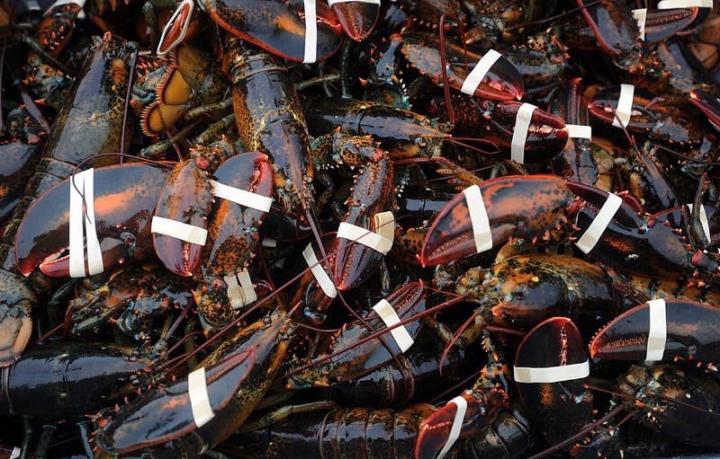
Credit: Charlie Ellis
Scientists have developed a test that can identify hybrids resulting from crossbreeding between European and American lobsters.
American lobsters have occasionally escaped or been released into European waters after being imported for the seafood market.
Experts have long feared they could threaten European lobsters by introducing disease or establishing as an invasive species.
Hybridisation – when a “pure” species is threatened at a genetic level via interbreeding with a different but related species – had been less of a concern because lab studies suggested European and American lobsters were reluctant to mate.
However, when an American lobster female was found bearing eggs in a fjord in Sweden, University of Exeter researchers tested the offspring and found they were “clearly distinct” from both European and American lobsters.
“We had just developed a genetic test for seafood traceability that could separate any American lobsters mislabelled as more expensive European equivalents once they’ve been cooked and shell colouration is no longer a useful indicator of the species,” said Dr Charlie Ellis, of the University of Exeter.
“What we found when we tested these offspring is that they came out exactly in the middle of this separation – half American and half European – so these lobsters were hybrids.”
This has potentially concerning implications for the lobster industry and conservation efforts, and Dr Ellis says further research is required to assess the extent of the threat.
“Until recently, it was thought that American and European lobsters would avoid crossbreeding, but this introduced American female has mated with a native European male, probably because she was unable to find an American male,” he said.
“We now need to check whether any mature adult hybrids are fertile, because if they are then they have the ability to spread these unwanted American genes far and wide across our native lobster stocks.”
Working with collaborators from the University of Gothenburg who originally found the hybrid egg clutch, the researchers say their study, published in the journal Scientific Reports, highlights the vital use of genetics to distinguish hybrid lobsters which might look almost identical to a pure strain.
“It is particularly concerning that we seem to have found American lobster genes in one of our lobster reserves,” said Linda Svanberg of the Gothenburg team.
“The better news is we now have this genetic tool to test lobsters or their eggs for hybridisation”, added Dr Jamie Stevens, leader of the research which was funded by an EU grant through the Agritech Cornwall scheme, “so we can use it track the spread of these ‘alien’ genes to assess how big a threat this presents to our native lobster species.”
The team advise that, for a range of conservation reasons including potential contact with American lobsters, it is important that the general public never release a marketed lobster back into the wild, even our native species.
Dr Tom Jenkins said: “Although we appreciate that all animal-lovers have concern for the fate of individual animals, in this case the rescue of one animal might endanger the health of the entire wild population, so once a lobster has entered the seafood supply chain that’s where it should stay.”
###
Media Contact
Alex Morrison
[email protected]
Related Journal Article
http://dx.