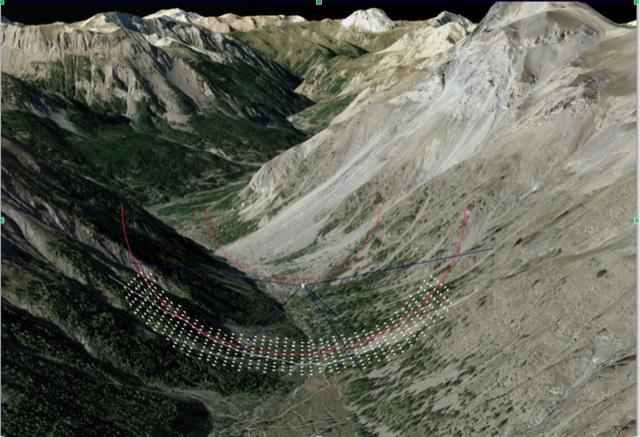
Credit: Antoine Labeyrie, Collège de France and Observatoire de la Cote d’Azur
WASHINGTON — Researchers have designed a new camera that could allow hypertelescopes to image multiple stars at once. The enhanced telescope design holds the potential to obtain extremely high-resolution images of objects outside our solar system, such as planets, pulsars, globular clusters and distant galaxies.
“A multi-field hypertelescope could, in principle, capture a highly detailed image of a star, possibly also showing its planets and even the details of the planets’ surfaces,” said Antoine Labeyrie, emeritus professor at the Collège de France and Observatoire de la Cote d’Azur, who pioneered the hypertelescope design. “It could allow planets outside of our solar system to
be seen with enough detail that spectroscopy could be used to search for evidence of photosynthetic life.”
In The Optical Society’s (OSA) journal Optics Letters, Labeyrie and a multi-institutional group of researchers report optical modeling results that verify that their multi-field design can substantially extend the narrow field-of-view coverage of hypertelescopes developed to date.
Making the mirror larger
Large optical telescopes use a concave mirror to focus light from celestial sources. Although larger mirrors can produce more detailed pictures because of their reduced diffractive spreading of the light beam, there is a limit to how large these mirrors can be made. Hypertelescopes are designed to overcome this size limitation by using large arrays of mirrors, which can be spaced widely apart.
Researchers have previously experimented with relatively small prototype hypertelescope designs, and a full-size version is currently under construction in the French Alps. In the new work, researchers used computer models to create a design that would give hypertelescopes a much larger field of view. This design could be implemented on Earth, in a crater of the moon or even on an extremely large scale in space.
Building a hypertelescope in space, for example, would require a large flotilla of small mirrors spaced out to form a very large concave mirror. The large mirror focuses light from a star or other celestial object onto a separate spaceship carrying a camera and other necessary optical components.
“The multi-field design is a rather modest addition to the optical system of a hypertelescope, but should greatly enhance its capabilities,” said Labeyrie. “A final version deployed in space could have a diameter tens of times larger than the Earth and could be used to reveal details of extremely small objects such as the Crab pulsar, a neutron star believed to be only 20 kilometers in size.”
Expanding the view
Hypertelescopes use what is known as pupil densification to concentrate light collection to form high-resolution images. This process, however, greatly limits the field of view for hypertelescopes, preventing the formation of images of diffuse or large objects such as a globular star cluster, exoplanetary system or galaxy.
The researchers developed a micro-optical system that can be used with the focal camera of the hypertelescope to simultaneously generate separate images of each field of interest. For star clusters, this makes it possible to obtain separate images of each of thousands of stars simultaneously.
The proposed multi-field design can be thought of as an instrument made of multiple independent hypertelescopes, each with a differently tilted optical axis that gives it a unique imaging field. These independent telescopes focus adjacent images onto a single camera sensor.
The researchers used optical simulation software to model different implementations of a multi-field hypertelescope. These all provided accurate results that confirmed the feasibility of multi-field observations.
Incorporating the multi-field addition into hypertelescope prototypes would require developing new components, including adaptive optics components to correct residual optical imperfections in the off-axis design. The researchers are also continuing to develop alignment techniques and control software so that the new camera can be used with the prototype in the Alps. They have also developed a similar design for a moon-based version.
###
Paper: Z. Xie, D. Mourard, T. Lepine, T. Houllier, A. Labeyrie, H. Ma, “A hypertelescope with multiplexed fields of view,” Opt. Lett., 45, 7, 1878-1811 (2020).
DOI: https:/
About Optics Letters
Optics Letters offers rapid dissemination of new results in all areas of optical science with short, original, peer-reviewed communications. Optics Letters accepts papers that are noteworthy to a substantial part of the optics community. Published by The Optical Society and led by Editor-in-Chief Miguel Alonso, Institut Fresnel, Ecole Central Marseille and Aix-Marseille Université, France, University of Rochester, USA, Optics Letters is available online at OSA Publishing.
About The Optical Society
Founded in 1916, The Optical Society (OSA) is the leading professional organization for scientists, engineers, students and business leaders who fuel discoveries, shape real-life applications and accelerate achievements in the science of light. Through world-renowned publications, meetings and membership initiatives, OSA provides quality research, inspired interactions and dedicated resources for its extensive global network of optics and photonics experts. For more information, visit osa.org.
Media Contact:
Media Contact
James Merrick
[email protected]
202-416-1994
Original Source
https:/
Related Journal Article
http://dx.