• HOME
  • NEWS
  • EXPLORE
    • CAREER
      • Companies
      • Jobs
    • EVENTS
    • iGEM
      • News
      • Team
    • PHOTOS
    • VIDEO
    • WIKI
  • BLOG
  • COMMUNITY
    • FACEBOOK
    • INSTAGRAM
    • TWITTER
Saturday, July 18, 2026
BIOENGINEER.ORG
No Result
View All Result
  • Login
  • HOME
  • NEWS
  • EXPLORE
    • CAREER
      • Companies
      • Jobs
        • Lecturer
        • PhD Studentship
        • Postdoc
        • Research Assistant
    • EVENTS
    • iGEM
      • News
      • Team
    • PHOTOS
    • VIDEO
    • WIKI
  • BLOG
  • COMMUNITY
    • FACEBOOK
    • INSTAGRAM
    • TWITTER
  • HOME
  • NEWS
  • EXPLORE
    • CAREER
      • Companies
      • Jobs
        • Lecturer
        • PhD Studentship
        • Postdoc
        • Research Assistant
    • EVENTS
    • iGEM
      • News
      • Team
    • PHOTOS
    • VIDEO
    • WIKI
  • BLOG
  • COMMUNITY
    • FACEBOOK
    • INSTAGRAM
    • TWITTER
No Result
View All Result
Bioengineer.org
No Result
View All Result
Home NEWS Science News

New technology lets quantum bits hold information for 10,000 times longer than previous record

Bioengineer by Bioengineer
September 4, 2020
in Science News
Reading Time: 2 mins read
0
IMAGE
Share on FacebookShare on TwitterShare on LinkedinShare on RedditShare on Telegram

IMAGE

Credit: Takashi Kobayashi, Tohoku University

Quantum bits, or qubits, can hold quantum information much longer now thanks to efforts by an international research team. The researchers have increased the retention time, or coherence time, to 10 milliseconds – 10,000 times longer than the previous record – by combining the orbital motion and spinning inside an atom. Such a boost in information retention has major implications for information technology developments since the longer coherence time makes spin-orbit qubits the ideal candidate for building large quantum computers.

They published their results on July 20 in Nature Materials.

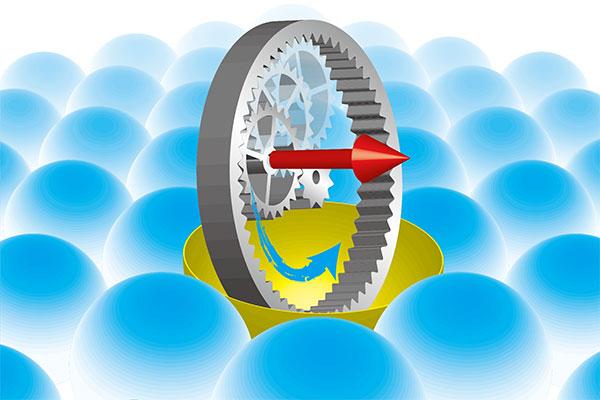
“We defined a spin-orbit qubit using a charged particle, which appears as a hole, trapped by an impurity atom in silicon crystal,” said lead author Dr. Takashi Kobayashi, research scientist at the University of New South Wales Sydney and assistant professor at Tohoku University. “Orbital motion and spinning of the hole are strongly coupled and locked together. This is reminiscent of a pair of meshing gears where circular motion and spinning are locked together.”

Qubits have been encoded with spin or orbital motion of a charged particle, producing different advantages that are highly demanded for building quantum computers. To utilize the advantages of qubits, Kobayashi and the team specifically used an exotic charged particle “hole” in silicon to define a qubit, since orbital motion and spin of holes in silicon are coupled together.

Spin-orbit qubits encoded by holes are particularly sensitive to electric fields, according to Kobayashi, which allows for more rapid control and benefits scaling up quantum computers. However, the qubits are affected by electrical noise, limiting their coherence time.

“In this work, we have engineered sensitivity to the electric field of our spin-orbit qubit by stretching the silicon crystal like a rubber band,” Kobayashi said. “This mechanical engineering of the spin-orbit qubit enables us to remarkably extend its coherence time, while still retaining moderate electrical sensitivity to control the spin-orbit qubit.”

Think of gears in a watch. Their individual spinning propels the entire mechanism to keep time. It is neither the spin nor orbital motion, but a combination of them that takes the information forward.

“These results open a pathway to develop new artificial quantum systems and to improve the functionality and scalability of spin-based quantum technologies,” Kobayashi said.

###

This work was supported in part by the ARC Centre of Excellence for Quantum Computation and Communication Technology, the U.S. Army Research Office and the Tohoku University Graduate Program in Spintronics.

Media Contact
Takashi Kobayashi
[email protected]

Original Source

https://www.tohoku.ac.jp/en/press/quibits_hold_information_longer.html

Related Journal Article

http://dx.doi.org/10.1038/s41563-020-0743-3

Tags: Technology/Engineering/Computer Science
Share12Tweet8Share2ShareShareShare2

Related Posts

The concealed geometry behind breeding constraints

The concealed geometry behind breeding constraints

July 18, 2026

Study Examines Physical Health Differences Across Fall-Risk Groups

July 18, 2026

UVA Engineer Geoff Geise Wins NAMS Permeance Prize for Mid-Career Excellence

July 18, 2026

Organic fertilizer helps biochar immobilize cadmium in contaminated soil

July 18, 2026
Please login to join discussion

POPULAR NEWS

  • A painless adhesive

    49 shares
    Share 20 Tweet 12
  • Groundbreaking Discovery: New Shark Species Identified for the First Time

    34 shares
    Share 14 Tweet 9
  • 研究人员开发认知工具包,实现阿尔茨海默症早期检测

    50 shares
    Share 20 Tweet 13
  • A varied menu

    51 shares
    Share 22 Tweet 12

About

We bring you the latest biotechnology news from best research centers and universities around the world. Check our website.

Follow us

Recent News

The concealed geometry behind breeding constraints

Study Examines Physical Health Differences Across Fall-Risk Groups

UVA Engineer Geoff Geise Wins NAMS Permeance Prize for Mid-Career Excellence

Subscribe to Blog via Email

Success! An email was just sent to confirm your subscription. Please find the email now and click 'Confirm' to start subscribing.

Join 85 other subscribers
  • Contact Us

Bioengineer.org © Copyright 2023 All Rights Reserved.

Welcome Back!

Login to your account below

Forgotten Password?

Retrieve your password

Please enter your username or email address to reset your password.

Log In
No Result
View All Result
  • Homepages
    • Home Page 1
    • Home Page 2
  • News
  • National
  • Business
  • Health
  • Lifestyle
  • Science

Bioengineer.org © Copyright 2023 All Rights Reserved.