

• HOME
  • NEWS
  • EXPLORE
    • CAREER
      • Companies
      • Jobs
    • EVENTS
    • iGEM
      • News
      • Team
    • PHOTOS
    • VIDEO
    • WIKI
  • BLOG
  • COMMUNITY
    • FACEBOOK
    • INSTAGRAM
    • TWITTER
Saturday, February 7, 2026
BIOENGINEER.ORG
No Result
View All Result
  • Login
  • HOME
  • NEWS
  • EXPLORE
    • CAREER
      • Companies
      • Jobs
        • Lecturer
        • PhD Studentship
        • Postdoc
        • Research Assistant
    • EVENTS
    • iGEM
      • News
      • Team
    • PHOTOS
    • VIDEO
    • WIKI
  • BLOG
  • COMMUNITY
    • FACEBOOK
    • INSTAGRAM
    • TWITTER
  • HOME
  • NEWS
  • EXPLORE
    • CAREER
      • Companies
      • Jobs
        • Lecturer
        • PhD Studentship
        • Postdoc
        • Research Assistant
    • EVENTS
    • iGEM
      • News
      • Team
    • PHOTOS
    • VIDEO
    • WIKI
  • BLOG
  • COMMUNITY
    • FACEBOOK
    • INSTAGRAM
    • TWITTER
No Result
View All Result
Bioengineer.org
No Result
View All Result
Home NEWS Science News Biology

New technology for enzyme design

Bioengineer by Bioengineer
June 1, 2018
in Biology
Reading Time: 2 mins read
0
Share on FacebookShare on TwitterShare on LinkedinShare on RedditShare on Telegram
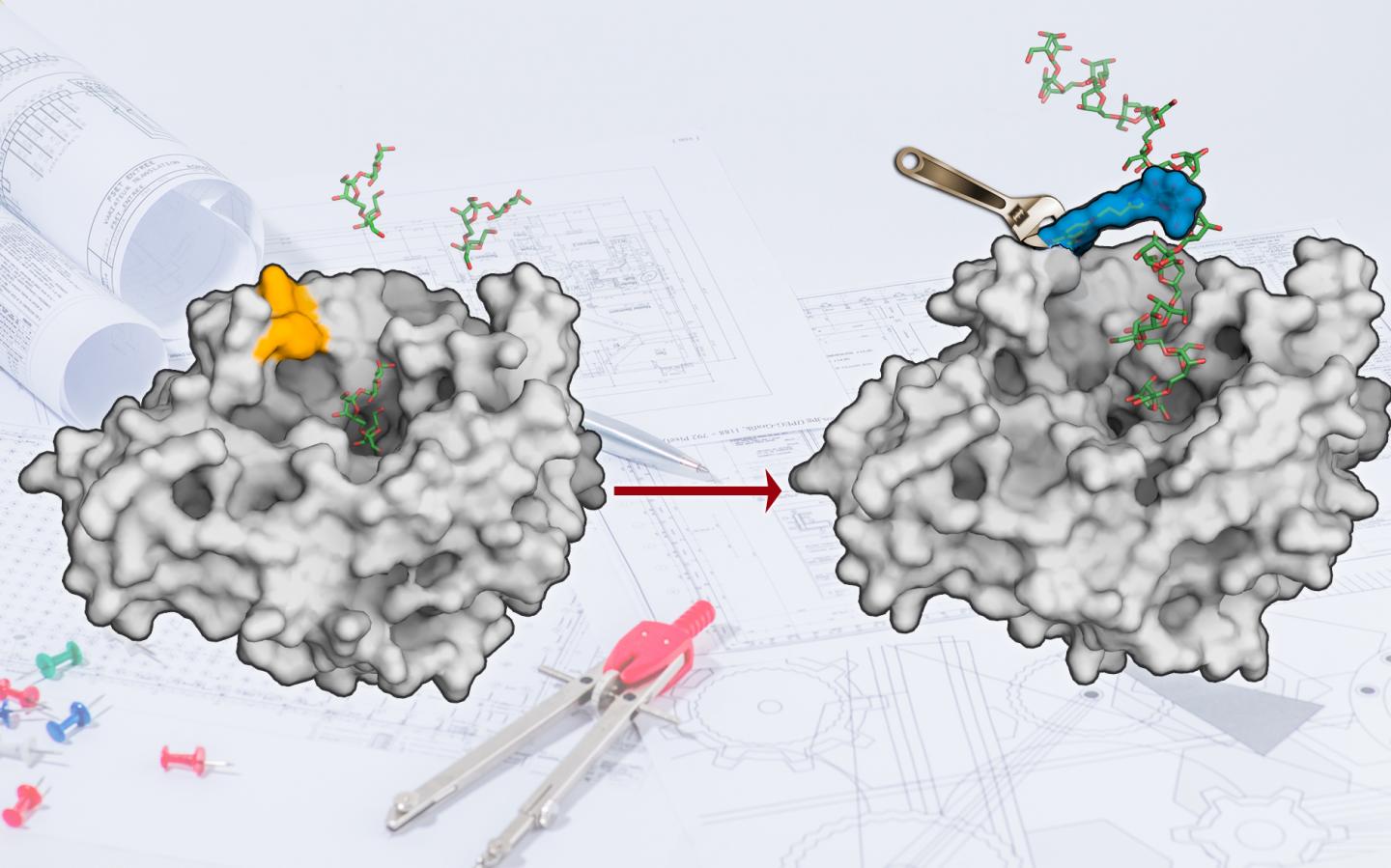
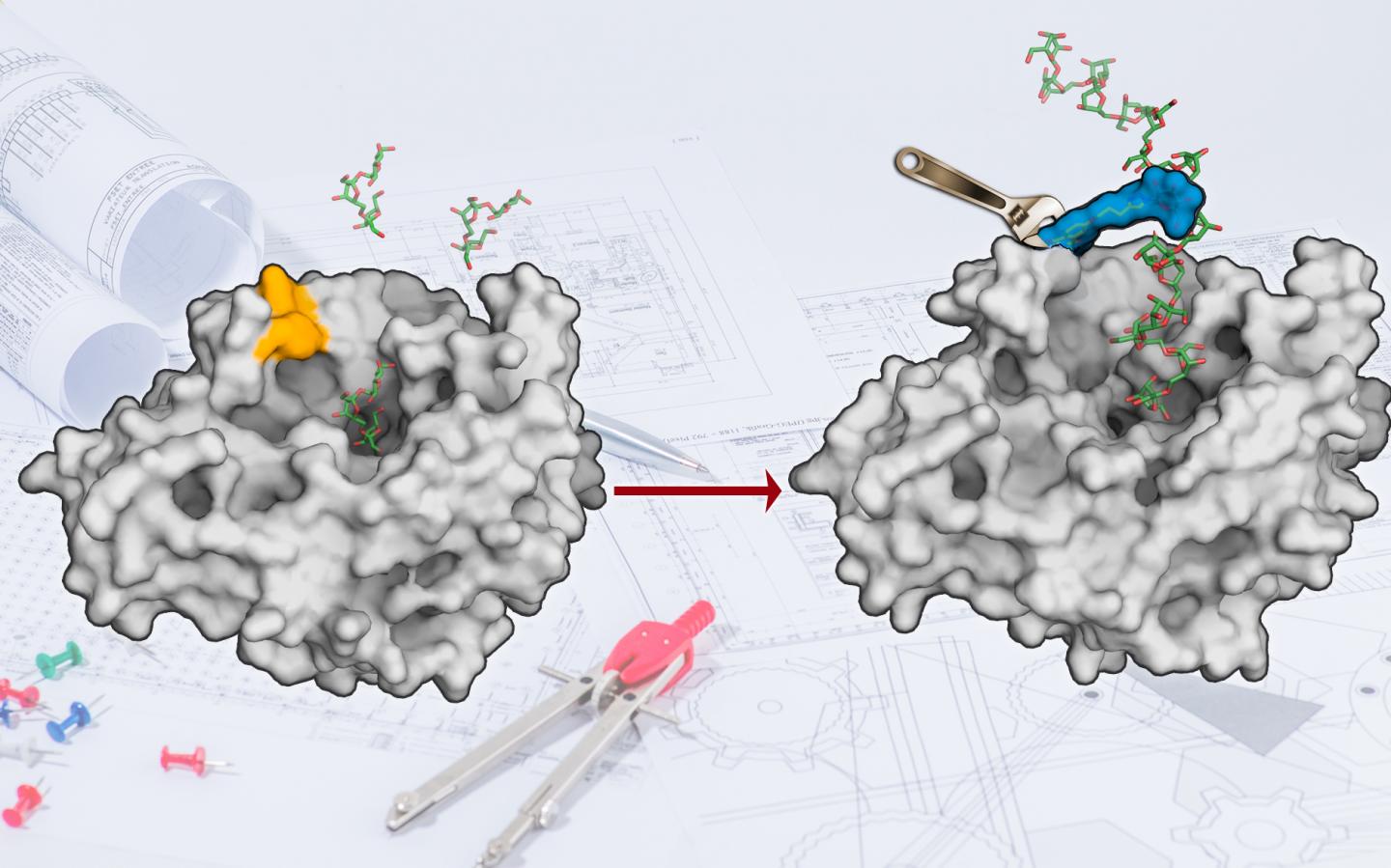
IMAGE

Credit: AK Seibel

Enzymes are tools of nature that accelerate almost all biochemical reactions in living cells as biological catalysts. For this reason, enzymes have been used in the chemical industry for some time now – in detergents and cleaners, toothpastes and shampoos, but also in foods. Enzymes help in the production of paper, textiles, leather, medicines, biofuels and other products.

Enzymes from the tailoring industry

Biochemically, enzymes are proteins that are composed of natural amino acids. They form a three-dimensional structure. Just like a key fits into a lock, each specific molecule fits into an enzyme and the enzyme converts it into a new product.

Technically, it is possible to exchange individual amino acids in an enzyme and thereby change its structure so that it can now process other molecules. In this way, British scientists have created just recently a mutant enzyme that breaks down plastic.

Surface of the levansucrase changed

Chemists from Julius-Maximilians-Universität Würzburg (JMU) in Bavaria, Germany, have now gone a step further in the tailoring of enzymes: "We thought what fascinating possibilities would arise if we could change the surface of enzymes chemically and use the chemical space of molecules," says Jürgen Seibel , Professor of Organic Chemistry at the JMU. "We have developed a reaction that does not occur in nature in this way. It gives us a lot of freedom in reshaping enzyme surfaces. "

As the JMU scientists report in the journal Chemical Science, they first redesigned the surface of the enzyme levansucrase. Now, the enzyme can convert the table sugar (sucrose) directly into a polymer of fructose building blocks.

"So far, such a synthesis has been possible with levansucrase, but it works much more efficiently with the modified enzyme," explains Seibel. The conversion of the enzyme per second is now significantly higher; moreover, it mainly produces the desired product and no accidental by-products.

Interesting for medicine and food industry

The fructose polymer could be used as a bio-gel for tissue transplantation in medicine or in the food industry – for example as a probiotic supplement in yogurts or baby food. Because like other functional sugars, the polymer could also serve certain intestinal bacteria as food and indirectly exert a health-promoting influence on the intestinal flora of humans.

###

Media Contact

Prof. Dr. Jürgen Seibel
[email protected]
49-931-318-5326
@Uni_WUE

https://www.uni-wuerzburg.de/

Original Source

https://www.uni-wuerzburg.de/en/sonstiges/news/detail/news/new-technology-for-enzyme-design/ http://dx.doi.org/10.1039/C8SC01244J


Share12Tweet8Share2ShareShareShare2

Related Posts

Florida Cane Toad: Complex Spread and Selective Evolution

Florida Cane Toad: Complex Spread and Selective Evolution

February 7, 2026
New Study Uncovers Mechanism Behind Burn Pit Particulate Matter–Induced Lung Inflammation

New Study Uncovers Mechanism Behind Burn Pit Particulate Matter–Induced Lung Inflammation

February 6, 2026

DeepBlastoid: Advancing Automated and Efficient Evaluation of Human Blastoids with Deep Learning

February 6, 2026

Navigating the Gut: The Role of Formic Acid in the Microbiome

February 6, 2026
Please login to join discussion

POPULAR NEWS

  • Robotic Ureteral Reconstruction: A Novel Approach

    Robotic Ureteral Reconstruction: A Novel Approach

    82 shares
    Share 33 Tweet 21
  • Digital Privacy: Health Data Control in Incarceration

    63 shares
    Share 25 Tweet 16
  • Study Reveals Lipid Accumulation in ME/CFS Cells

    57 shares
    Share 23 Tweet 14
  • Breakthrough in RNA Research Accelerates Medical Innovations Timeline

    53 shares
    Share 21 Tweet 13

About

We bring you the latest biotechnology news from best research centers and universities around the world. Check our website.

Follow us

Recent News

Evaluating Pediatric Emergency Care Quality in Ethiopia

TPMT Expression Predictions Linked to Azathioprine Side Effects

Improving Dementia Care with Enhanced Activity Kits

Subscribe to Blog via Email

Enter your email address to subscribe to this blog and receive notifications of new posts by email.

Join 73 other subscribers
  • Contact Us

Bioengineer.org © Copyright 2023 All Rights Reserved.

Welcome Back!

Login to your account below

Forgotten Password?

Retrieve your password

Please enter your username or email address to reset your password.

Log In
No Result
View All Result
  • Homepages
    • Home Page 1
    • Home Page 2
  • News
  • National
  • Business
  • Health
  • Lifestyle
  • Science

Bioengineer.org © Copyright 2023 All Rights Reserved.