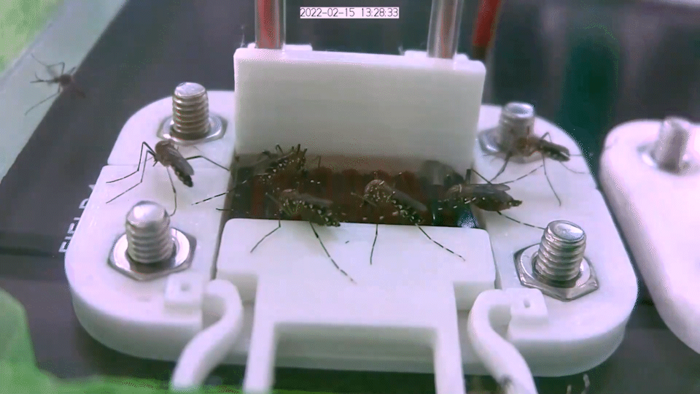
One by one, mosquitoes are captured by a handheld vacuum and released into a clear plastic box. After taking a moment to adjust to their new surroundings, the mosquitoes smell blood and swarm to the source.
Credit: Tulane University
One by one, mosquitoes are captured by a handheld vacuum and released into a clear plastic box. After taking a moment to adjust to their new surroundings, the mosquitoes smell blood and swarm to the source.
But instead of finding a creature to feast on, they buzz toward a vessel of scarlet blood flowing under a small square of clear synthetic skin and begin to feed.
This is not the stuff of science fiction, but a research partnership between Tulane and Rice universities to see if gelatin-like patches of fake skin – called hydrogels – are the future of studying how mosquitoes transmit deadly diseases and which repellants are most effective. Hydrogels eliminate the need for human and animal testing to answer such questions.
The hydrogels are already in use at Tulane University’s School of Public Health and Tropical Medicine, where the insectary produces more than 1,000 mosquitoes a week and a 3D printer creates hydrogels. Rice University bioengineers developed the hydrogel material and a machine-learning software that analyzes video of feeding mosquitoes to identify patterns.
In new research published in Frontiers in Bioengineering and Biotechnology, the hydrogels were found to create a more consistent environment for mosquito testing regardless of species. Testing showed that both DEET and plant-based repellant made from lemon eucalyptus oils were effective in repelling the mosquitoes, while mosquitoes fed eagerly on the hydrogels without repellant.
“It’s a huge game changer,” said Dawn Wesson, associate professor of tropical medicine at Tulane’s School of Public Health and Tropical Medicine. “If we can study how they (mosquitoes) feed, what they do in the process of feeding, we can better understand their potential for transmitting diseases and possibly do things to stop them from feeding.”
More than a nuisance, mosquitoes are perhaps the world’s most dangerous animal. They are vectors for deadly diseases such as malaria, dengue, West Nile virus, Zika and yellow fever. Mosquito-borne diseases are responsible for approximately 725,000 deaths each year, according to the World Health Organization.
Studying mosquito feeding has long posed a challenge as the use of live mice and humans can be costly and inconsistent. By being able to efficiently produce hydrogels with different blood vessel patterns, Wesson said the ability to study the mechanics of disease transmission and test new types of repellants has increased exponentially. Each testing chamber is outfitted with cameras which record the mosquitoes’ feeding patterns. Artificial intelligence is used to track and sort common bite locations and how long it takes to feed.
While mosquito saliva is thought to play a crucial role in disease transmission, questions remain about the process.
“If we can study that process in a more fine-scaled way without having to use animals, we can potentially interrupt transmission, and that would have a very large impact,” Wesson said. “We’re just starting to scratch the surface of what we can do with this product.”
Omid Veiseh, the study’s corresponding author and an assistant professor of bioengineering in Rice’s George R. Brown School of Engineering, said the hydrogel system can be scaled up to test or discover new repellents, study mosquito behavior more broadly and open the door for testing in labs that couldn’t previously afford it.
“It provides a consistent and controlled method of observation,” Veiseh said. “The hope is researchers will be able to use that to identify ways to prevent the spread of disease in the future.”
Journal
Frontiers in Bioengineering and Biotechnology
DOI
10.3389/fbioe.2023.1103748
Method of Research
Experimental study
Subject of Research
Animals
Article Title
Development of an automated biomaterial platform to study mosquito feeding behavior
Article Publication Date
9-Feb-2023
COI Statement
None.