• HOME
  • NEWS
  • EXPLORE
    • CAREER
      • Companies
      • Jobs
    • EVENTS
    • iGEM
      • News
      • Team
    • PHOTOS
    • VIDEO
    • WIKI
  • BLOG
  • COMMUNITY
    • FACEBOOK
    • INSTAGRAM
    • TWITTER
Monday, May 11, 2026
BIOENGINEER.ORG
No Result
View All Result
  • Login
  • HOME
  • NEWS
  • EXPLORE
    • CAREER
      • Companies
      • Jobs
        • Lecturer
        • PhD Studentship
        • Postdoc
        • Research Assistant
    • EVENTS
    • iGEM
      • News
      • Team
    • PHOTOS
    • VIDEO
    • WIKI
  • BLOG
  • COMMUNITY
    • FACEBOOK
    • INSTAGRAM
    • TWITTER
  • HOME
  • NEWS
  • EXPLORE
    • CAREER
      • Companies
      • Jobs
        • Lecturer
        • PhD Studentship
        • Postdoc
        • Research Assistant
    • EVENTS
    • iGEM
      • News
      • Team
    • PHOTOS
    • VIDEO
    • WIKI
  • BLOG
  • COMMUNITY
    • FACEBOOK
    • INSTAGRAM
    • TWITTER
No Result
View All Result
Bioengineer.org
No Result
View All Result
Home NEWS Science News Chemistry

New SwRI study argues that Saturn’s rings are actually not young

Bioengineer by Bioengineer
September 18, 2019
in Chemistry
Reading Time: 2 mins read
0
IMAGE
Share on FacebookShare on TwitterShare on LinkedinShare on RedditShare on Telegram

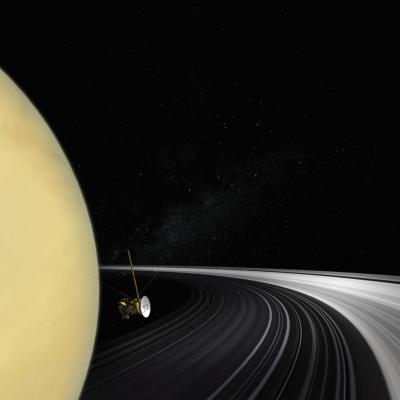
Research of Cassini data suggests icy rings are as old as the solar system itself
IMAGE

Credit: NASA

SAN ANTONIO — Sept. 18, 2019 — No one knows for certain when Saturn’s iconic rings formed, but a new study co-authored by a Southwest Research Institute scientist suggests that they are much older than some scientists think.

The study takes a closer look at 2017 Cassini spacecraft data that inspired several research papers suggesting that the rings were formed around the time dinosaurs roamed the Earth. Those studies, published in 2018 and 2019, challenged long-held models that put the formation of the rings several billion years earlier, around the time Saturn formed with the rest of the solar system.

In a new twist, SwRI scientist Luke Dones and three French researchers argue that the historic models probably had it right in the first place. The age debate centers around Cassini data from 2017, when the craft revealed a trove of data with dazzling images of Saturn’s rings, which are composed of clear, almost pure water ice.

“After Cassini’s mission ended, there was a small flood of research that claimed the rings were much younger than we had considered them to be. A common argument was that the rings, if much older, would have become much more polluted as a result of meteoroids crashing into them,” Dones said.

A series of studies suggested that the rings would have absorbed portions of dark, dusty material from the meteoroids and gradually become darker. Therefore, the rings would be too bright and clean to have existed in the solar system for billions of years.

Dones and his collaborators, Aurélien Crida of the Université Côte d’Azur, Sébastien Charnoz of the Institut de Physique du Globe de Paris, and Hsiang-Wen Hsu of the University of Colorado, Boulder, pointed out Cassini measurements that show the rings are constantly losing matter to Saturn. The process, which is largely a mystery, could very well be “cleaning” the ice of the rings and making them brighter over time.

Dones and his collaborators state that one of the clearest indications that the rings are old is that their mass is consistent with researchers’ current understanding of how primordialrings change. Rings spread with time, spawning satellites at their outer edge and losing mass to Saturn at their inner edge. More massive rings spread faster, so even a very massive primordial ring would be expected to now have the present mass of the rings. If the rings are young, then their current mass would have to be a coincidence.

“It’s not impossible to determine the age of the rings, but to do so we’ll need a future mission to Saturn that spends a long, intense period studying the rings themselves as well as the relationship between them and the gas giant,” Dones said.

###

For more information, visit https://www.swri.org/planetary-science.

Media Contact
Joanna Carver
[email protected]

Original Source

https://www.swri.org/press-release/saturn-rings-creation-cassini?utm_source=EurekAlert!&utm_medium=Distribution&utm_campaign=Saturn-PR

Tags: AstrophysicsPlanets/MoonsSatellite Missions/ShuttlesSpace/Planetary Science
Share13Tweet8Share2ShareShareShare2

Related Posts

Miniature Sensor Uses Light to Detect Touch — Chemistry

Miniature Sensor Uses Light to Detect Touch

May 8, 2026
Iron Minerals Determine Whether Dissolved Organic Matter Fuels Microbes or Becomes Long-Term Carbon Storage — Chemistry

Iron Minerals Determine Whether Dissolved Organic Matter Fuels Microbes or Becomes Long-Term Carbon Storage

May 8, 2026

Kate Evans Appointed Associate Lab Director for Biological and Environmental Systems Science at ORNL

May 8, 2026

Advancing Multiscale Modeling and Overcoming Operational Challenges in Autothermal CO₂-to-Methanol Reactors

May 8, 2026
Please login to join discussion

POPULAR NEWS

  • Research Indicates Potential Connection Between Prenatal Medication Exposure and Elevated Autism Risk

    840 shares
    Share 336 Tweet 210
  • New Study Reveals Plants Can Detect the Sound of Rain

    727 shares
    Share 290 Tweet 181
  • Salmonella Haem Blocks Macrophages, Boosts Infection

    61 shares
    Share 24 Tweet 15
  • Breastmilk Balances E. coli and Beneficial Bacteria in Infant Gut Microbiomes

    57 shares
    Share 23 Tweet 14

About

We bring you the latest biotechnology news from best research centers and universities around the world. Check our website.

Follow us

Recent News

New Post-Hoc Analysis Explores Daily Oral Orforglipron Use in Adults Over 65 with Obesity, Regardless of Diabetes Status

Evaluating Digoxin Use in Patients with Symptomatic Rheumatic Heart Disease

Evaluating the Effectiveness and Safety of Digitalis Glycosides in Treating Heart Failure

Subscribe to Blog via Email

Enter your email address to subscribe to this blog and receive notifications of new posts by email.

Join 82 other subscribers
  • Contact Us

Bioengineer.org © Copyright 2023 All Rights Reserved.

Welcome Back!

Login to your account below

Forgotten Password?

Retrieve your password

Please enter your username or email address to reset your password.

Log In
No Result
View All Result
  • Homepages
    • Home Page 1
    • Home Page 2
  • News
  • National
  • Business
  • Health
  • Lifestyle
  • Science

Bioengineer.org © Copyright 2023 All Rights Reserved.