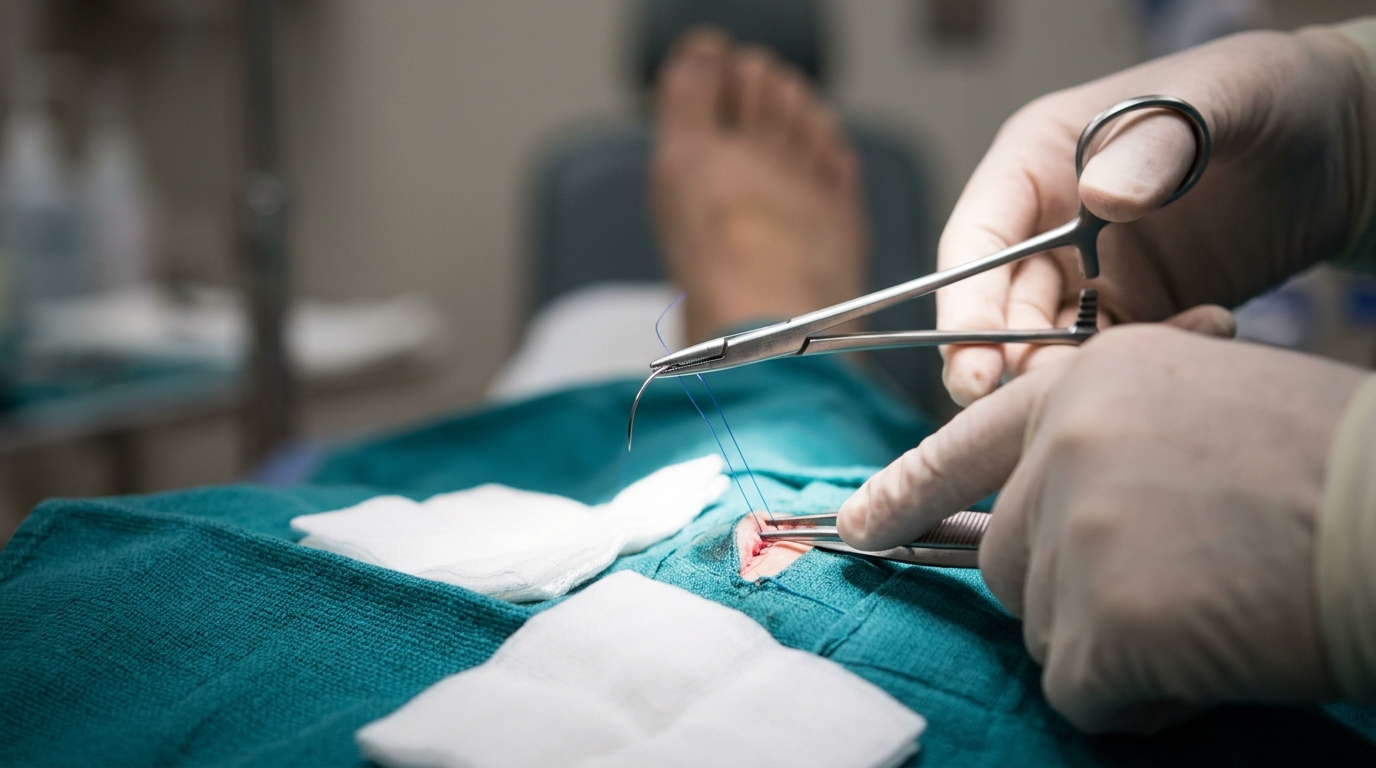
A retrospective comparative observational study published in the European Journal of Medical Research suggests that adding a vertical half-mattress suture to the standard Winograd procedure for ingrown toenails may lower recurrence rates and complication risks. The study, conducted at an Orthopedic Center, enrolled 80 patients with 106 great toes affected by Heifetz stage II–III ingrown toenails between July 2022 and January 2024. The researchers aimed to evaluate the clinical efficacy and safety of this specific suture technique as an adjunct to the widely used Winograd procedure, which is a common surgical intervention for this condition but has historically been associated with high recurrence rates and suboptimal cosmetic outcomes.
The study design divided the participants into two groups based on the suture technique used during surgery. The observation group, consisting of 40 patients with 54 great toes, received the Winograd procedure combined with a vertical half-mattress suture. This group was further subdivided into those who received the classic type of suture and those who received a modified type. The control group, comprising 40 patients with 52 great toes, underwent the Winograd procedure with conventional interrupted sutures. All patients completed two years of follow-up, allowing for a robust assessment of long-term outcomes including pain, healing time, recurrence, and patient satisfaction.
Baseline characteristics were comparable between the two groups, with no statistically significant differences observed prior to surgery. The primary and secondary outcomes measured included visual analogue scale (VAS) pain scores, wound healing time, the time required to return to wearing shoes, the two-year recurrence rate, cosmetic satisfaction, and the overall complication rate. To address potential statistical biases caused by patients having both feet affected, the researchers also performed a patient-level sensitivity analysis on all 80 patients to ensure the robustness of their findings.
The results indicated that the observation group demonstrated superior outcomes across several key endpoints at the two-year follow-up. Specifically, the recurrence rate was lower in the observation group compared to the control group, both at the toe level (5.6% versus 13.5%, P = 0.042) and at the patient level (5.0% versus 12.5%, P = 0.039).
In addition to reduced recurrence, the observation group experienced a lower overall incidence of complications. At the toe level, the complication rate was 1.9% in the observation group compared to 15.4% in the control group (P = 0.025). At the patient level, the rates were 2.5% versus 20.0% (P = 0.014). The study also noted fewer Clavien–Dindo Grade I complications in the observation group (2.5% versus 15.0%, P = 0.047), and no Grade II infections were recorded in this group, indicating a potentially safer postoperative course.
Recovery metrics also favored the new suture technique. Patients in the observation group returned to wearing shoes earlier, with a mean time of 11.20 ± 2.15 days compared to 13.56 ± 3.08 days in the control group (P = 0.001). However, there was no significant difference in wound healing times between the two groups (11.1 ± 1.2 days versus 11.3 ± 1.7 days, P = 0.512). Cosmetic satisfaction was higher in the observation group, with 92.6% of patients reporting satisfaction compared to 78.8% in the control group (P = 0.028).
Regarding pain management, visual analogue scale (VAS) scores were lower in the observation group at two years (1.4 with an interquartile range of 1.3–1.5) compared to the control group (1.6 with an interquartile range of 1.4–1.8). However, the researchers noted that this difference did not reach the minimal clinically important difference for foot pain, suggesting that while the new technique may offer slight pain advantages, it does not provide a clinically meaningful difference in pain relief compared to conventional sutures. Subgroup analysis by suture technique within the observation group revealed no significant differences between the classic and modified types of vertical half-mattress suture.
The patient-level sensitivity analysis confirmed the toe-level findings, showing significant advantages in recurrence (P = 0.039), complications (P = 0.014), and time to return to shoes (P = 0.000). The authors concluded that the vertical half-mattress suture as an adjunct to the Winograd procedure is associated with reduced recurrence rates and complications, shorter time to resume normal footwear, and improved cosmetic satisfaction. They emphasized that these findings suggest the technique is safe and effective, though they recommended further prospective validation to confirm these results in larger, controlled trials.
Subject of Research: Clinical efficacy of vertical half-mattress suture combined with Winograd procedure for ingrown toenails
Article Title: Vertical half-mattress suture combined with Winograd procedure for ingrown toenails: a retrospective comparative observational study
Article References: Liu, X., & Wang, S. (2026). Vertical half-mattress suture combined with Winograd procedure for ingrown toenails: a retrospective comparative observational study. European Journal of Medical Research. https://doi.org/10.1186/s40001-026-05044-x
Image Credits: AI Generated
DOI: 10.1186/s40001-026-05044-x
Keywords: ingrown toenail, Winograd procedure, surgical suture, orthopedics, retrospective study, recurrence rate, foot surgery, clinical outcomes, Vertical, half-mattress, suture, combined
News Source: Ophelia Keating. (November 7, 2026). New Suture Technique May Reduce Ingrown Toenail Recurrence. Scienmag.