• HOME
  • NEWS
  • EXPLORE
    • CAREER
      • Companies
      • Jobs
    • EVENTS
    • iGEM
      • News
      • Team
    • PHOTOS
    • VIDEO
    • WIKI
  • BLOG
  • COMMUNITY
    • FACEBOOK
    • INSTAGRAM
    • TWITTER
Thursday, June 25, 2026
BIOENGINEER.ORG
No Result
View All Result
  • Login
  • HOME
  • NEWS
  • EXPLORE
    • CAREER
      • Companies
      • Jobs
        • Lecturer
        • PhD Studentship
        • Postdoc
        • Research Assistant
    • EVENTS
    • iGEM
      • News
      • Team
    • PHOTOS
    • VIDEO
    • WIKI
  • BLOG
  • COMMUNITY
    • FACEBOOK
    • INSTAGRAM
    • TWITTER
  • HOME
  • NEWS
  • EXPLORE
    • CAREER
      • Companies
      • Jobs
        • Lecturer
        • PhD Studentship
        • Postdoc
        • Research Assistant
    • EVENTS
    • iGEM
      • News
      • Team
    • PHOTOS
    • VIDEO
    • WIKI
  • BLOG
  • COMMUNITY
    • FACEBOOK
    • INSTAGRAM
    • TWITTER
No Result
View All Result
Bioengineer.org
No Result
View All Result
Home NEWS Science News Chemistry

New substance can form in the OA process of crystal growth, new study reveals

Bioengineer by Bioengineer
May 29, 2019
in Chemistry
Reading Time: 2 mins read
0
IMAGE
Share on FacebookShare on TwitterShare on LinkedinShare on RedditShare on Telegram

IMAGE

Credit: LIU Yongfei and YANG Yong

Chinese scientists have revealed that a new substance can form during the oriented attachment (OA) process of crystal growth, which may shed new light on the microscopic mechanism of crystal growth.

The research was done by scientists from the Institute of Solid State Physics (ISSP) under the Hefei Institutes of Physical Science, Chinese Academy of Sciences and other collaborative institutions. It was published in Matter on May 29.

Crystallization, a very familiar physical process, occurs both naturally and artificially. The resulting products – crystals – play an important role in modern science and technology. For instance, single silicon crystals play a central role in the semiconductor industry; nonlinear optical crystals – e.g., β-BaB2O4 (BBO) – are indispensable in modern laser technology and experiments on quantum optics; and high-quality single crystalline samples are usually a prerequisite for experimental measurements and studies on novel quantum effects. Therefore, research on crystal growth is always in the spotlight.

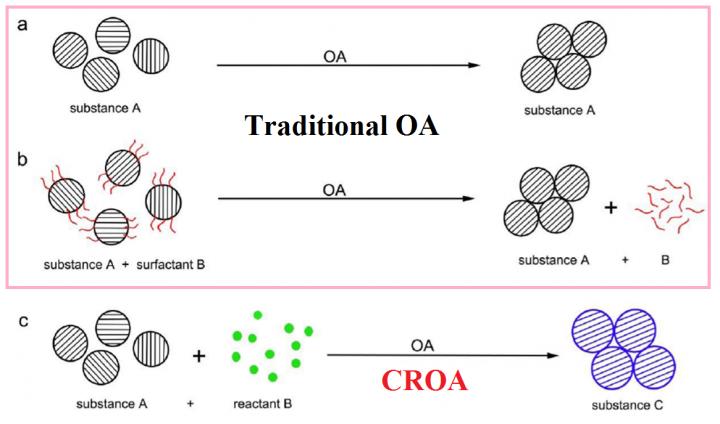
Oriented attachment (OA) is a concept that cannot be ignored when it comes to crystal growth (see Background Information). OA is commonly thought to be a physical process whereby nanocrystals align in certain directions to form larger single crystals by interface fusion (Figs. 1a and 1b). Due to this process, the resulting crystals possess both constituent and phase structures identical to those of the precursor nanoparticles.

But is it possible for a new substance to form through OA process?

To answer this question, Chinese scientists conducted a series of experiments and their results provided a positive answer.

By adding NaHCO3 to Y2(CO3)3·2H2O nanoparticle suspensions in an aqueous environment, the researchers obtained single crystalline sheets identified as NaY(CO3)2·6H2O. A similar product ((NH4)Y(CO3)2·H2O) was obtained by adding (NH4)HCO3 to the suspension.

The morphology and atomic structures of the products were characterized by using state-of-the-art experimental methods. Combined with theoretical calculations, the researchers provided convincing evidence that the mechanism governing the synthesis process is a new type of OA (Fig. 1c). The scientists have named the mechanism “Chemical Reaction-directed Oriented Attachment” (CROA).

“We believe that the discovery of CROA will pave a new way for the synthesis of novel functional materials, and deepen the understanding of the mechanism of natural mineral formation,” said QIN Xiaoying, the corresponding author of the work from ISSP.

###

The work was supported by the National Natural Science Foundation of China.

Media Contact
ZHOU Shu
[email protected]

Original Source

http://english.hf.cas.cn/

Related Journal Article

http://dx.doi.org/10.1016/j.matt.2019.05.001

Tags: Chemistry/Physics/Materials SciencesNanotechnology/MicromachinesPolymer Chemistry
Share13Tweet7Share2ShareShareShare1

Related Posts

AI and Physics Collaborate to Design Advanced Hydrogen Storage Materials

June 25, 2026

International Team Including Dresden Scientists Develops Novel Designer Proteins for Advanced Study of Living Tissue

June 25, 2026

New Study Uncovers Key Factors Driving Water Chemistry in Nanoscale Environments

June 25, 2026

Plasma Technology Extends Catalyst Lifespan in Hydrogen Production

June 24, 2026
Please login to join discussion

POPULAR NEWS

  • Saying Goodbye to PGY-6: Pediatric Fellowship Realities

    103 shares
    Share 41 Tweet 26
  • Multi-Hospital Study Reveals Long Covid Burden Is Twice as High as Current Estimates

    92 shares
    Share 36 Tweet 23
  • Detection of EDCs in Breast Milk and Infant Urine Up to Six Months Highlights Early Exposure Risks

    77 shares
    Share 31 Tweet 19
  • New Drug Candidate Developed at McMaster Shows Potential for Treating Brain Cancer

    58 shares
    Share 23 Tweet 15

About

We bring you the latest biotechnology news from best research centers and universities around the world. Check our website.

Follow us

Recent News

Tracking Lanthanide-Labeled Microplastics in Plants

POSTECH Researchers Slash Cost of Reconstituted Cell-Free Systems by 95%

AI and Physics Collaborate to Design Advanced Hydrogen Storage Materials

Subscribe to Blog via Email

Success! An email was just sent to confirm your subscription. Please find the email now and click 'Confirm' to start subscribing.

Join 82 other subscribers
  • Contact Us

Bioengineer.org © Copyright 2023 All Rights Reserved.

Welcome Back!

Login to your account below

Forgotten Password?

Retrieve your password

Please enter your username or email address to reset your password.

Log In
No Result
View All Result
  • Homepages
    • Home Page 1
    • Home Page 2
  • News
  • National
  • Business
  • Health
  • Lifestyle
  • Science

Bioengineer.org © Copyright 2023 All Rights Reserved.