• HOME
  • NEWS
  • EXPLORE
    • CAREER
      • Companies
      • Jobs
    • EVENTS
    • iGEM
      • News
      • Team
    • PHOTOS
    • VIDEO
    • WIKI
  • BLOG
  • COMMUNITY
    • FACEBOOK
    • INSTAGRAM
    • TWITTER
Thursday, June 25, 2026
BIOENGINEER.ORG
No Result
View All Result
  • Login
  • HOME
  • NEWS
  • EXPLORE
    • CAREER
      • Companies
      • Jobs
        • Lecturer
        • PhD Studentship
        • Postdoc
        • Research Assistant
    • EVENTS
    • iGEM
      • News
      • Team
    • PHOTOS
    • VIDEO
    • WIKI
  • BLOG
  • COMMUNITY
    • FACEBOOK
    • INSTAGRAM
    • TWITTER
  • HOME
  • NEWS
  • EXPLORE
    • CAREER
      • Companies
      • Jobs
        • Lecturer
        • PhD Studentship
        • Postdoc
        • Research Assistant
    • EVENTS
    • iGEM
      • News
      • Team
    • PHOTOS
    • VIDEO
    • WIKI
  • BLOG
  • COMMUNITY
    • FACEBOOK
    • INSTAGRAM
    • TWITTER
No Result
View All Result
Bioengineer.org
No Result
View All Result
Home NEWS Science News Biology

New study works with historically disenfranchised communities to combat sudden oak death

Bioengineer by Bioengineer
July 17, 2019
in Biology
Reading Time: 2 mins read
0
IMAGE
Share on FacebookShare on TwitterShare on LinkedinShare on RedditShare on Telegram

IMAGE

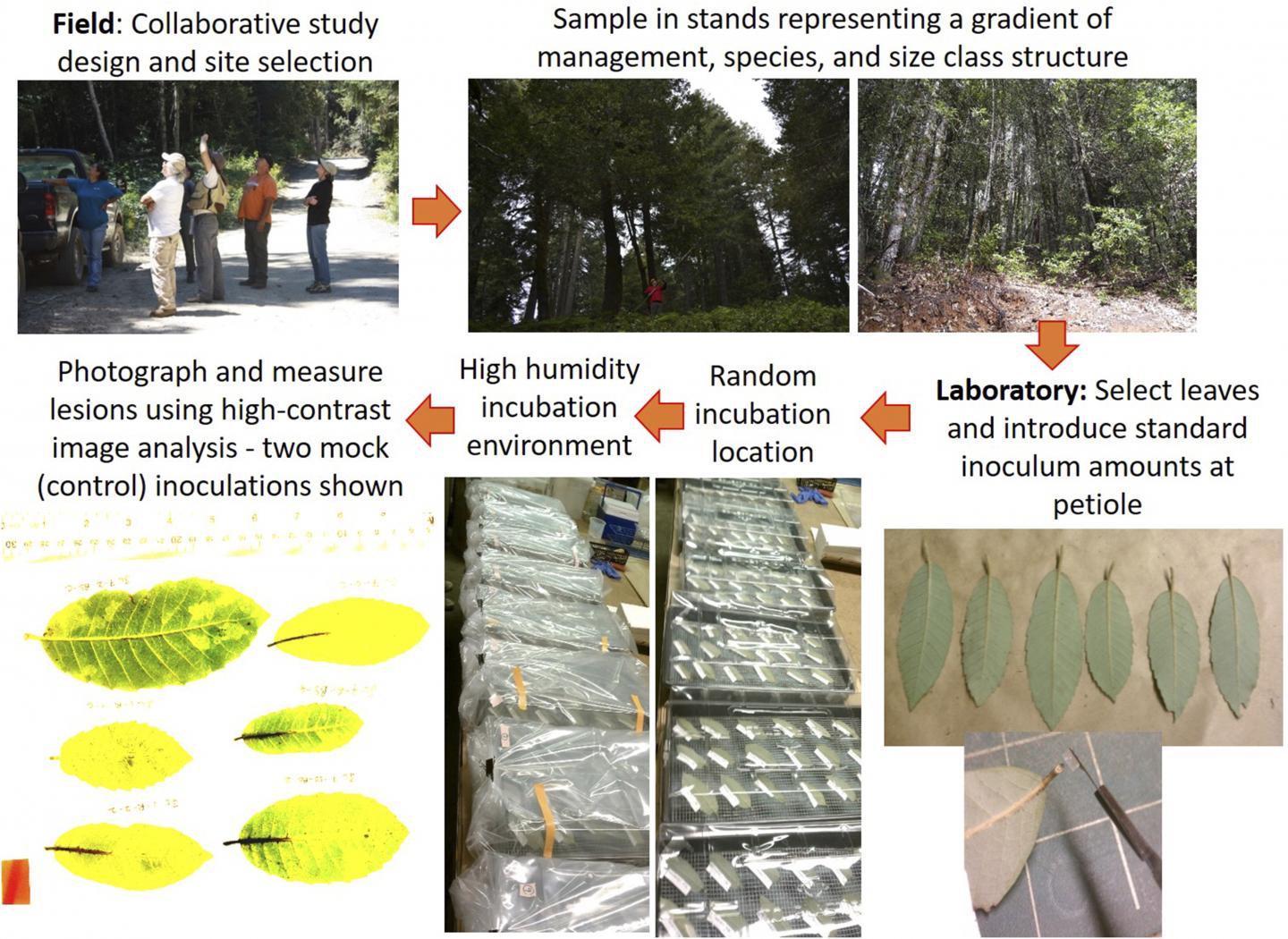
Credit: Richard C. Cobb, Noam Ross, Katherine J. Hayden, Catherine A. Eyre, Richard S. Dodd, Susan J. Frankel, Matteo Garbelotto, and David M. Rizzo

Science often reflects the priorities of dominant industries and ignores the needs of disenfranchised communities, resulting in the perpetuation of historical injustices. One team of scientists in Northern California studying sudden oak death, which poses a threat to the longstanding cultural heritage of several indigenous tribes, sought to chip away at this cycle through a new collaboration with these communities.

Sudden oak death has killed 50 million trees since emerging in 1995 and is an impending threat to the tanoak trees in Northern California. Tanoak, an evergreen tree, is native to the western United States and prolific along the California coast. In these regions it is revered by many indigenous tribes, including the Hoopa and Yurok, who value the tree as a source of food and medicine. The tanoak also holds an important role in their religious practices.

To develop resistance measures that represented the interests and unique perspectives of these tribes, the team of scientists worked with the tribal forest managers and community members to identify proactive ways to prevent the spread of sudden oak death. Through this partnership, the scientists were able to publish a paper bringing together indigenous land management, ecology, genetics, pathology, and epidemiology.

“I mostly work on the mathematical side,” said co-author Noam Ross, who created the simulations and software used in the paper, “but it’s important how that can be used to understand and manage the cultural and social effects of this forest disease, which has had significant impacts in these communities.”

The results of this study, published in Promise and Pitfalls of Endemic Resistance for Cultural Resources Threatened by Phytophthora ramorum in Phytopathology, underscore the importance of collaboration between different interest groups. “This collaborative approach holds valuable lessons for researchers and managers working to empower a broader cross section of stakeholders,” says author Richard Cobb.

More details about this study can be found in Phytopathology Volume 103, Number 3, published May 8, 2019. Phytopathology is an international journal publishing articles on fundamental research that advances understanding of the nature of plant diseases, the agents that cause them, their spread, the losses they cause, and measures used to control them.

###

Media Contact
Ashley Bergman Carlin
[email protected]

Related Journal Article

http://dx.doi.org/10.1094/PHYTO-04-18-0142-R

Tags: Agricultural Production/EconomicsAgricultureCollaborationForestryMedical/Scientific EthicsMinoritiesPlant SciencesSocioeconomics
Share12Tweet8Share2ShareShareShare2

Related Posts

Natural Hallucinogens: Evolution’s Ecological Tools, Not Mere Chemical Byproducts

June 25, 2026

This Famous Butterfly Revealed: Three Distinct Species Hidden in One

June 25, 2026

Scientists Attack Soybean Cyst Nematode by Starving Its Food Source

June 25, 2026

Decoding the Secret Code of a Crucial Immune Sensor

June 24, 2026
Please login to join discussion

POPULAR NEWS

  • Saying Goodbye to PGY-6: Pediatric Fellowship Realities

    103 shares
    Share 41 Tweet 26
  • Multi-Hospital Study Reveals Long Covid Burden Is Twice as High as Current Estimates

    92 shares
    Share 36 Tweet 23
  • Detection of EDCs in Breast Milk and Infant Urine Up to Six Months Highlights Early Exposure Risks

    77 shares
    Share 31 Tweet 19
  • New Drug Candidate Developed at McMaster Shows Potential for Treating Brain Cancer

    58 shares
    Share 23 Tweet 15

About

We bring you the latest biotechnology news from best research centers and universities around the world. Check our website.

Follow us

Recent News

Tracking Lanthanide-Labeled Microplastics in Plants

POSTECH Researchers Slash Cost of Reconstituted Cell-Free Systems by 95%

AI and Physics Collaborate to Design Advanced Hydrogen Storage Materials

Subscribe to Blog via Email

Enter your email address to subscribe to this blog and receive notifications of new posts by email.

Join 82 other subscribers
  • Contact Us

Bioengineer.org © Copyright 2023 All Rights Reserved.

Welcome Back!

Login to your account below

Forgotten Password?

Retrieve your password

Please enter your username or email address to reset your password.

Log In
No Result
View All Result
  • Homepages
    • Home Page 1
    • Home Page 2
  • News
  • National
  • Business
  • Health
  • Lifestyle
  • Science

Bioengineer.org © Copyright 2023 All Rights Reserved.