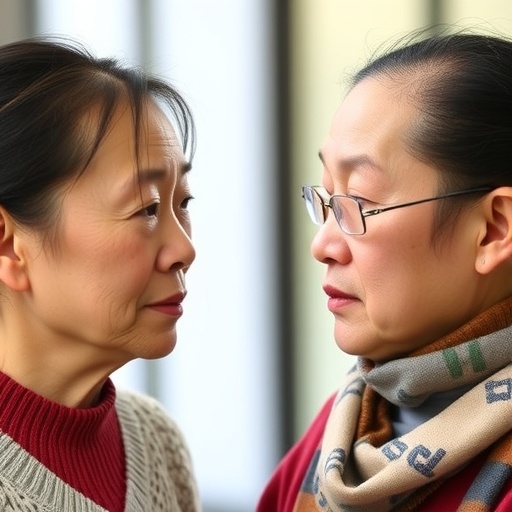
In a groundbreaking study focusing on the interplay between chronological and perceived age, researchers have explored the complex mechanisms that govern how age is visually assessed among Chinese women. Utilizing a cohort of 308 women aged between 15 and 65 years, this expansive investigation offers new insights into the subtleties of facial aging, integrating both expert evaluation and novel methodologies for perceived age determination. The implications of this study are profound, particularly for the cosmetic science sector and personal skincare regimes.
The research employed an observational design to systematically evaluate distinct facial aging features through high-standardized photographic techniques and expert analyses. Non-expert assessors then provided perceived age ratings based on these photographic images, allowing for an unbiased comparative framework. This dual approach exposed a consistent discrepancy showing that Chinese women, on average, are perceived to be 1.6 years older than their actual chronological age. Such a finding challenges conventional assumptions about aging perception and highlights the nuances in how age indicators manifest visually.
Further dissecting the facial characteristics, the study identified key aging markers that heavily influence perceived age. Among these, nasolabial folds, marionette lines, facial contour tightness, skin evenness, and radiance were pinpointed as pivotal contributors. These age-related features were strongly correlated with both perceived age and chronological age, indicating that the visual cues responsible for signaling age are consistently interpretable by observers, regardless of their expert status.
The significance of nasolabial folds and marionette lines as primary hallmarks underscores the critical role of facial morphology in age perception. These features, often accentuated with advancing years due to skin laxity and volume loss, alter the structural integrity of the facial landscape. By quantifying these changes, the study lends credence to the use of perceived age as a tangible endpoint for the evaluation of anti-aging interventions, positioning this metric as a valuable tool for product development and clinical assessments.
Notably, the research also revealed age-specific patterns whereby the weight of particular aging features varies across different chronological age groups. This nuanced understanding facilitates more personalized approaches to skincare and aesthetic treatments, enabling strategies tailored not just to chronological age but to the perceptual aging signature unique to each individual.
The methodological innovation of the study lies in its systematic validation of a new method to determine perceived age. Traditional approaches have often relied on subjective estimations prone to bias and inconsistency. By introducing a standardized photographic assessment validated across multiple non-expert raters, the study achieves a robust measurement of perceived age that can be reliably reproduced and applied in future research and practical applications.
Beyond its methodological advancements, the study’s findings resonate strongly with ongoing developments in dermatologic science. The identification of readily observable facial features as determinants of age perception offers an empirical foundation for the design of next-generation cosmetic products targeting specific aging manifestations. Innovations inspired by this research could focus on enhancing facial contour tightness or improving skin evenness and radiance to effectively modulate perceived age.
The practical applications of this research extend to social and psychological domains as well. Age perception significantly influences interpersonal interactions and societal attitudes towards aging. By elucidating the facial characteristics that drive these perceptions, the study presents opportunities to reshape cultural narratives around aging, potentially contributing to improved psychosocial well-being among aging populations.
Importantly, this study was financially supported by the Beiersdorf Innovation Center Shanghai, with the authors affiliated with the same institution, ensuring alignment between academic rigor and industry relevance. This collaboration underlines the importance of integrated research efforts in advancing cosmetic science with direct translational impact for consumers.
In conclusion, this exploration into the dichotomy of chronological and perceived age advances both scientific understanding and practical capabilities in aging research. By bridging expert analyses, standardized imaging, and perceptual assessments, it lays a foundation for the development of tailored skincare solutions and anti-aging therapies that address individual aging profiles with unprecedented precision.
Future research inspired by these findings could expand to include diverse populations, examining whether similar aging patterns and perception discrepancies exist across different ethnicities and cultural backgrounds. Such comparative analyses would enrich the global understanding of aging and enhance the universality of cosmetic interventions.
Additionally, integrating emerging technologies such as artificial intelligence and machine learning could refine the accuracy and predictive power of perceived age assessments. Automated analysis of facial images may offer scalable, objective metrics, transforming age perception studies and product testing paradigms in dermatologic science.
This comprehensive study symbolizes a significant leap forward in decoding the language of facial aging. It emphasizes the importance of perceived age as a multi-dimensional construct shaped by visible signs, biological processes, and psychological interpretation, setting the stage for more holistic approaches to aging research and skincare innovation.
Subject of Research: People
Article Title: An exploration study on the relationship between chronological and perceived age in Chinese women with systematic validation of a new method for perceived age determination
News Publication Date: 31-Mar-2026
Web References: http://dx.doi.org/10.1016/j.jdsct.2026.100148
Image Credits: This infographic is free to use in connection with this story if credited to “Beiersdorf Innovation Center Shanghai”
Keywords: Health and medicine
Tags: age perception discrepancies in womenage perception research in dermatologychronological vs perceived age in Chinese womencosmetic science applications in agingexpert vs non-expert age assessment methodsfacial aging markers in Asian womenfacial contour and skin tightness effectsmarionette lines and agingnasolabial folds impact on perceived ageobservational study on facial agingphotographic techniques for aging studiesskin evenness and radiance in aging