• HOME
  • NEWS
  • EXPLORE
    • CAREER
      • Companies
      • Jobs
    • EVENTS
    • iGEM
      • News
      • Team
    • PHOTOS
    • VIDEO
    • WIKI
  • BLOG
  • COMMUNITY
    • FACEBOOK
    • INSTAGRAM
    • TWITTER
Sunday, May 10, 2026
BIOENGINEER.ORG
No Result
View All Result
  • Login
  • HOME
  • NEWS
  • EXPLORE
    • CAREER
      • Companies
      • Jobs
        • Lecturer
        • PhD Studentship
        • Postdoc
        • Research Assistant
    • EVENTS
    • iGEM
      • News
      • Team
    • PHOTOS
    • VIDEO
    • WIKI
  • BLOG
  • COMMUNITY
    • FACEBOOK
    • INSTAGRAM
    • TWITTER
  • HOME
  • NEWS
  • EXPLORE
    • CAREER
      • Companies
      • Jobs
        • Lecturer
        • PhD Studentship
        • Postdoc
        • Research Assistant
    • EVENTS
    • iGEM
      • News
      • Team
    • PHOTOS
    • VIDEO
    • WIKI
  • BLOG
  • COMMUNITY
    • FACEBOOK
    • INSTAGRAM
    • TWITTER
No Result
View All Result
Bioengineer.org
No Result
View All Result
Home NEWS Science News Biology

New study sheds light on evolution of hell ants from 100 million years ago

Bioengineer by Bioengineer
August 6, 2020
in Biology
Reading Time: 2 mins read
0
IMAGE
Share on FacebookShare on TwitterShare on LinkedinShare on RedditShare on Telegram

IMAGE

Credit: NIGPAS

Ants are the most successful social insects and play an important role in modern terrestrial ecosystems. The origin and early evolution of ants have attracted lots of attention.

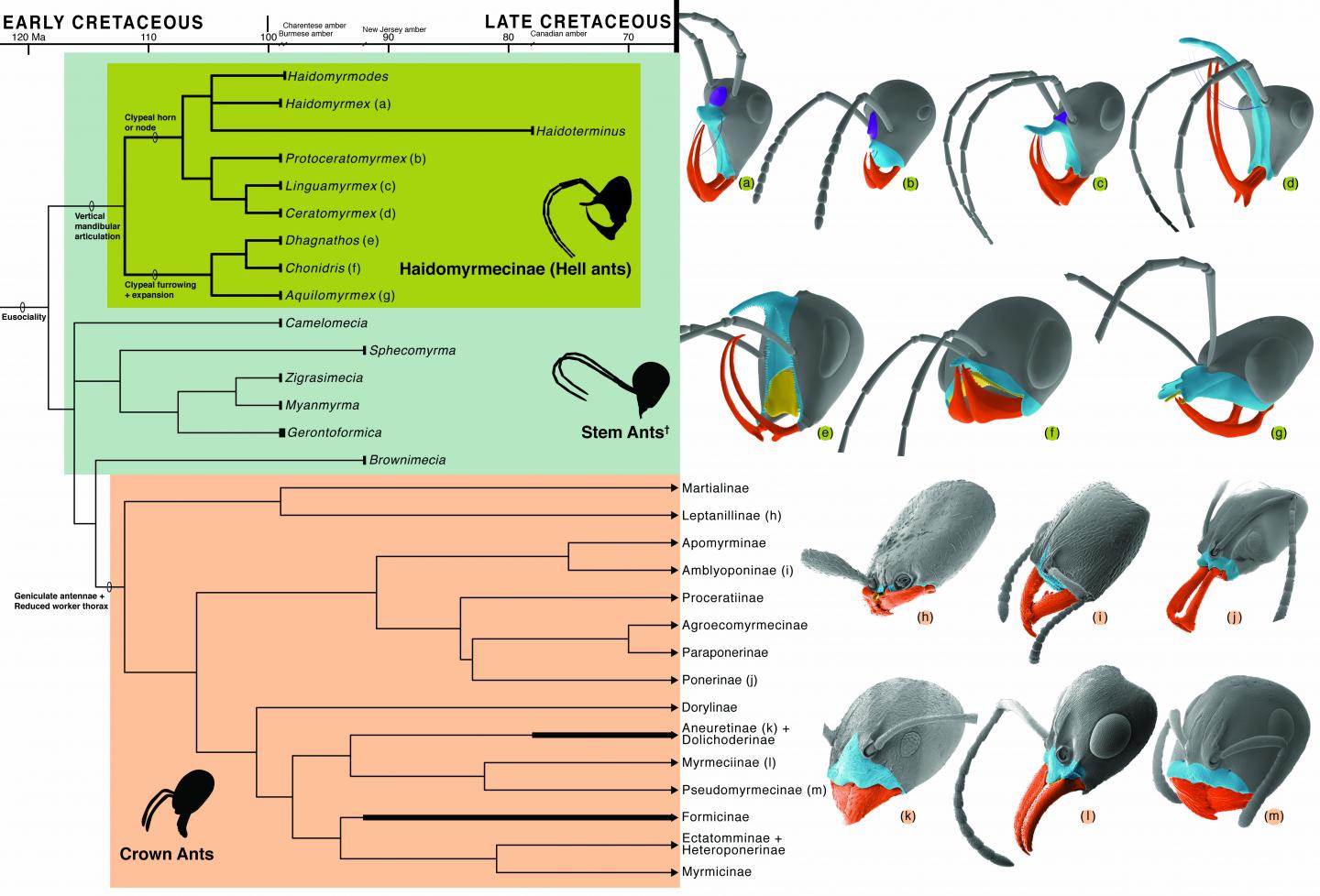
Among the earliest fossil ants known, haidomyrmecine “hell ants” from Cretaceous amber reveal an ancient and dramatic early burst radiation of adaptive forms.

Hell ants possessed bizarre scythe-like mouthparts along with a striking array of horn-like cephalic projections. But how did this type of ant evolve? This question was long a mystery.

Now, however, an international research team co-led by Prof. WANG Bo from the Nanjing Institute of Geology and Palaeontology (NIGPAS) of the Chinese Academy of Sciences has confirmed the special trap-jaw predation mechanism of hell ants, providing new insights into their evolution.

The study was published in Current Biology on August 6.

The research team conducted morphological and anatomical analysis of the heads of all hell ants in the amber specimens, in combination with a special predator specimen, and confirmed the “trap-jaw” predation mechanism adopted by hell ants from their morphological and functional aspects.

The scientists reported an instance of fossilized predation that provides direct evidence for the function of dorsoventrally expanded mandibles and elaborate horns.

Their findings confirmed the hypothesis that hell ants captured other arthropods between mandible and horn in a manner that could only be achieved by articulating their mouthparts in an axial plane perpendicular to that of modern ants.

The head capsule and mandibles of hell ants are uniquely integrated as a consequence of this predatory mode and covary across species, while no evidence has been found of such modular integration in extant ant groups.

The results of this study suggest an extinct early burst adaptive radiation into morphospace that was unoccupied by any living taxon. This radiation was triggered by an innovation in mouthpart movement and subsequent modular covariation between mandible and horn.

The new results also suggest that hell ant cephalic integration – analogous to the vertebrate skull – triggered a pathway for an ancient adaptive radiation and expansion into morphospace unoccupied by any living taxon.

###

Media Contact
LIU Yun
[email protected]

Related Journal Article

http://dx.doi.org/10.1016/j.cub.2020.06.106

Tags: ArchaeologyEntomologyEvolutionOld World
Share13Tweet8Share2ShareShareShare2

Related Posts

Ancient Plant Populations Reveal Fresh Insights into Climate Resilience — Biology

Ancient Plant Populations Reveal Fresh Insights into Climate Resilience

May 8, 2026
Rare Brain Disorders in Children Linked to Mutations in Lesser-Known Protein Complex — Biology

Rare Brain Disorders in Children Linked to Mutations in Lesser-Known Protein Complex

May 8, 2026

From Odd Insect to Underwater Predator: The Remarkable Evolution of a Bloodthirsty Fruit Fly

May 8, 2026

SNU Professor Sangwoo Seo’s Team Develops Next-Generation CRISPR Biocontainment Technology to Control Microbial Survival Without DNA Cleavage

May 8, 2026
Please login to join discussion

POPULAR NEWS

  • Research Indicates Potential Connection Between Prenatal Medication Exposure and Elevated Autism Risk

    840 shares
    Share 336 Tweet 210
  • New Study Reveals Plants Can Detect the Sound of Rain

    727 shares
    Share 290 Tweet 181
  • Scientists Investigate Possible Connection Between COVID-19 and Increased Lung Cancer Risk

    68 shares
    Share 27 Tweet 17
  • Salmonella Haem Blocks Macrophages, Boosts Infection

    61 shares
    Share 24 Tweet 15

About

We bring you the latest biotechnology news from best research centers and universities around the world. Check our website.

Follow us

Recent News

Evaluating Digoxin Use in Patients with Symptomatic Rheumatic Heart Disease

Evaluating the Effectiveness and Safety of Digitalis Glycosides in Treating Heart Failure

Urdu Fall Risk Questionnaire Adapted for Elderly

Subscribe to Blog via Email

Enter your email address to subscribe to this blog and receive notifications of new posts by email.

Join 82 other subscribers
  • Contact Us

Bioengineer.org © Copyright 2023 All Rights Reserved.

Welcome Back!

Login to your account below

Forgotten Password?

Retrieve your password

Please enter your username or email address to reset your password.

Log In
No Result
View All Result
  • Homepages
    • Home Page 1
    • Home Page 2
  • News
  • National
  • Business
  • Health
  • Lifestyle
  • Science

Bioengineer.org © Copyright 2023 All Rights Reserved.