• HOME
  • NEWS
  • EXPLORE
    • CAREER
      • Companies
      • Jobs
    • EVENTS
    • iGEM
      • News
      • Team
    • PHOTOS
    • VIDEO
    • WIKI
  • BLOG
  • COMMUNITY
    • FACEBOOK
    • INSTAGRAM
    • TWITTER
Monday, February 9, 2026
BIOENGINEER.ORG
No Result
View All Result
  • Login
  • HOME
  • NEWS
  • EXPLORE
    • CAREER
      • Companies
      • Jobs
        • Lecturer
        • PhD Studentship
        • Postdoc
        • Research Assistant
    • EVENTS
    • iGEM
      • News
      • Team
    • PHOTOS
    • VIDEO
    • WIKI
  • BLOG
  • COMMUNITY
    • FACEBOOK
    • INSTAGRAM
    • TWITTER
  • HOME
  • NEWS
  • EXPLORE
    • CAREER
      • Companies
      • Jobs
        • Lecturer
        • PhD Studentship
        • Postdoc
        • Research Assistant
    • EVENTS
    • iGEM
      • News
      • Team
    • PHOTOS
    • VIDEO
    • WIKI
  • BLOG
  • COMMUNITY
    • FACEBOOK
    • INSTAGRAM
    • TWITTER
No Result
View All Result
Bioengineer.org
No Result
View All Result
Home NEWS Science News Health

New study reveals critical role of FAM3c in breast cancer progression

Bioengineer by Bioengineer
January 19, 2024
in Health
Reading Time: 2 mins read
0
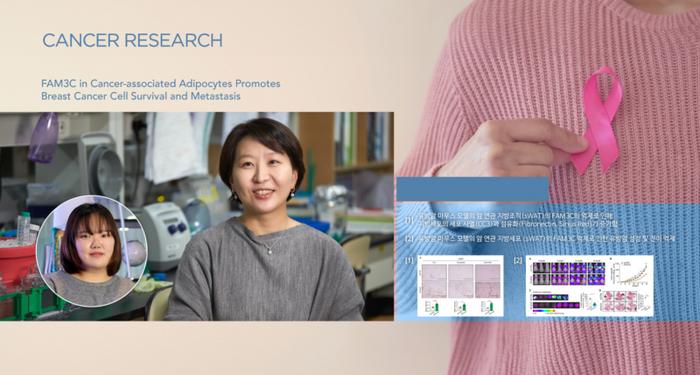
Professor Jiyoung Park and Sahee Kim (left circle)
Share on FacebookShare on TwitterShare on LinkedinShare on RedditShare on Telegram

A groundbreaking study conducted by Professor Jiyoung Park and her research team in the Department of Biological Sciences at UNIST has identified FAM3C, a metabolism-regulating signaling molecule produced by cancer-associated adipocytes (CAAs), as a key regulator of breast cancer progression within the tumor microenvironment (TME). The findings, published in the prestigious academic journal Cancer Research, shed light on the potential for targeted therapies in the treatment of breast cancer.
Professor Jiyoung Park and Sahee Kim (left circle)

Credit: UNIST

A groundbreaking study conducted by Professor Jiyoung Park and her research team in the Department of Biological Sciences at UNIST has identified FAM3C, a metabolism-regulating signaling molecule produced by cancer-associated adipocytes (CAAs), as a key regulator of breast cancer progression within the tumor microenvironment (TME). The findings, published in the prestigious academic journal Cancer Research, shed light on the potential for targeted therapies in the treatment of breast cancer.

The study demonstrates that overexpression of FAM3C in cultured adipocytes significantly reduces cell death in both adipocytes and co-cultured breast cancer cells, while suppressing markers of fibrosis. Conversely, depletion of FAM3C in CAAs leads to adipocyte-mesenchymal transition (AMT) and increased fibrosis within the TME. The research team also discovered that breast cancer cells stimulate the expression of FAM3C in adipocytes through TGF-β signaling, which can be inhibited by a TGF-β-neutralizing antibody.

In a genetically engineered mouse model of breast cancer, early knockdown of FAM3C in CAAs significantly inhibited primary and metastatic tumor growth. Furthermore, elevated levels of circulating FAM3C were observed in patients with metastatic breast cancer compared to those with non-metastatic breast cancer.

“These findings suggest that therapeutic inhibition of FAM3C expression in CAAs during early tumor development could hold promise as a novel approach in the treatment of patients with breast cancer,” said Professor Jiyoung Park. “Understanding the role of cancer-associated adipocytes and their secretory molecules, such as FAM3C, opens up new avenues for the development of early diagnosis markers and targeted treatments for breast cancer.”

The findings of this study have been published in the online version of Cancer Research on December 20, 2023. This research was conducted with the support of the National Research Foundation of Korea (NRF), funded by the Ministry of Science and ICT (MSIT), the Basic Science Research Program, as well as a grant of the Korea Health Technology R&D Project through the Korea Health Industry Development Institute (KHIDI), funded by the Ministry of Health & Welfare, Republic of Korea.

Journal Reference
Sahee Kim, Jiyoung Oh, Chanho Park, et al., “FAM3C in cancer-associated adipocytes promotes breast cancer cell survival and metastasis,” Cancer Research, (2023).


Journal

Cancer Research

Article Title

FAM3C in cancer-associated adipocytes promotes breast cancer cell survival and metastasis

Article Publication Date

20-Dec-2023

Share12Tweet8Share2ShareShareShare2

Related Posts

Analyzing Elderly Care Needs Using Kano Model

February 9, 2026

Triple Targeting Enhances CXCL16–CXCR6 Antitumor Response

February 9, 2026

Intensive Short-Duration Exercise Outperforms Standard Care in Treating Panic Disorder

February 9, 2026

Exercise’s Impact on SASP Biomarkers in Seniors Unexplored

February 9, 2026

POPULAR NEWS

  • Robotic Ureteral Reconstruction: A Novel Approach

    Robotic Ureteral Reconstruction: A Novel Approach

    82 shares
    Share 33 Tweet 21
  • Digital Privacy: Health Data Control in Incarceration

    63 shares
    Share 25 Tweet 16
  • Mapping Tertiary Lymphoid Structures for Kidney Cancer Biomarkers

    50 shares
    Share 20 Tweet 13
  • Breakthrough in RNA Research Accelerates Medical Innovations Timeline

    53 shares
    Share 21 Tweet 13

About

We bring you the latest biotechnology news from best research centers and universities around the world. Check our website.

Follow us

Recent News

Analyzing Elderly Care Needs Using Kano Model

Private Sector Cuts Greenhouse Gases in Africa’s Livestock

Triple Targeting Enhances CXCL16–CXCR6 Antitumor Response

Subscribe to Blog via Email

Enter your email address to subscribe to this blog and receive notifications of new posts by email.

Join 74 other subscribers
  • Contact Us

Bioengineer.org © Copyright 2023 All Rights Reserved.

Welcome Back!

Login to your account below

Forgotten Password?

Retrieve your password

Please enter your username or email address to reset your password.

Log In
No Result
View All Result
  • Homepages
    • Home Page 1
    • Home Page 2
  • News
  • National
  • Business
  • Health
  • Lifestyle
  • Science

Bioengineer.org © Copyright 2023 All Rights Reserved.