• HOME
  • NEWS
  • EXPLORE
    • CAREER
      • Companies
      • Jobs
    • EVENTS
    • iGEM
      • News
      • Team
    • PHOTOS
    • VIDEO
    • WIKI
  • BLOG
  • COMMUNITY
    • FACEBOOK
    • INSTAGRAM
    • TWITTER
Tuesday, May 12, 2026
BIOENGINEER.ORG
No Result
View All Result
  • Login
  • HOME
  • NEWS
  • EXPLORE
    • CAREER
      • Companies
      • Jobs
        • Lecturer
        • PhD Studentship
        • Postdoc
        • Research Assistant
    • EVENTS
    • iGEM
      • News
      • Team
    • PHOTOS
    • VIDEO
    • WIKI
  • BLOG
  • COMMUNITY
    • FACEBOOK
    • INSTAGRAM
    • TWITTER
  • HOME
  • NEWS
  • EXPLORE
    • CAREER
      • Companies
      • Jobs
        • Lecturer
        • PhD Studentship
        • Postdoc
        • Research Assistant
    • EVENTS
    • iGEM
      • News
      • Team
    • PHOTOS
    • VIDEO
    • WIKI
  • BLOG
  • COMMUNITY
    • FACEBOOK
    • INSTAGRAM
    • TWITTER
No Result
View All Result
Bioengineer.org
No Result
View All Result
Home NEWS Science News Health

New study highlights links between inflammation and Parkinson’s disease

Bioengineer by Bioengineer
October 14, 2020
in Health
Reading Time: 2 mins read
0
IMAGE
Share on FacebookShare on TwitterShare on LinkedinShare on RedditShare on Telegram

Luxembourg research on Parkinson’s disease
IMAGE

Credit: ©University Of Luxembourg

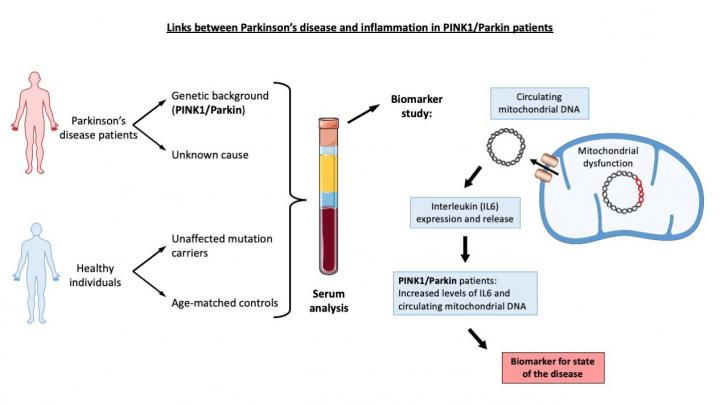
Around 15% of Parkinson’s disease cases are related to a known genetic background, out of which mutations in the Parkin and PINK1 genes are among the most frequent ones. Thus, revealing cellular mechanisms which are altered by these mutations is crucial for the development of new therapeutic approaches. In this study, the researchers analysed the blood serum of 245 participants from two independent cohorts and showed that patients carrying mutations in the Parkin or PINK1 genes have an increased level of circulating mitochondrial DNA and interleukin 6 (IL6).

These results indicate that deficiency in Parkin or PINK1 proteins – caused by a mutation on the corresponding gene – leads to impaired mitophagy. This dysfunction at the mitochondria level causes the release of mitochondrial DNA, thereby triggering inflammation and the elevation of interleukin 6 levels in the blood. When reaching the brain, IL6 is then thought to play a role in neurodegeneration. “Our study suggests that treatment with anti-inflammatory drugs holds the potential to alleviate the course of Parkinson’s disease – at least for patients with mutations in the Parkin or PINK1 gene,” explains Prof. Anne Grünewald, head of the Molecular and Functional Neurobiology group at the LCSB and one of the two senior authors of the study.

By studying the difference between patients carrying the Parkin or PINK1 mutation either on one (heterozygous) or both chromosomes, the researchers also showed that monitoring the level of systemic inflammation in the blood might be used as a biomarker for these genetic forms of Parkinson’s disease. Whereas patients with mutations in both chromosomes showed elevated levels of interleukin 6 compared to heterozygous patients, the latter still displayed a significant increase compared to healthy controls. “This tells us that heterozygous mutations also constitute a strong risk factor for the onset of Parkinson’s disease,” explains Prof. Grünewald. “Even before the disease has broken out in these heterozygous carriers, we might be able to detect it at an early stage by monitoring IL6 in the serum.” Similarly, the study showed that the level of circulating mitochondrial DNA could serve as a marker of the progression of the disease for heterozygous Parkin/PINK1 mutation carriers.

Prof. Grünewald concludes: “Our findings have a high value for potential clinical applications, be it biomarkers in the patient’s serum that detect the state of the disease or new therapeutic approaches targeting the innate immune response in Parkin/PINK1-associated Parkinson’s disease.”

###

Media Contact
Laura Bianchi
[email protected]

Original Source

https://wwwen.uni.lu/lcsb/news_events/new_study_highlights_links_between_inflammation_parkinson_s_disease

Tags: BiologyneurobiologyParkinson
Share12Tweet8Share2ShareShareShare2

Related Posts

Medicaid Expansion Reduces Mortality in Young Adults with Kidney Failure

May 11, 2026

CRISPR Technology Shows Promise in Inhibiting Hepatitis E Virus

May 11, 2026

Mapping Ocular Bioenergetics: Insights into TCA Cycle Intermediates and Gender Differences in Eye Tissues

May 11, 2026

Telemedicine Does Not Drive Higher Medical Utilization or Health Care Costs, Study Finds

May 11, 2026
Please login to join discussion

POPULAR NEWS

  • Research Indicates Potential Connection Between Prenatal Medication Exposure and Elevated Autism Risk

    841 shares
    Share 336 Tweet 210
  • New Study Reveals Plants Can Detect the Sound of Rain

    728 shares
    Share 290 Tweet 182
  • Salmonella Haem Blocks Macrophages, Boosts Infection

    62 shares
    Share 25 Tweet 16
  • Breastmilk Balances E. coli and Beneficial Bacteria in Infant Gut Microbiomes

    57 shares
    Share 23 Tweet 14

About

We bring you the latest biotechnology news from best research centers and universities around the world. Check our website.

Follow us

Recent News

Humans and Zebra Finches Share Similar Speech Learning Techniques #ASA190

New Study Uncovers How Fungal Parasites Attack Strawberries and Raspberries

City of Hope Researchers to Present Groundbreaking Immunotherapy and Precision Medicine Advances Across Multiple Cancer Types at ASCO 2026

Subscribe to Blog via Email

Enter your email address to subscribe to this blog and receive notifications of new posts by email.

Join 82 other subscribers
  • Contact Us

Bioengineer.org © Copyright 2023 All Rights Reserved.

Welcome Back!

Login to your account below

Forgotten Password?

Retrieve your password

Please enter your username or email address to reset your password.

Log In
No Result
View All Result
  • Homepages
    • Home Page 1
    • Home Page 2
  • News
  • National
  • Business
  • Health
  • Lifestyle
  • Science

Bioengineer.org © Copyright 2023 All Rights Reserved.