

• HOME
  • NEWS
  • EXPLORE
    • CAREER
      • Companies
      • Jobs
    • EVENTS
    • iGEM
      • News
      • Team
    • PHOTOS
    • VIDEO
    • WIKI
  • BLOG
  • COMMUNITY
    • FACEBOOK
    • INSTAGRAM
    • TWITTER
Tuesday, December 30, 2025
BIOENGINEER.ORG
No Result
View All Result
  • Login
  • HOME
  • NEWS
  • EXPLORE
    • CAREER
      • Companies
      • Jobs
        • Lecturer
        • PhD Studentship
        • Postdoc
        • Research Assistant
    • EVENTS
    • iGEM
      • News
      • Team
    • PHOTOS
    • VIDEO
    • WIKI
  • BLOG
  • COMMUNITY
    • FACEBOOK
    • INSTAGRAM
    • TWITTER
  • HOME
  • NEWS
  • EXPLORE
    • CAREER
      • Companies
      • Jobs
        • Lecturer
        • PhD Studentship
        • Postdoc
        • Research Assistant
    • EVENTS
    • iGEM
      • News
      • Team
    • PHOTOS
    • VIDEO
    • WIKI
  • BLOG
  • COMMUNITY
    • FACEBOOK
    • INSTAGRAM
    • TWITTER
No Result
View All Result
Bioengineer.org
No Result
View All Result
Home NEWS Science News Biology

New study finds surface disturbance can limit mule deer migration

Bioengineer by Bioengineer
June 10, 2020
in Biology
Reading Time: 2 mins read
0
IMAGE
Share on FacebookShare on TwitterShare on LinkedinShare on RedditShare on Telegram

IMAGE

Credit: Joe Riis

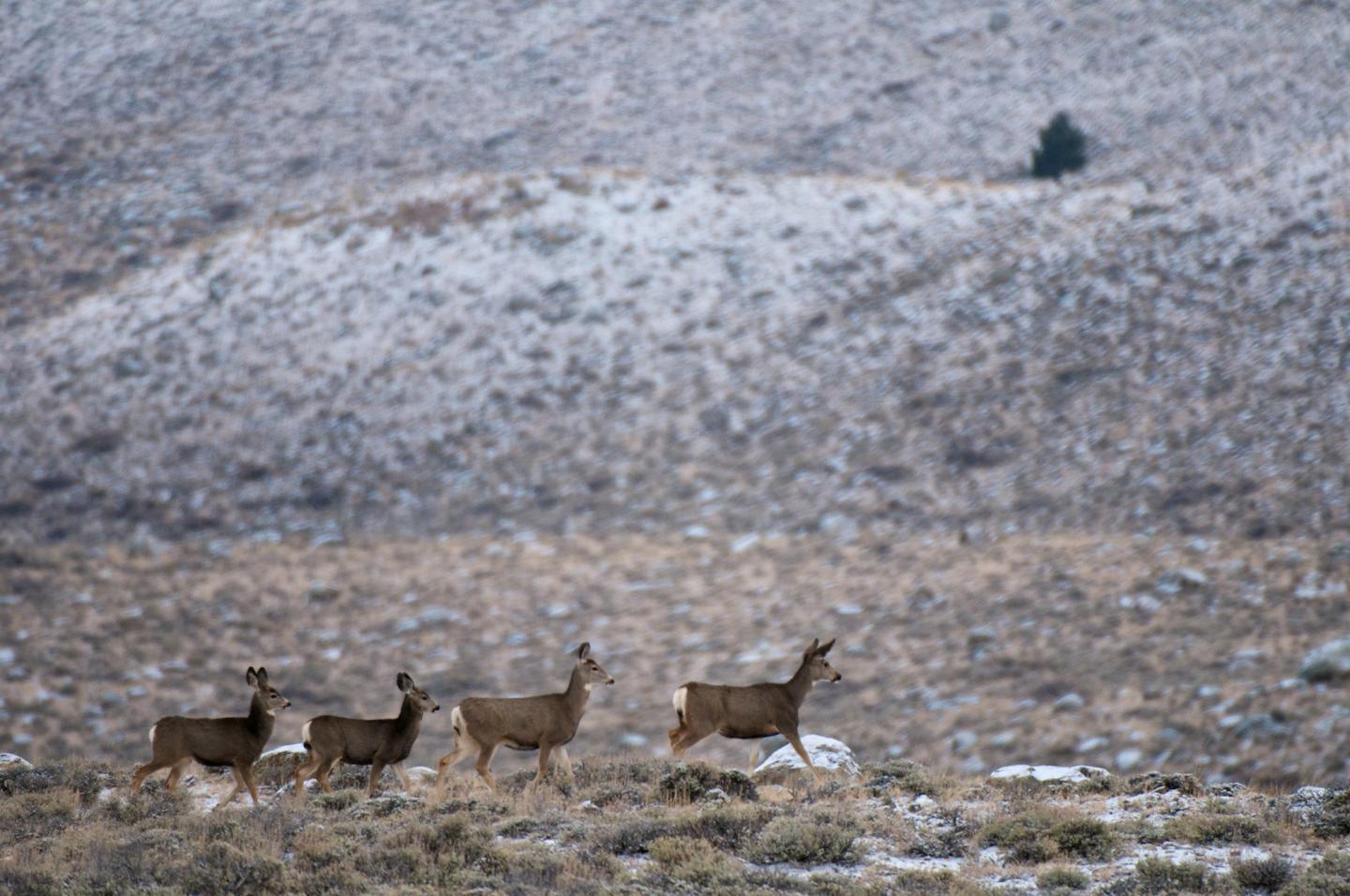
A new study shows that surface disturbance from energy development can hinder mule deer migrations when it exceeds 3 percent.

Researchers from the University of Wyoming and Western Ecosystems Technology used 15 years of movement data collected from GPS-collared mule deer in western Wyoming to evaluate how much disturbance mule deer could withstand during migration. The study was conducted in the Pinedale Anticline — the sixth-largest natural gas field in the nation and home to one of the largest deer herds in West.

The findings were published in the Journal of Wildlife Management.

Researchers used 145 migrations from 56 individual deer to examine disturbance effects at various scales. Results consistently showed that mule deer use of migration corridors steeply declined when surface disturbance from roads and well pads surpassed 3 percent. Mule deer were able to migrate through areas where surface disturbance was lower.

“Better understanding the relationship between surface disturbance and migratory behavior can help managers identify trade-offs and potential mitigation measures associated with mineral leasing and energy development that overlap with the migratory routes of big game,” research biologist and co-author Hall Sawyer says.

The authors note that similar disturbance thresholds likely vary across development types — such as wind, solar and residential – as well as geographic regions and species.

“There is a growing need to understand and predict how our migratory animals respond to disturbed landscapes, so we hope to expand this type of work in the future,” says Jerod Merkle, who is the Knobloch Professor of Migration and Conservation Ecology at UW.

Mallory Lambert, a UW graduate student and study co-author, says the next steps will be identifying disturbance thresholds for migrating pronghorn and wintering mule deer.

###

This study was funded, in part, by the Wyoming Game and Fish Department.

Visit the Wyoming Game and Fish Department and Wyoming Migration Initiative websites for information on big-game migrations in Wyoming.

Media Contact
Jerod Merkle
[email protected]

Original Source

https://www.uwyo.edu/uw/news/2020/06/new-uw-study-finds-surface-disturbance-can-limit-mule-deer-migration.html

Related Journal Article

http://dx.doi.org/10.1002/jwmg.21847

Tags: BiodiversityBiologyEcology/EnvironmentNatureZoology/Veterinary Science
Share12Tweet8Share2ShareShareShare2

Related Posts

Impact of Wildlife on Livestock Production in Zimbabwe

Impact of Wildlife on Livestock Production in Zimbabwe

December 30, 2025
Dictyostelium discoideum Adapts Gene Expression to Hypoxia

Dictyostelium discoideum Adapts Gene Expression to Hypoxia

December 30, 2025

Impact of Sex and Gender on Clinical Outcomes: Review

December 29, 2025

Thousands of Lytic Phages Found in Bacterial Genomes

December 29, 2025
Please login to join discussion

POPULAR NEWS

  • Robotic Waist Tether for Research Into Metabolic Cost of Walking

    NSF funds machine-learning research at UNO and UNL to study energy requirements of walking in older adults

    71 shares
    Share 28 Tweet 18
  • Exploring Audiology Accessibility in Johannesburg, South Africa

    51 shares
    Share 20 Tweet 13
  • Nurses’ Views on Online Learning: Effects on Performance

    70 shares
    Share 28 Tweet 18
  • SARS-CoV-2 Subvariants Affect Outcomes in Elderly Hip Fractures

    44 shares
    Share 18 Tweet 11

About

We bring you the latest biotechnology news from best research centers and universities around the world. Check our website.

Follow us

Recent News

Optimizing Collaborative Elderly Care: Game Theory Insights

IL-17a Drives Age-Related Loss of Smell

Impact of Wildlife on Livestock Production in Zimbabwe

Subscribe to Blog via Email

Enter your email address to subscribe to this blog and receive notifications of new posts by email.

Join 71 other subscribers
  • Contact Us

Bioengineer.org © Copyright 2023 All Rights Reserved.

Welcome Back!

Login to your account below

Forgotten Password?

Retrieve your password

Please enter your username or email address to reset your password.

Log In
No Result
View All Result
  • Homepages
    • Home Page 1
    • Home Page 2
  • News
  • National
  • Business
  • Health
  • Lifestyle
  • Science

Bioengineer.org © Copyright 2023 All Rights Reserved.


