• HOME
  • NEWS
  • EXPLORE
    • CAREER
      • Companies
      • Jobs
    • EVENTS
    • iGEM
      • News
      • Team
    • PHOTOS
    • VIDEO
    • WIKI
  • BLOG
  • COMMUNITY
    • FACEBOOK
    • INSTAGRAM
    • TWITTER
Sunday, February 8, 2026
BIOENGINEER.ORG
No Result
View All Result
  • Login
  • HOME
  • NEWS
  • EXPLORE
    • CAREER
      • Companies
      • Jobs
        • Lecturer
        • PhD Studentship
        • Postdoc
        • Research Assistant
    • EVENTS
    • iGEM
      • News
      • Team
    • PHOTOS
    • VIDEO
    • WIKI
  • BLOG
  • COMMUNITY
    • FACEBOOK
    • INSTAGRAM
    • TWITTER
  • HOME
  • NEWS
  • EXPLORE
    • CAREER
      • Companies
      • Jobs
        • Lecturer
        • PhD Studentship
        • Postdoc
        • Research Assistant
    • EVENTS
    • iGEM
      • News
      • Team
    • PHOTOS
    • VIDEO
    • WIKI
  • BLOG
  • COMMUNITY
    • FACEBOOK
    • INSTAGRAM
    • TWITTER
No Result
View All Result
Bioengineer.org
No Result
View All Result
Home NEWS Science News Health

New stem cell research may have implications for liver transplantation

Bioengineer by Bioengineer
May 9, 2024
in Health
Reading Time: 2 mins read
0
Key Results
Share on FacebookShare on TwitterShare on LinkedinShare on RedditShare on Telegram

Liver disease, due to viral infections, alcohol abuse, obesity, or cancer, accounts for 1 in every 25 deaths worldwide. A liver transplant can be life saving for people with end-stage liver disease. However, the procedure has limitations related to donor shortage, a technically challenging and invasive surgical procedure, and the requirement for lifelong immunosuppressive medication in the transplant recipients. An alternative to whole organ transplantation is the less invasive injection of dissociated human liver cells, but donor shortage is still an issue. Utilizing interspecies blastocyst complementation to obtain transplantable human liver cells or whole organs in sufficient quantity in a different animal species was one way to overcome these barriers.
Key Results

Credit: Chinese Academy of Sciences, Beijing

Liver disease, due to viral infections, alcohol abuse, obesity, or cancer, accounts for 1 in every 25 deaths worldwide. A liver transplant can be life saving for people with end-stage liver disease. However, the procedure has limitations related to donor shortage, a technically challenging and invasive surgical procedure, and the requirement for lifelong immunosuppressive medication in the transplant recipients. An alternative to whole organ transplantation is the less invasive injection of dissociated human liver cells, but donor shortage is still an issue. Utilizing interspecies blastocyst complementation to obtain transplantable human liver cells or whole organs in sufficient quantity in a different animal species was one way to overcome these barriers.

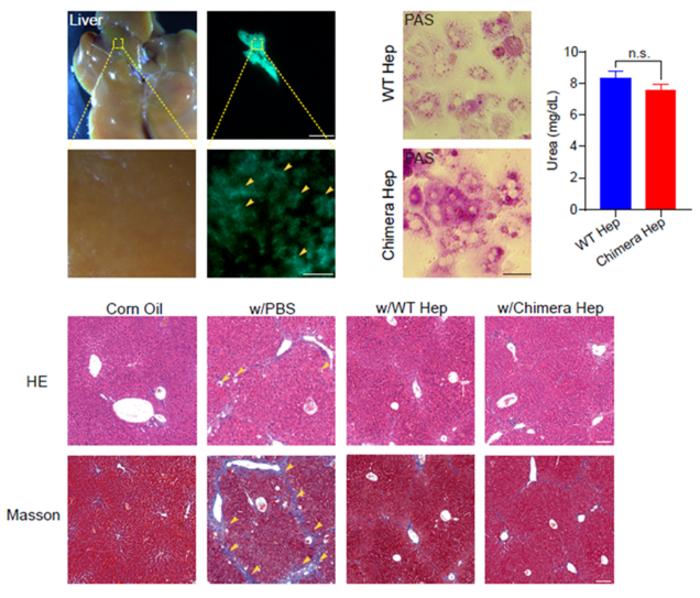
One important question is whether liver cells grown in a different species would be fully functional. To find out, Wei Li and colleagues from the Chinese Academy of Sciences in Beijing injected mouse embryonic stem cells into early rat embryos. Mouse-rat chimeras born from these engineered embryos contained mouse cells in most parts of the body including the livers. The percentage of live mouse liver cells enriched was up to 20.6% from chimeric livers. Encouragingly, mouse liver cells grown in mouse-rat chimeras had normal appearance and mature function in a panel of lab-based tests. Moreover, mouse liver cells from mouse-rat chimeras could be transplanted into mice with liver damage and had a similar therapeutic effect as normal mouse liver cells in relieving chronic liver fibrosis. This data, recently published in the journal Stem Cell Reports, provides proof of principle that functional liver cells can be grown in a different species…and could represent a solution to transplant shortage. Future work is needed to develop efficient techniques to grow human liver cells in large animals such as pigs, and to investigate whether these human liver cells are fully functional.


Journal

Stem Cell Reports

DOI

10.1016/j.stemcr.2024.04.006

Article Title

Functional Mouse Hepatocytes Derived from Interspecies Chimeric Livers Effectively Mitigate Chronic Liver Fibrosis

Article Publication Date

9-May-2024

Share12Tweet8Share2ShareShareShare2

Related Posts

Group Therapy Boosts Recovery in Elderly Depression

February 8, 2026

Evaluating Biosimilar Trastuzumab for Breast Cancer in Thailand

February 8, 2026

Decoding Phantom Limb Movements via Intraneural Signals

February 8, 2026

Attitudes Toward Aging Impact Early Nursing Home Quality

February 8, 2026

POPULAR NEWS

  • Robotic Ureteral Reconstruction: A Novel Approach

    Robotic Ureteral Reconstruction: A Novel Approach

    82 shares
    Share 33 Tweet 21
  • Digital Privacy: Health Data Control in Incarceration

    63 shares
    Share 25 Tweet 16
  • Breakthrough in RNA Research Accelerates Medical Innovations Timeline

    53 shares
    Share 21 Tweet 13
  • Mapping Tertiary Lymphoid Structures for Kidney Cancer Biomarkers

    50 shares
    Share 20 Tweet 13

About

We bring you the latest biotechnology news from best research centers and universities around the world. Check our website.

Follow us

Recent News

Group Therapy Boosts Recovery in Elderly Depression

Evaluating Biosimilar Trastuzumab for Breast Cancer in Thailand

Decoding Phantom Limb Movements via Intraneural Signals

Subscribe to Blog via Email

Enter your email address to subscribe to this blog and receive notifications of new posts by email.

Join 73 other subscribers
  • Contact Us

Bioengineer.org © Copyright 2023 All Rights Reserved.

Welcome Back!

Login to your account below

Forgotten Password?

Retrieve your password

Please enter your username or email address to reset your password.

Log In
No Result
View All Result
  • Homepages
    • Home Page 1
    • Home Page 2
  • News
  • National
  • Business
  • Health
  • Lifestyle
  • Science

Bioengineer.org © Copyright 2023 All Rights Reserved.