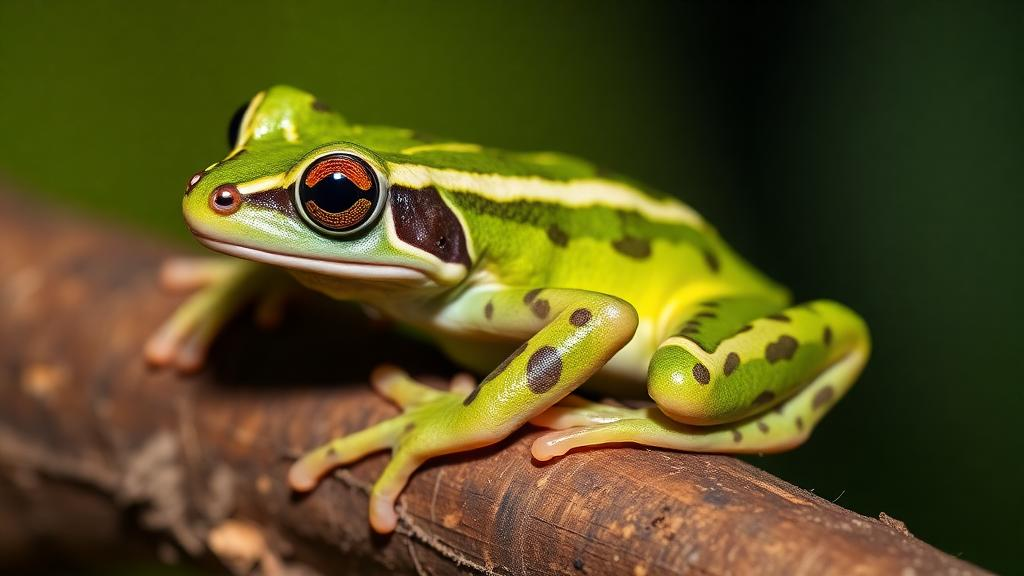
Deep in the cloud-veined premontane forests of central Peru, a spiny-backed tree frog has been hiding in plain sight. Scientists have described a new species of the genus Osteocephalus from the Yanachaga Chemillén National Park, naming it Osteocephalus vasquezi in honor of Peruvian forest engineer Pedro Vásquez Ruesta, a pioneer of wildlife management and protected-area conservation in the country. The discovery, published in the journal Evolutionary Systematics, adds a 30th nominal species to a Neotropical frog genus that has proven remarkably rich in hidden diversity.
Spiny-backed tree frogs are nocturnal, arboreal amphibians widely distributed across the Amazon Basin, the Guyana region, and Mato Grosso in Brazil. Their common name derives from the heavily keratinized spicules that appear on the backs of breeding males of most species. Although most members of the genus live in Amazonian lowlands, some climb into montane forests up to 2000 meters above sea level on the eastern slopes of the Andes. More than half of the genus’s recognized species have been resurrected or described only since 2000, a sign that taxonomists are still far from finished with this group.
The new species was collected at night on leaves and branches of bushes up to two meters above the ground, along ravines draining into the Río Huancabamba in the Cordillera del Yanachaga. All known individuals come from elevations between 1000 and 1150 meters, within the park’s premontane forest in the upper Amazon basin of Pasco department. The ravines hold torrential streams of clear water over rocky bottoms, and it is in these fast waters that the tadpoles of the new species reveal one of their most striking features.
To establish that the frogs represented an undescribed species, the research team combined morphology with molecular evidence. DNA was extracted from muscle or liver tissue preserved in 95% ethanol, and the team amplified fragments of the mitochondrial genes 12S RNA, CO1, 16S, and ND1, together with the nuclear genes POMC and RAG-1. Sequencing was performed by Macrogen in Seoul. The final concatenated alignment contained 38 terminals and 14,791 base pairs, and phylogenetic relationships were inferred using maximum likelihood in IQ-TREE, with the matrix partitioned into 22 segments by gene or codon position, each analyzed under the GTR+G model.
The resulting phylogeny, supported by 1000 ultrafast bootstrap searches and 1000 replicates of the SH-like approximate likelihood ratio test, placed Osteocephalus vasquezi as the sister species of O. mimeticus, with strong support for the O. mimeticus species group as a whole. Both species are in turn sister to a seemingly undescribed species, O. aff. mimeticus, from the Cusco department in southern Peru. A time tree built with the least square dating method, calibrated with divergence points of 13.1 million years and 23.5 million years taken from a previous phylogeny of the genus, suggests that the new species split from its sister at the beginning of the Pleistocene, roughly 2.5 million years ago. The O. mimeticus group itself diverged from its sister clade, the O. buckleyi group, about 9.3 million years ago, with diversification within the group starting around 5 million years ago.
Genetic distances added further weight to the case. The average uncorrected p-distance for the 12S gene between the new species and O. mimeticus is 2.03%, and between the new species and O. aff. mimeticus it is 1.67%. These values sit at the lower end of the range observed between sister species of Osteocephalus, but combined with unmistakable morphological differences they confirmed that the Yanachaga frogs deserved species status. Among the most telling characters is the ventral pattern: O. vasquezi has a cream or creamy-tan belly with a well-defined pattern of chocolate-brown blotches and flecks, whereas the venter of O. mimeticus is cream, tan, or brown without marks.
Body size separates the two species as well. Adult males of O. mimeticus measure 58.2 to 67.5 millimeters in snout-vent length, with a mean of 63.4 millimeters, while males of the new species range from 40.9 to 52.9 millimeters, with a mean of 47.9 millimeters, non-overlapping ranges that make field identification straightforward once the species are known. Females of the new species are considerably larger than males, with the largest known female reaching 75.5 millimeters, a pronounced sexual dimorphism typical of many hylid frogs. In life, the iris of O. vasquezi is dark brown with golden vermiculations or flecks, the bones are green, and juveniles sport a bright red iris with an almost black dorsum marked in gold.
The tadpoles may be the most remarkable part of the story. Of the genus’s 29 previously known species, larvae had been formally described for only six. The tadpoles of O. vasquezi, collected at Quebrada Honda, the same ravine as the holotype, belong to the exotrophic, lotic, suctorial guild. Their oral disk spans 70.86% of body width, an enormous structure that lets them adhere to rocks in strong currents, and they possess nine lower labial tooth rows, a labial tooth row formula of 3(3)/9, compared with only six rows in O. mimeticus. Their snout is truncate in dorsal view rather than rounded, their nostrils are oriented dorsolaterally closer to the eyes, and their tail fins are conspicuously narrower at the posterior third. Together with the tadpoles of O. festae, which share the suctorial guild and a large oral disk, they represent the most specialized larval form known in the genus, equipped with robust caudal musculature and narrow fins suited to life in torrential rocky streams.
Distinguishing the new species from its many brown-backed relatives required a careful tour of the genus. O. festae and O. verruciger, both members of the O. buckleyi group, share dark irises, tuberculate dorsal skin, and brown coloration, but their irises lack bright marks and their flanks are areolate, while the new species has golden-flecked dark brown irises and flanks that are smooth or only weakly areolate in the anterior third. Other brown species such as O. mutabor, O. omega, and O. sangay differ in iris color, dorsal striping, or throat pattern, and species of the O. planiceps group differ in vocal sac structure, skin texture, and breeding behavior, laying eggs in phytotelmata such as leaf axils, bamboo, and tree holes rather than in torrential streams. The new species breeds in fast-flowing water, and its paired lateral vocal sacs sit behind the jaw articulation, above the arms and below the ears.
The discovery underscores how much remains to be learned about Neotropical amphibian diversity. Recent systematic studies have documented large numbers of candidate species within Osteocephalus, along with poorly understood species limits and complexes such as the O. verruciger-cannatellai and O. helenae groups. The populations from Cusco assigned to O. aff. mimeticus likely represent yet another new species, but their formal description will require additional evidence, including improved phylogenetic sampling, comparative tadpole morphology, and, if possible, advertisement calls. For now, Osteocephalus vasquezi stands as a reminder that even well-surveyed Andean parks can shelter species that have waited millions of years, since the dawn of the Pleistocene, for a name of their own.
Subject of Research: Description of a new spiny-backed tree frog species, Osteocephalus vasquezi, from premontane forest in central Peru
Article Title: A new species of spiny-backed tree frog, genus Osteocephalus ( Anura , Hylidae ), from the Yanachaga Chemillén National Park in central Peru
Article References: Venegas, P. J., García-Ayachi, L. A., Toral, E., Malqui, J., & Ron, S. R. (2023). A new species of spiny-backed tree frog, genus Osteocephalus (Anura, Hylidae), from the Yanachaga Chemillén National Park in central Peru. Evolutionary Systematics, 7(2), 237-251. https://doi.org/10.3897/evolsyst.7.102360
Image Credits: AI Generated
DOI: 10.3897/evolsyst.7.102360
Keywords: Osteocephalus vasquezi, spiny-backed tree frogs, new species, Peru, Yanachaga Chemillén National Park, herpetology, phylogenetics, tadpoles, Andes, amphibian taxonomy, Evolutionary Systematics, biodiversity
News Source: Margaret Porter. (October 19, 2026). New spiny-backed tree frog species discovered in Peru’s Yanachaga Chemillén National Park. Scienmag.