Birmingham, AL (February 7, 2024) – Today, a team of scientists is pleased to announce the discovery of a new fossil shark species from Alabama, USA. The team is led by Jun Ebersole, Director of Collections, McWane Science Center, Birmingham, AL, David Cicimurri, Curator of Natural History, South Carolina State Museum in Columbia, and T. Lynn Harrell, Jr., Paleontologist and Fossil Collections Curator at the Geological Survey of Alabama in Tuscaloosa.
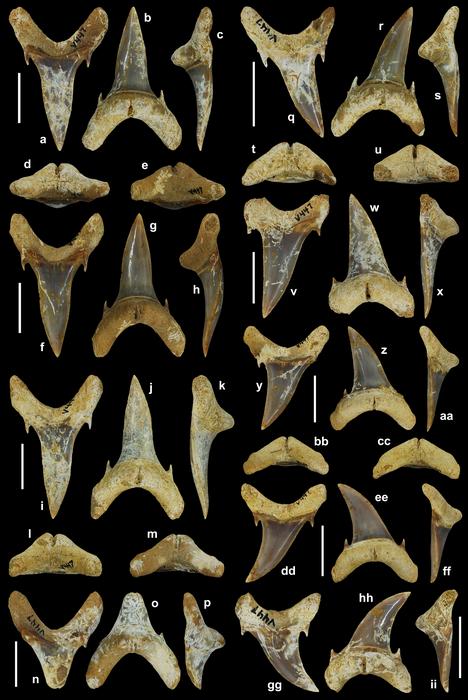
Credit: Ebersole et al.
Birmingham, AL (February 7, 2024) – Today, a team of scientists is pleased to announce the discovery of a new fossil shark species from Alabama, USA. The team is led by Jun Ebersole, Director of Collections, McWane Science Center, Birmingham, AL, David Cicimurri, Curator of Natural History, South Carolina State Museum in Columbia, and T. Lynn Harrell, Jr., Paleontologist and Fossil Collections Curator at the Geological Survey of Alabama in Tuscaloosa.
The shark is a new species of Palaeohypotodus (pronounced pale-ee-oh-hype-oh-toe-duss), which means “ancient small-eared tooth,” in reference to the small needle-like fangs present on the sides of the teeth. It has been named Palaeohypotodus bizzocoi, for the late Dr. Bruce Bizzoco (1949-2022) of Birmingham, AL. Bizzoco served as a Dean at Shelton State Community College, archaeologist, and was a longtime volunteer at McWane Science Center. The naming of this species honors Dr. Bizzoco’s lifelong commitments to education and the preservation of Alabama’s history.
According to Ebersole, the discovery of this shark was accidental.
“A few years ago, I was looking through the historical fossil collections at the Geological Survey in Alabama and came across a small box of shark teeth that were collected over 100 years ago in Wilcox County,” Ebersole said. “Having documented hundreds of fossil fish species over the last decade, I found it puzzling that these teeth were from a shark that I didn’t recognize.” Ebersole quickly realized that these teeth belonged to a new species.
“Perhaps one of the coolest aspects of this shark, is when it lived – the Paleocene, approximately 65-million-years-ago,” Cicimurri said. This is the time-period from just after the death of the dinosaurs, where over 75% of life on Earth went extinct.”
According to Cicimurri, this shark was a leading predator during the time when the oceans were recovering.
In Alabama, much of the southern half of the state was covered by a shallow tropical to sub- tropical ocean during the Paleocene. “This time period is understudied, which makes the discovery of this new shark species that much more significant,” Harrell said.
“Shark discoveries like this one give us tremendous insights into how ocean life recovers after major extinction events and also allows us to potentially forecast how global events, like climate change, affect marine life today,” Harrell continued.
As part of their study of this ancient shark, the team compared the fossil teeth to those of various living sharks, like Great Whites and Makos. According to Cicimurri, shark teeth differ in shape depending on where they are located in the mouth.
“By studying the jaws and teeth of living sharks, it allowed us to reconstruct the dentition of this ancient species and showed that it had a tooth arrangement that differed from any living shark,” Cicimurri said.
The naming of this shark is part of an ongoing project led by Ebersole and Cicimurri to document Alabama’s fossil fishes. Together, they have confirmed over 400 unique species of fossil sharks and bony fishes, which, according to Ebersole makes Alabama one of the richest places in the world in terms of fossil fish diversity.
The study, titled A new species Palaeohypotodus Glickman, 1964 (Chondrichthyes, Lamniformes) from the lower Paleocene (Danian) Porters Creek Formation, Wilcox County, Alabama, USA, was published today in the open access journal Fossil Record and can be downloaded here: htps://doi.org/10.3897/fr.27.e112800
About McWane Science Center
McWane Science Center is a nonprofit 501 (c)(3) science center, children’s museum, natural history museum, aquarium, and IMAX Dome Theater. Designed to “spark wonder and curiosity about our world through hands-on science,” McWane Science Center has welcomed millions of visitors since opening its doors in 1998. The McWane Collection houses one of the largest collection of fossils in the state of Alabama. For more information, visit www.mcwane.org.
DOI
10.3897/fr.27.e112800
Article Title
A new species of Palaeohypotodus Glückman, 1964 (Chondrichthyes, Lamniformes) from the lower Paleocene (Danian) Porters Creek Formation, Wilcox County, Alabama, USA
Article Publication Date
7-Feb-2024