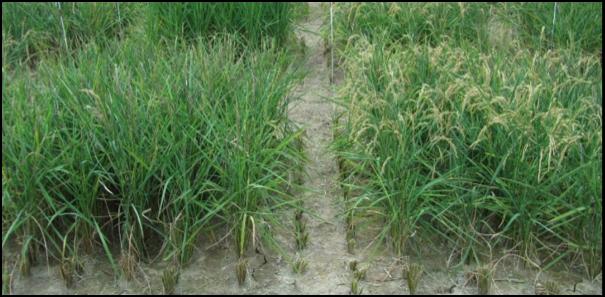
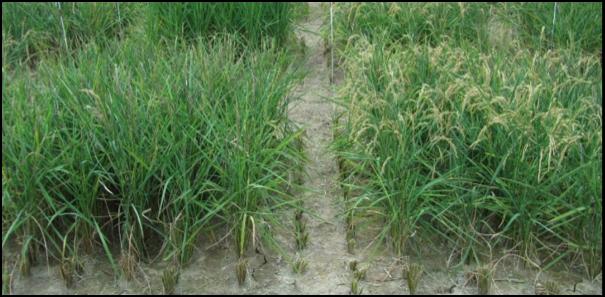
Credit: RIKEN and CIAT
Scientists at the RIKEN Center for Sustainable Resource Science (CSRS) have developed strains of rice that are resistant to drought in real-world situations. Published in Plant Biotechnology Journal, the study reports that transgenic rice modified with a gene from the Arabidopsis plant yield more rice than unmodified rice when subjected to stress brought by natural drought. The study was carried out in collaboration with researchers from the International Center for Tropical Agriculture (CIAT) in Colombia and the Japanese International Research Center for Agricultural Sciences (JIRCAS) in Japan.
As the amount of rice needed to help feed the global population increases, the consequences of drought-related crop reduction are becoming more severe. RIKEN scientists and their collaborators tackled this issue by developing transgenic strains of rice that are more resistant to drought.
Normally, plants adapt to drought-related stress by producing osmoprotectants — molecules like soluble sugars that help prevent water from leaving cells. Galactinol synthase (GolS) is an enzyme needed to produce one these important sugars called galactinol. In previous work, RIKEN scientists showed that Arabidopsis plants express the AtGolS2 gene in response to drought and salinity stress.
"The Arabidopsis GolS2 gene was first identified with basic research at RIKEN," explains RIKEN scientist Fuminori Takahashi. "Using it, we were able to improve resistance to drought-related stress, and increased the grain yield of rice in dry field conditions. This is one of the best model cases in which basic research knowledge has been successfully applied toward researching a resolution to a food-related problem."
For this study, they created several lines of transgenic Brazilian and African rice that overexpress this gene, and with their CIAT and JIRCAS collaborators, tested how well the rice grew in different conditions in different years.
The results were very promising. First, they grew the different rice lines in greenhouse conditions and showed that the modified Brazilian and African rice did indeed show higher levels of galactinol than the unmodified control rice. Next, they tested tolerance to drought during the seedling growth period because this period often overlaps with seasonal drought. In order to precisely control this part of the experiment, it was conducted in a rainout shelter that allowed them to artificially create drought-like conditions. After three weeks, the modified strains had grown taller and showed less leaf-rolling, a common response to drought stress.
Drought tolerance was next confirmed at the reproductive stage in three rainout field trials in Colombia. These trials were during different seasons and different locations. Nevertheless, transgenic lines in both species of rice showed higher yield, greater biomass, lower leaf-rolling, and greater fertility than the unmodified rice. Closer examination showed that five of the most promising strains had greater relative water content during drought conditions, and also used more light for photosynthesis, and contained more chlorophyll.
Finally, they tested the transgenic rice over a three-year period in different natural environments. Again, several of the transgenic strains showed higher grain yield under mild and severe natural drought.
When might we see this useful rice on the market? According to Takahashi, the greatest barrier to commercial availability is that they used genetically modified (GM) technology to generate the GolS2 transgenic rice. "Now, we have begun our next collaborative project, in which we will generate useful rice without GM technology. It might take 5-10 years to reach our goal, but we must keep pressing forward because droughts and climate change might get worse in the future."
###
Reference: Selvaraj M, Ishizaki T, Valencia MO, Ogawa S, Dedicova B, Ogata T, Yoshikawa K, Maruyama K, Kusano M, Saito K, Takahashi F, Shinozaki K, Nakashima K, Ishitani M. Overexpression of an Arabidopsis thaliana galactinol synthase gene improves drought tolerance in transgenic rice and increased grain yield in the field. Plant Biotechnology Journal. doi: 10.1111/pbi.12731.
Media Contact
Adam Phillips
[email protected]
@riken_en
http://www.riken.jp/en/
############
Story Source: Materials provided by Scienmag