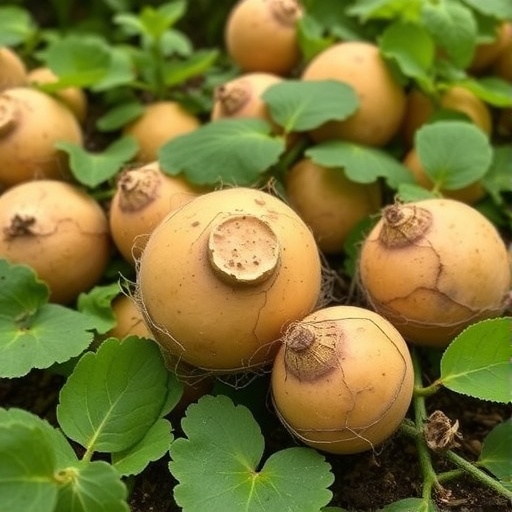
In a groundbreaking advancement for agricultural science, researchers at Stockholm’s KTH Royal Institute of Technology, in collaboration with international partners, have unveiled a novel peptide-based strategy to combat the devastating potato late blight disease caused by the pathogen Phytophthora infestans. Nearly two centuries after this pathogen orchestrated the tragic Irish Potato Famine, modern agriculture still grapples with its destructive effects, now exacerbated by global climate change. This newly synthesized peptide, designated CS5, selectively targets a pivotal enzyme in P. infestans’ unique biology, offering a promising, environmentally friendly alternative to traditional fungicides.
Late blight remains among the most economically damaging diseases to key staple crops such as potatoes and tomatoes worldwide. As rising temperatures and increased humidity extend infection periods and broaden the geographical range where the disease flourishes, farmers face mounting challenges protecting their harvests. This emerging threat underscores the urgency for innovative control methods that are both effective and sustainable. The Swedish-led team’s research leverages intricate biochemical understanding of the pathogen’s cell wall biosynthesis, specifically targeting an enzyme critical to its growth and infectivity.
Unlike fungi, Phytophthora infestans belongs to the oomycetes group, organisms phylogenetically closer to certain algae than to fungi. This distinction manifested notably in its cell wall composition, which primarily comprises cellulose and complex sugars, exhibiting minimal or absent chitin content—unlike the chitin-rich walls of true fungi. Consequently, the significance of chitin synthase enzymes in oomycete biology remained ambiguous. The researchers, however, identified a chitin synthase enzyme, termed PiChs, within P. infestans that synthesizes discrete chitin fragments essential to pathogen development.
By focusing on PiChs, the research revealed crucial vulnerabilities in P. infestans’ metabolic pathways. Their custom-designed cyclic peptide, CS5, binds uniquely to the active site of this enzyme, effectively inhibiting its function. Laboratory assays confirmed that CS5 application not only hampered enzymatic activity but also suppressed pathogen growth and thwarted infection progression on treated potatoes. Importantly, this selective inhibition spares non-target plants and humans, as the specific chitin synthase targeted by CS5 is absent in these organisms, highlighting its safety profile for agricultural deployment.
The implications of such specificity and efficacy are profound. Traditional chemical fungicides often exhibit broad-spectrum activity, impacting non-target organisms and contributing to environmental degradation. Moreover, their continued use accelerates the evolution of resistant pathogen strains. CS5’s mode of action, by contrast, targets a singular molecular feature exclusive to P. infestans, reducing the likelihood of collateral effects and resistance development. When integrated with existing management practices, this peptide represents a powerful tool to extend the longevity and performance of late blight control measures.
This research embodies a sophisticated application of glycoscience and molecular biology techniques. Through structural elucidation, the peptide was engineered to achieve an optimal fit and binding affinity to PiChs, ensuring potent and stable inhibition. The interdisciplinary collaboration across institutions in Sweden, Italy, India, and Australia facilitated the convergence of expertise in pathogen biology, peptide synthesis, and applied agricultural technology, propelling this innovation from conceptual framework to practical demonstration.
Beyond potatoes and tomatoes, the successful targeting of an oomycete-specific enzyme invites broader possibilities. Numerous oomycete pathogens threaten various crops globally, many possessing similar biochemical pathways. The foundation laid by this study paves the way for designing analogous peptide inhibitors tailored to other destructive oomycetes, potentially revolutionizing crop protection strategies across diverse agricultural systems worldwide.
Climate change’s role in intensifying late blight prevalence cannot be overstated. Regions historically afflicted by sporadic late blight outbreaks, such as cooler highlands and temperate margins, now encounter prolonged and severe infection windows conducive to pathogen proliferation. This shift complicates spray scheduling and resistance management, rendering conventional approaches insufficient. The advent of peptide-based pathogen control aligns with these emerging ecological realities, offering adaptive, precision agriculture solutions.
The environmental and economic stakes are considerable. Farmers globally expend billions annually combating late blight, often resorting to frequent chemical treatments that bear ecological costs. The introduction of CS5 and related peptides could reduce reliance on broad-spectrum fungicides, diminishing chemical residues in ecosystems and enhancing crop safety. Furthermore, these biotechnological interventions support sustainable intensification of food production, addressing the critical need to feed a growing global population amidst shrinking arable land and unpredictable climatic conditions.
Integral to this research’s success was the multidisciplinary approach melding biochemistry, plant pathology, and synthetic chemistry. Detailed enzymology investigations elucidated PiChs’s role and structural characteristics, enabling rational design of the synthetic peptide. Subsequent bioassays utilizing infected potato samples verified functional efficacy, providing a demonstrable proof-of-concept with real-world agricultural relevance.
The insights gleaned from this research underscore the potential of targeting pathogen-specific molecular machinery. Traditional fungicides frequently act on broad biological targets, but next-generation crop protection exploits the pathogen’s unique vulnerabilities. By focusing tightly on an enzyme indispensable for P. infestans growth yet absent in host plants and humans, CS5 represents a paradigm shift towards precision biocontrol agents engineered for maximal impact and minimal collateral damage.
This advance also accentuates the promise of peptide therapeutics beyond human medicine, extending into sustainable agriculture. Peptides offer modifiable frameworks with high specificity, amenable to chemical enhancements improving stability and efficacy in field conditions. The successful in vitro and ex vivo performance of CS5 beckons further field trials and formulation development, aiming toward scalable deployment within integrated pest management frameworks.
In conclusion, the discovery and characterization of CS5 mark a pivotal development in combatting one of agriculture’s deadliest pathogens. By combining molecular ingenuity with cross-continental collaboration, this work not only offers immediate prospects for mitigating late blight but also exemplifies the broader trajectory toward targeted, eco-friendly crop disease interventions that may well define the future of sustainable farming.
Subject of Research: Sustainable disease control targeting Phytophthora infestans in potatoes and tomatoes through peptide inhibition of chitin synthase.
Article Title: Inhibition of Phytophthora infestans chitin synthase via cyclic peptide targeting for sustainable disease control.
News Publication Date: 24-Jan-2026
Web References: http://dx.doi.org/10.1016/j.ijbiomac.2026.150339
Image Credits: KTH
Keywords: late blight, Phytophthora infestans, peptide therapeutics, chitin synthase, oomycete pathogens, sustainable agriculture, crop protection, potato disease control, molecular biocontrol, climate change impact
Tags: agricultural impact of climate changebiochemical strategies in plant pathologycrop protection against oomycetesenzyme-targeted pathogen inhibitionKTH Royal Institute of Technology researchlate blight disease economic impactnovel agricultural biotechnologypeptide CS5 for plant diseasePhytophthora infestans peptide treatmentpotato late blight disease controlpotato late blight global managementsustainable fungicide alternatives