• HOME
  • NEWS
  • EXPLORE
    • CAREER
      • Companies
      • Jobs
    • EVENTS
    • iGEM
      • News
      • Team
    • PHOTOS
    • VIDEO
    • WIKI
  • BLOG
  • COMMUNITY
    • FACEBOOK
    • INSTAGRAM
    • TWITTER
Friday, August 21, 2026
BIOENGINEER.ORG
No Result
View All Result
  • Login
  • HOME
  • NEWS
  • EXPLORE
    • CAREER
      • Companies
      • Jobs
        • Lecturer
        • PhD Studentship
        • Postdoc
        • Research Assistant
    • EVENTS
    • iGEM
      • News
      • Team
    • PHOTOS
    • VIDEO
    • WIKI
  • BLOG
  • COMMUNITY
    • FACEBOOK
    • INSTAGRAM
    • TWITTER
  • HOME
  • NEWS
  • EXPLORE
    • CAREER
      • Companies
      • Jobs
        • Lecturer
        • PhD Studentship
        • Postdoc
        • Research Assistant
    • EVENTS
    • iGEM
      • News
      • Team
    • PHOTOS
    • VIDEO
    • WIKI
  • BLOG
  • COMMUNITY
    • FACEBOOK
    • INSTAGRAM
    • TWITTER
No Result
View All Result
Bioengineer.org
No Result
View All Result
Home NEWS Science News Biology

New research sheds light on causes of reproductive disorders, infertility, miscarriage, birth defects

Bioengineer by Bioengineer
March 22, 2022
in Biology
Reading Time: 2 mins read
0
Testis tissue section
Share on FacebookShare on TwitterShare on LinkedinShare on RedditShare on Telegram

Researchers at Rutgers University, Memorial Sloan Kettering Cancer Center, Rockefeller University, and Cornell University are teaming up to examine how the processes that regulate gene expression and chromosome behaviors can lead to health issues, including cancer, birth defects, miscarriage, and infertility.
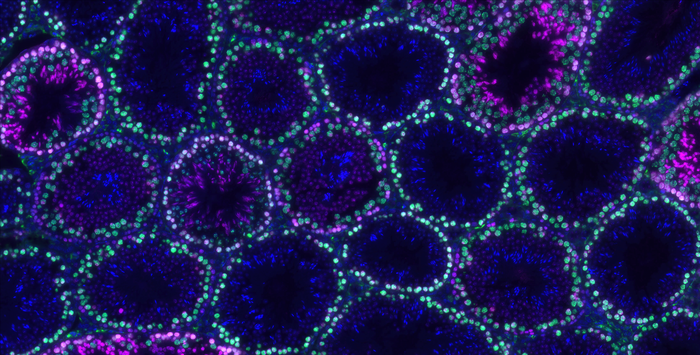
Testis tissue section

Credit: Courtesy of Devanshi Jain

Researchers at Rutgers University, Memorial Sloan Kettering Cancer Center, Rockefeller University, and Cornell University are teaming up to examine how the processes that regulate gene expression and chromosome behaviors can lead to health issues, including cancer, birth defects, miscarriage, and infertility.

Cells undergo a remarkable transformation process to form eggs and sperm, which upon fertilization can form an entire organism. A key step of this transformation involves meiosis, a cell division that halves the genome content of cells. During early stages of egg and sperm development, cells divide by mitosis, the process used by most cells in our body. They then undergo a complete remodeling of the gene expression landscape, and switch to meiosis. Mis-regulation of the mitosis-to-meiosis switch can lead to tumor-like growth, depletion of the reproductive cell pool or failure to complete meiosis.

In the new Rutgers-led study in the journal Genes & Development, the researchers applied powerful methods for mapping genome-wide protein-RNA interactions and innovative genetic mouse mutants to define how the RNA helicase, YTHDC2, binds RNA and controls gene expression to regulate meiosis. YTHDC2 and its interacting protein partners form an essential pathway that controls the mitosis-to-meiosis switch. Prior to this study, little was known about the mechanisms regulating this switch in mammals.

“Our work sheds light on the genetic and molecular mechanisms that are required for normal meiosis, which is an essential step towards understanding how and why these processes go wrong and lead to reproductive disorders,” said Devanshi Jain, a principal investigator of the study and an Assistant Professor of Genetics at the School of Arts and Sciences (SAS) at Rutgers University-New Brunswick. “Additionally, as YTHDC2 has been implicated in multiple diseases, especially cancers, our work will have broad implications on those fields as well.”

Jain said this new study, along with ongoing research at the Rutgers-housed Jain Lab, explores the genetic and molecular mechanisms of meiosis, and the processes that regulate gene expression and chromosome behaviors. Researchers at the Jain Lab use the mouse model system to explore these fundamental aspects of cell biology.

“Understanding meiosis is of paramount importance to reproductive health as errors in meiosis can lead to reproductive cell death and infertility,” said Jain. “Going forward, we plan to delve deeper into the molecular mechanisms of the YTHDC2 pathway and its control of gene expression. We also continue to study other fundamental aspects of how meiosis is regulated.”


Journal

Genes & Development

DOI

10.1101/gad.349190.121

Article Title

YTHDC2 control of gametogenesis requires helicase activity but not m6A binding

Article Publication Date

20-Jan-2022

Share12Tweet8Share2ShareShareShare2

Related Posts

Tropical Mountain Forest Canopies and Understories Reveal Contrasting Biodiversity Patterns Along Elevation

Tropical Mountain Forest Canopies and Understories Reveal Contrasting Biodiversity Patterns Along Elevation

August 21, 2026
Heart backup blood vessels grow from capillaries—not arteries

Heart backup blood vessels grow from capillaries—not arteries

August 21, 2026

Newly discovered jungle snake named after Guns N’ Roses guitarist Slash

August 21, 2026

Younger lung cancer patients more likely to harbor targetable mutations, study finds

August 20, 2026

POPULAR NEWS

  • Clonal Follicular CD4+ T Cells Adapt Across Lymph Nodes and Lung Tumors

    29 shares
    Share 12 Tweet 7
  • Tobacco Firms Overwhelmed Federal Comments, Delaying Proposed Menthol Cigarette Ban

    29 shares
    Share 12 Tweet 7
  • Durable hydrogen catalyst operates continuously for 3,000 hours

    29 shares
    Share 12 Tweet 7
  • Scientists warn free-to-play games hide high costs, urging stronger player protections

    29 shares
    Share 12 Tweet 7

About

We bring you the latest biotechnology news from best research centers and universities around the world. Check our website.

Follow us

Recent News

Clonal Follicular CD4+ T Cells Adapt Across Lymph Nodes and Lung Tumors

Tobacco Firms Overwhelmed Federal Comments, Delaying Proposed Menthol Cigarette Ban

Durable hydrogen catalyst operates continuously for 3,000 hours

Subscribe to Blog via Email

Enter your email address to subscribe to this blog and receive notifications of new posts by email.

Join 85 other subscribers
  • Contact Us

Bioengineer.org © Copyright 2023 All Rights Reserved.

Welcome Back!

Login to your account below

Forgotten Password?

Retrieve your password

Please enter your username or email address to reset your password.

Log In
No Result
View All Result
  • Homepages
    • Home Page 1
    • Home Page 2
  • News
  • National
  • Business
  • Health
  • Lifestyle
  • Science

Bioengineer.org © Copyright 2023 All Rights Reserved.