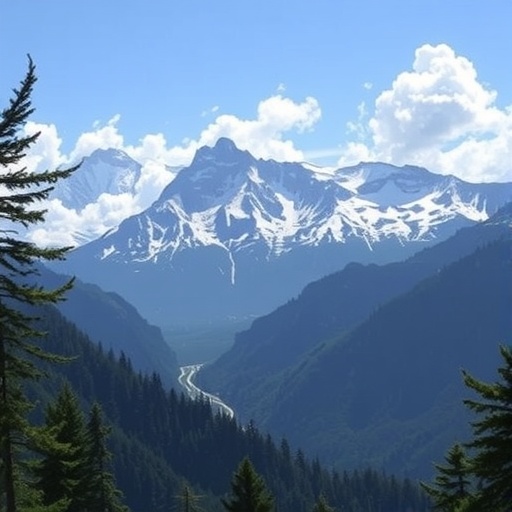
In a groundbreaking advancement challenging long-standing assumptions, researchers have revealed that hilly and mountainous terrains possess a significantly greater capacity for soil carbon storage than previously understood. This new insight emerges from a comprehensive study led by earth scientists at the University of Oregon, shedding light on the critical role of complex geomorphic landscapes in the global carbon cycle. Published on June 12, 2026, in the prestigious journal Science Advances, the findings pave the way for novel natural climate solutions targeting carbon sequestration in rugged environments.
Traditionally, mountainous regions were undervalued in climate models concerning their soil’s ability to act as carbon reservoirs. The prevailing narrative suggested that rapid erosion and thin, unstable soils in such areas limited organic carbon storage potential. However, the new research overturns this misconception by demonstrating that these landscapes are remarkable reservoirs of organic carbon held within deep soil deposits that form over millennia through processes of bedrock weathering and sediment accumulation following landslides.
Soil organic carbon (SOC) is pivotal in moderating atmospheric concentrations of carbon dioxide, a dominant greenhouse gas driving modern climate change. SOC emerges from the decomposition and integration of plant and microbial residues, mineral interactions, and soil structure developments. The capacity of soil to lock away carbon is strongly influenced by its physical attributes—depth, mineral composition, texture, and the complex chemical environment mediated by weathering. In mountainous terrains, these factors conspire to create deep, chemically reactive zones capable of sequestering large quantities of organic carbon.
Josh Roering, a principal investigator specializing in geomorphology at the University of Oregon, elaborated on the study’s implications. He explained that contrary to earlier views, mountainous areas undergo long-term stabilization processes that allow soil to persist and thicken significantly. “We observed that these regions are not just transient soil carriers,” Roering stated, “but stable and dynamic environments where soil organic matter accumulates in concentrations far exceeding those of adjacent flatter landscapes.”
The research team, spearheaded by Brooke Hunter during her doctoral studies, utilized a sophisticated methodology combining fieldwork, geochemical assays, and modeling to investigate nearly 10,000 ancient landslide deposits across the Oregon Coast Range. These landslides, ranging in age from a few thousand to nearly half a million years, represent natural laboratories where bedrock is fractured and transformed into soil with variable but often remarkable depths exceeding five meters (approximately 16 feet), contrasting sharply with previous assumptions of shallow 30-centimeter soil profiles.
Hunter emphasized the importance of accurately quantifying soil carbon stocks for global carbon budget assessments. “Soils hold more carbon than vegetation and even the atmosphere combined,” she noted. “Understanding the spatial distribution and depth of carbon storage is essential for refining climate models and guiding strategies that leverage natural systems to offset emissions.” The study’s approach incorporated detailed soil core sampling and carbon density measurements, revealing a strong correlation between soil thickness and carbon content, with deeper soils enriched in fine-grained particles conducive to carbon fixation.
At the heart of the study lies the intricate interaction between geomorphological processes and biogeochemical cycles. The researchers mapped and dated landslide deposits, demonstrating that deep soil weathering zones progressively accumulate organic carbon through continuous mineral transformations and organic matter inputs. This deep weathering fosters increased surface areas of clay minerals and other reactive substrates that chemically bind organic molecules, effectively stabilizing carbon on timescales relevant to climate mitigation.
This revelation challenges the adequacy of previous global carbon models which have underestimated carbon stocks in mountainous soils by approximately a factor of two. By integrating geomorphic data with carbon cycle models, the University of Oregon team has proposed a new framework that dynamically accounts for landscape evolution and soil development patterns crucial to carbon storage capacity. Such integrative modeling represents an essential step toward accurately predicting terrestrial carbon sinks under changing climatic and land-use conditions.
The study further highlights the necessity of improved remote sensing and ground-based geomorphic mapping to identify and protect high-carbon landscapes. Protecting these undervalued natural carbon reservoirs could be vital in natural climate solution initiatives, which now increasingly consider not only afforestation and soil amendments but also geomorphic stability and land management practices that preserve existing carbon stocks against erosion and disturbance.
Roering pointed out the tangible applications of these findings: “If land managers prioritize conservation efforts in mountainous terrains with high soil carbon content, especially those on stable landslide deposits, we can safeguard these reservoirs and enhance their role in climate regulation.” Additionally, the research supports emerging strategies such as mineral weathering enhancement, where targeted interventions accelerate natural soil chemical processes to sequester more carbon dioxide, leveraging the unique properties of weathered mountain soils.
The implications of this study extend beyond Oregon’s landscapes, inviting a reevaluation of soil carbon potential in other mountainous regions worldwide. By shifting the focus from conventional lowland agricultural soils to diverse and dynamic geomorphic settings, scientists and policymakers can integrate a broader spectrum of ecosystems into climate mitigation frameworks, leveraging deep-time processes for near-term solutions.
Finally, this research underscores a broader scientific paradigm in carbon cycle science—recognizing the intersection of earth surface processes with ecological functions as fundamental to understanding and addressing climate change. It invites a multidisciplinary approach combining geomorphology, soil science, ecology, and climate modeling to develop holistic strategies that conserve and enhance natural carbon sinks embedded within the planet’s varied terrains.
Subject of Research: Soil organic carbon storage in mountainous landslide deposits and their implications for carbon cycle modeling and natural climate solutions.
Article Title: Widespread ancient bedrock landslide deposits facilitate deep weathering for storage and access of organic carbon
News Publication Date: 12-Jun-2026
Web References: Not provided
References: Not provided
Image Credits: Not provided
Keywords
Soil carbon, Organic carbon sequestration, Geomorphology, Landslides, Bedrock weathering, Carbon cycle, Climate change mitigation, Soil chemistry, Natural climate solutions, Oregon Coast Range, Soil depth, Carbon modeling
Tags: bedrock weathering and carbon accumulationcarbon sequestration in hilly terrainsdeep soil organic carbon reservoirsgeomorphic landscapes and carbon cyclelandslide sediment carbon storagemountainous soil carbon storagenatural climate solutions for carbon captureoverturning soil carbon misconceptionsrole of mountainous regions in climate modelssoil carbon and greenhouse gas mitigationsoil organic carbon in rugged environmentsUniversity of Oregon carbon research