• HOME
  • NEWS
  • EXPLORE
    • CAREER
      • Companies
      • Jobs
    • EVENTS
    • iGEM
      • News
      • Team
    • PHOTOS
    • VIDEO
    • WIKI
  • BLOG
  • COMMUNITY
    • FACEBOOK
    • INSTAGRAM
    • TWITTER
Thursday, June 25, 2026
BIOENGINEER.ORG
No Result
View All Result
  • Login
  • HOME
  • NEWS
  • EXPLORE
    • CAREER
      • Companies
      • Jobs
        • Lecturer
        • PhD Studentship
        • Postdoc
        • Research Assistant
    • EVENTS
    • iGEM
      • News
      • Team
    • PHOTOS
    • VIDEO
    • WIKI
  • BLOG
  • COMMUNITY
    • FACEBOOK
    • INSTAGRAM
    • TWITTER
  • HOME
  • NEWS
  • EXPLORE
    • CAREER
      • Companies
      • Jobs
        • Lecturer
        • PhD Studentship
        • Postdoc
        • Research Assistant
    • EVENTS
    • iGEM
      • News
      • Team
    • PHOTOS
    • VIDEO
    • WIKI
  • BLOG
  • COMMUNITY
    • FACEBOOK
    • INSTAGRAM
    • TWITTER
No Result
View All Result
Bioengineer.org
No Result
View All Result
Home NEWS Science News

New research project on sustainable electronics promises to reduce e-waste problem

Bioengineer by Bioengineer
January 25, 2021
in Science News
Reading Time: 2 mins read
0
IMAGE
Share on FacebookShare on TwitterShare on LinkedinShare on RedditShare on Telegram

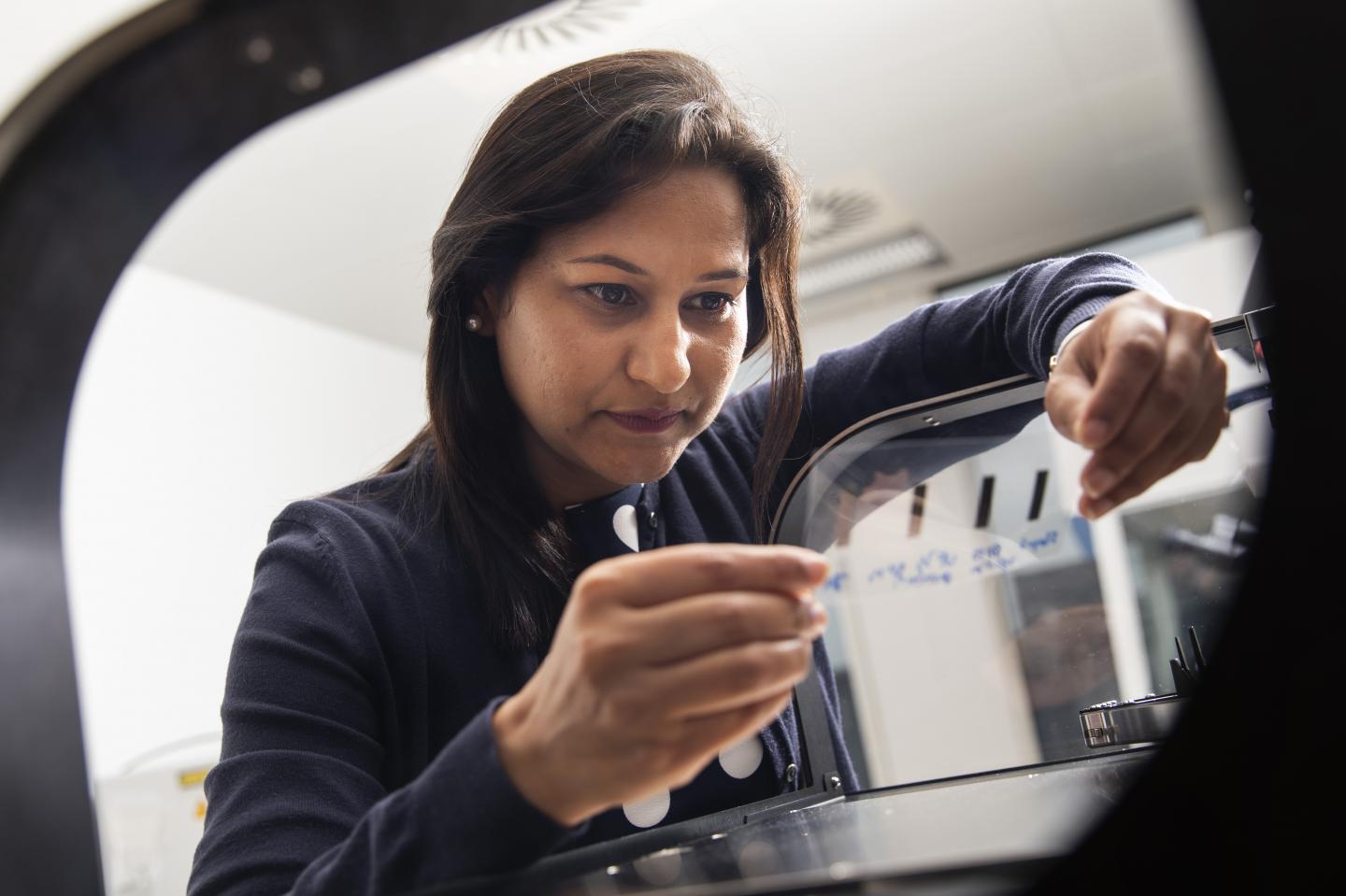
Assistant Professor Shweta Agarwala from the Department of Electrical and Computer Engineering at Aarhus University will use materials science and printed electronics to deal with the ever-increasing problem of electronic waste
IMAGE

Credit: Lars Kruse, AU Photo

The accumulation of electronic waste (e-waste) on the Earth is not just a growing problem but an environmental threat. E-Waste is now considered the fastest-growing waste stream in the world and has been called a veritable tsunami by the UN.

In 2019, a record 53.6 million tonnes of e-waste was generated worldwide, up 9.2 Mt in five years. Just 17.4 pct. of this was officially documented as formally collected and recycled. Assistant Professor Shweta Agarwala, an expert in printed electronics, wants to deal with this problem.

She has just received DKK 6 million (EUR 810.000) from the Villum Foundation to start a research project aimed at creating novel electronically functional materials that are completely biologically degradable.

“We are rapidly developing solutions for sustainable societies with renewable energies, smart manufacturing, green aviation etc. But if the supporting electronics is not degradable, then the future isn’t sustainable. Coupled with ever-decreasing shell life of electronic devices we have a problem. Moreover, most electronics aren’t just non-degradable, they also release toxins harmful to the environment,” she says.

Shweta Agarwala’s research lies at the interface of nanotechnology, electronics engineering and additive manufacturing. Via the technology of printed electronics (PE), she is using functional inks to print electronic circuits on various flexible substrates, such as textiles, paper, biomaterials or plastic.

“In this new project, I will manipulate the architecture of a polymer to create a novel, tunable, insulating and conducting material that is biodegradable. Although there has been some work done on biodegradable substrates, synthesis of biodegradable conductors and semiconductors is almost a virgin area. This is where I want to push the scientific boundaries to design a new material class with unique properties and dedicated functionalities,” she says and continues:

“I think it’s high time we start making solutions for replacing the classic materials such as silicon and germanium in electrical components with new biodegradable materials. This prestigious grant will give me the necessary tools to build the solution.”

Even though Assistant Professor Shweta Agarwala doesn’t expect the project to breed industry-ready technology, she does have a vision to take it far and beyond. The project will not only develop a new material class, but also translate its findings to fill the gap between science and engineering:

“In my opinion, it’s important to design and create solutions that allow for discovered materials to be made into devices and integrated into products for a coherent flow between discovery to product. 3D printing is of paramount importance here, since it enables such solutions to be easily integrated into industries at a later stage.”

###

The project goes under the name “Printed bio-inspired hydrogel substrate with adhesive and electrical conductivity for sustainable electronics”, and starts on 1 April 2021.

Media Contact
Shweta Agarwala
[email protected]
Tags: Biomedical/Environmental/Chemical EngineeringChemistry/Physics/Materials SciencesElectrical Engineering/ElectronicsGrants/FundingMaterialsNaturePolymer ChemistrySuperconductors/SemiconductorsTechnology/Engineering/Computer Science
Share12Tweet8Share2ShareShareShare2

Related Posts

Natural Hallucinogens: Evolution’s Ecological Tools, Not Mere Chemical Byproducts

June 25, 2026

Neural Design Enables Zero-Shot Drug-Binding Proteins

June 25, 2026

Genomic Insights into Human Skin Fungi Diversity

June 25, 2026

Energy-Saving Membrane Technology Developed by KAIST and Georgia Tech Enables Crude Oil Separation Without Boiling

June 25, 2026
Please login to join discussion

POPULAR NEWS

  • Saying Goodbye to PGY-6: Pediatric Fellowship Realities

    103 shares
    Share 41 Tweet 26
  • Multi-Hospital Study Reveals Long Covid Burden Is Twice as High as Current Estimates

    92 shares
    Share 36 Tweet 23
  • Detection of EDCs in Breast Milk and Infant Urine Up to Six Months Highlights Early Exposure Risks

    77 shares
    Share 31 Tweet 19
  • New Drug Candidate Developed at McMaster Shows Potential for Treating Brain Cancer

    58 shares
    Share 23 Tweet 15

About

We bring you the latest biotechnology news from best research centers and universities around the world. Check our website.

Follow us

Recent News

Natural Hallucinogens: Evolution’s Ecological Tools, Not Mere Chemical Byproducts

Neural Design Enables Zero-Shot Drug-Binding Proteins

Genomic Insights into Human Skin Fungi Diversity

Subscribe to Blog via Email

Enter your email address to subscribe to this blog and receive notifications of new posts by email.

Join 82 other subscribers
  • Contact Us

Bioengineer.org © Copyright 2023 All Rights Reserved.

Welcome Back!

Login to your account below

Forgotten Password?

Retrieve your password

Please enter your username or email address to reset your password.

Log In
No Result
View All Result
  • Homepages
    • Home Page 1
    • Home Page 2
  • News
  • National
  • Business
  • Health
  • Lifestyle
  • Science

Bioengineer.org © Copyright 2023 All Rights Reserved.