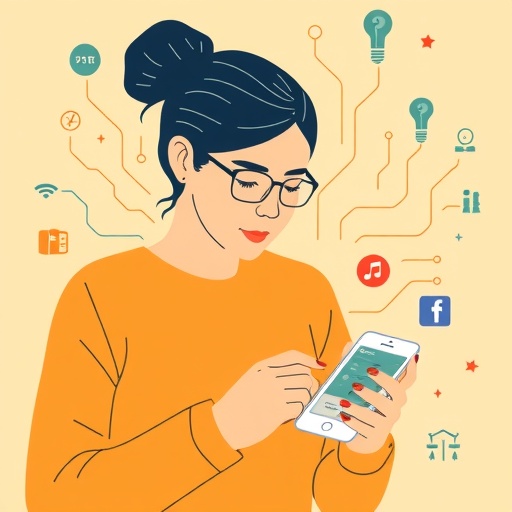

In an era where technology is intertwined with nearly every aspect of human life, the potential for smartphones to offer insights into mental health has become an area of increasing interest for researchers and clinicians alike. Recent findings suggest that data collected passively from mobile devices could identify a range of behaviors linked to various mental health disorders, from anxiety and depression to more intricate conditions like narcissistic personality disorder. This emerging research could revolutionize the way mental health assessments are conducted by providing clinicians with a wealth of real-world data that offers a comprehensive view of a patient’s behavior outside of clinical settings.
The study spearheaded by a team from the University of Minnesota, with contributions from Pitt’s Department of Psychology, aims to broaden the clinical understanding of mental health by utilizing smartphone sensor data. Led by Whitney Ringwald and supported by prominent figures such as Colin E. Vize and Aiden Wright, the research explores the implications of analyzing smartphone behaviors as a way to detect, assess, and ultimately treat mental health disorders. It presents an opportunity to fill gaps in traditional assessment methods that often rely heavily on self-reported data, which can be notoriously unreliable due to memory lapses or reluctance to disclose certain behaviors.
The potential application of this technology is vast. Imagine a scenario where a dedicated app allows for the unobtrusive collection of various behavioral data points from a patient’s daily life. Such an application could track GPS locations, physical activity levels, sleep patterns, and even communication behaviors, creating a nuanced profile of behavioral habits that relate to mental health symptoms. This could significantly enhance clinicians’ abilities to assess patients’ conditions, as it would provide a much richer dataset than typical clinical visits where patients may struggle to remember details or may feel pressured to present themselves in a certain light.
.adsslot_WA8Yi9w3Ll{width:728px !important;height:90px !important;}
@media(max-width:1199px){ .adsslot_WA8Yi9w3Ll{width:468px !important;height:60px !important;}
}
@media(max-width:767px){ .adsslot_WA8Yi9w3Ll{width:320px !important;height:50px !important;}
}
ADVERTISEMENT
However, the challenges that lie ahead are critical to address. The technology is not currently a substitute for human clinicians, but rather a complementary tool that could enhance existing therapeutic practices. Vize highlights the importance of approaching this data responsibly. He notes that while statistical methods can yield connections between sensor data and symptomatology, the individual nuances of a person’s mental health need to be preserved and respected. A broad dataset may not accurately represent individual experiences, thus necessitating caution in interpretation and application.
Methodologically, the researchers employed advanced statistical analysis tools like Mplus to derive correlations between passive sensor data and various mental health symptoms, focusing on dimensions that are applicable across multiple disorders. These dimensions encompass broader symptom categories, including internalizing issues, detachment, disinhibition, and antagonism, among others. This transdiagnostic approach recognizes that mental health disorders often share symptoms, and thus insight derived from one area can inform understanding in another.
Particularly insightful was the relationship discovered between sensor data and the so-called p-factor, a construct that signifies a commonality across various mental health conditions. The p-factor serves as an abstract indicator for shared features of mental disorders, which can overlap in significant ways. Understanding this shared ground is vital for tailoring treatment to individuals, potentially leading to more effective interventions for those whose experiences do not conform neatly to established diagnostic criteria.
In their study, the researchers analyzed data from the Intensive Longitudinal Investigation of Alternative Diagnostic Dimensions (ILIADD), focusing on a cohort of participants who shared extensive data from their smartphones. Key metrics included the duration spent at home versus out and about, instances of physical activity, screen time, communication frequency, and even sleep quality. The findings indicated strong correlations between these behaviors and the mental health symptoms reported by participants, paving the way for more integrated approaches to understanding psychological wellbeing.
As exciting as these developments are, Vize emphasizes that the data derived from smartphones will merely suggest trends and averages rather than definitive conclusions about individual mental health statuses. Mental health encompasses a broad spectrum of experiences and variations that can’t be wholly captured by technology alone. Rather than positioning this data as a definitive assessment tool, it should be viewed as an auxiliary resource that can help pick up on patterns that clinicians can explore in further detail during consultations.
There exists a natural apprehension surrounding the implications of employing technology in mental health treatment. The reliance on sensors and algorithms stirs concerns about privacy, data security, and the potential for misinterpretation. Addressing these concerns necessitates a clear ethical framework surrounding the acquisition, storage, and utilization of sensitive personal data. Researchers and practitioners must be diligent in ensuring transparency and consent in how user data is managed and analyzed.
Looking to the future, the prospective enhancement of mental health treatment through the integration of smartphone data represents a blend of clinical psychology and cutting-edge technology. The potential for this innovation to make strides in personalized therapy approaches could lead to not just improved outcomes for patients, but also a paradigm shift in how mental health is conceptualized and treated.
In conclusion, while the intersection of technology and mental health treatment presents formidable challenges and questions, it also holds remarkable promise. The pioneering research conducted by Vize, Ringwald, and their colleagues signifies a step toward a future where mental health assessments are more comprehensive, informed by the rich tapestry of data that our daily lives generate. As this field evolves, it may very well redefine the clinician’s role and reshape the very landscape of mental health care.
Subject of Research: The use of passive smartphone sensor data to detect and analyze mental health disorders and symptoms.
Article Title: Passive Smartphone Sensors for Detecting Psychopathology
News Publication Date: 3-Jul-2025
Web References: JAMA Network Open
References: N/A
Image Credits: N/A
Keywords
Tags: anxiety and depression detectionbehavioral analysis using smartphonesclinical psychology advancementsdiagnosing mental health disordersinnovative mental health treatmentsnarcissistic personality disorder assessmentpassive data collection in psychologyreal-world data in psychologysmartphone data for mental healthsmartphone sensor data applicationstechnology in mental health assessmentUniversity of Minnesota research