


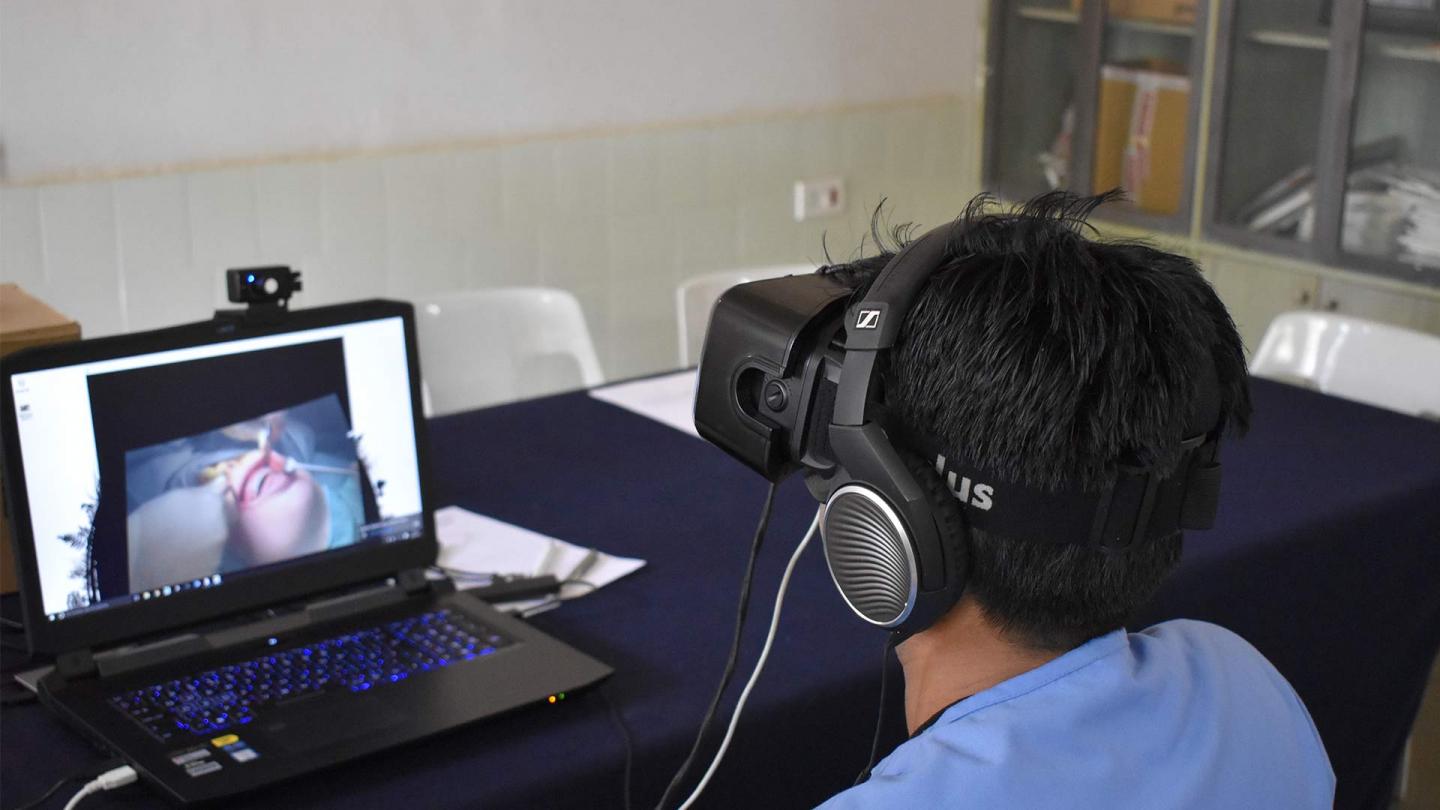
Credit: University of Huddersfield
A new report that could help improve how immersive technologies such as Virtual Reality (VR) and Augmented Reality (AR) are used in healthcare education and training has been published with significant input from the University of Huddersfield.
Professor David Peebles, Director of the University’s Centre for Cognition and Neuroscience, and Huddersfield PhD graduate Matthew Pears contributed to the report – ‘Immersive technologies in healthcare training and education: Three principles for progress’ – recently published by the University of Leeds with input from range of academics, technologists and health professionals.
The principles have also been expanded upon in a letter to the prestigious journal BMJ Simulation and Technology Enhanced Learning.
The Huddersfield contribution to the report stems from research conducted over several years, which involved another former Huddersfield PhD researcher, Yeshwanth Pulijala, and Professor Eunice Ma, now with Falmouth University.
“Yeshwanth had an interest in technology and education, and in using VR for dentistry training. Matthew was looking at soft skills and situation awareness, which could be applied to investigating how dentists were able to keep a track of what was going on around them. They were similar subjects, although with different emphases, and so it seemed a natural area for collaboration.”
With only a relatively small number of dental schools in the UK, the quartet visited seven dental schools in India in early 2017, with support from travel grants from Santander Bank, to test their VR-based training materials on students. The experience gained from that visit contributed to both researchers’ PhDs, and ultimately led to the involvement of Professor Peebles and Matthew Pears in the new report.
The report argues for greater standardisation of how to use immersive technologies in healthcare training and education. As Professor Peebles explains, “It’s about developing a set of principles and guidelines for the use of immersive technology in medical treatment. Immersive technology is becoming increasingly popular and, as the technology is advancing, it’s becoming clear that there is great potential to make training more accessible and effective.
“It is important, however, that research is driven by the needs of the user and existing evidence rather than the technology. Rather than thinking ‘we have a new bit of VR or AR kit, what can we do with it?’, we should be looking at the problem that needs solving – what are the learning needs, so how do we use technology to solve it?
“Developing immersive training materials can be very time-consuming and difficult to evaluate properly. Getting surgeons and medical students to take time out to test your VR training is challenging. In our case we were lucky to have a surgeon, Professor Ashraf Ayoub, a Professor of Oral and Maxillofacial Surgery at the University of Glasgow, who granted us permission to film a surgical procedure that was then transformed into a 3D environment to train students about situation awareness while in the operating theatre.”
Professor Peebles hopes the work so far will provide a basis for more investigations that could help get the most from the potential that VR and immersive technology have to offer.
“Conducting these kinds of studies is difficult to do well, in particular getting sufficient quantitative data that allows you to rigorously evaluate them. “As the report recommends, more collaboration is required to pool technological and intellectual resources, to try to develop a set of standards and a community that works together to boost and improve research in this area.”
###
Media Contact
Tim Oscroft
[email protected]
Original Source
https:/
Related Journal Article
http://dx.



