• HOME
  • NEWS
  • EXPLORE
    • CAREER
      • Companies
      • Jobs
    • EVENTS
    • iGEM
      • News
      • Team
    • PHOTOS
    • VIDEO
    • WIKI
  • BLOG
  • COMMUNITY
    • FACEBOOK
    • INSTAGRAM
    • TWITTER
Wednesday, April 1, 2026
BIOENGINEER.ORG
No Result
View All Result
  • Login
  • HOME
  • NEWS
  • EXPLORE
    • CAREER
      • Companies
      • Jobs
        • Lecturer
        • PhD Studentship
        • Postdoc
        • Research Assistant
    • EVENTS
    • iGEM
      • News
      • Team
    • PHOTOS
    • VIDEO
    • WIKI
  • BLOG
  • COMMUNITY
    • FACEBOOK
    • INSTAGRAM
    • TWITTER
  • HOME
  • NEWS
  • EXPLORE
    • CAREER
      • Companies
      • Jobs
        • Lecturer
        • PhD Studentship
        • Postdoc
        • Research Assistant
    • EVENTS
    • iGEM
      • News
      • Team
    • PHOTOS
    • VIDEO
    • WIKI
  • BLOG
  • COMMUNITY
    • FACEBOOK
    • INSTAGRAM
    • TWITTER
No Result
View All Result
Bioengineer.org
No Result
View All Result
Home NEWS Science News Biology

New regulator of liver metabolism discovered

Bioengineer by Bioengineer
September 29, 2017
in Biology
Reading Time: 2 mins read
0
Share on FacebookShare on TwitterShare on LinkedinShare on RedditShare on Telegram
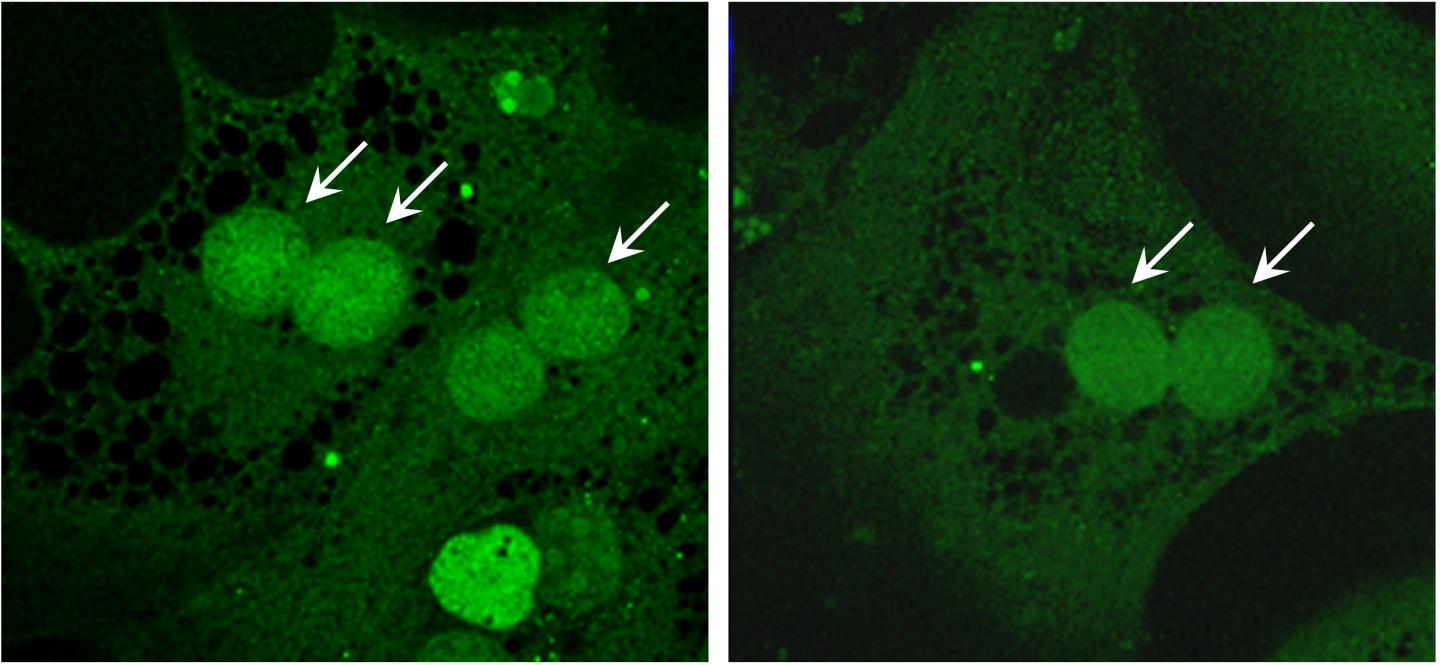
IMAGE

Credit: M.Schupp

All cells can adapt their metabolic activity with respect to the availability of various sources of energy, such as glucose. This vital ability makes cells more efficient at absorbing and utilizing these substances, in addition to protecting them against the negative effects of overload. However, exposure to chronically-high glucose levels can result in an adaptive response which is damaging to cells and promoting diseases.

Led by Prof. Dr. Michael Schupp, head of the Molecular Pharmacology and Metabolism Working Group at Charité's Institute of Pharmacology, the researchers showed that the enzyme retinol saturase plays a role in the adaptive processes found in liver cells. By studying levels of the enzyme in both slim and obese participants, the researchers found that levels increase in line with body weight. They also analyzed the cells' metabolic pathways and their metabolic adaptation to glucose levels after reducing the enzyme's abundance. The negative metabolic effects associated with excess exposure to glucose were significantly less pronounced in cells that had been modified in this way.

Discussing the results of the study, Prof. Schupp concludes: "The inactivation of retinol saturase activity may offer a new approach to the treatment of metabolic liver disease and its associated problems, such as fatty liver disease and dyslipidemia." As a next step, the researchers are planning to identify the mechanisms involved, and to test whether other cell types also need the enzyme to adapt to changing glucose levels.

###

Media Contact

Michael Schupp
[email protected]
49-304-505-78724

http://www.charite.de

Related Journal Article

http://dx.doi.org/10.1038/s41467-017-00430-w

Share14Tweet8Share2ShareShareShare2

Related Posts

New Study Reveals Respiratory Evolution as Key Driver of Body Size Variation in Early Terrestrial Vertebrates

New Study Reveals Respiratory Evolution as Key Driver of Body Size Variation in Early Terrestrial Vertebrates

April 1, 2026
Survey Reveals Many Dog Owners Overlook Subtle Pain Signs Like Nighttime Restlessness and Clinginess

Survey Reveals Many Dog Owners Overlook Subtle Pain Signs Like Nighttime Restlessness and Clinginess

April 1, 2026

Ancient 500-Million-Year-Old Clawed Predator Redefines the Evolution of Spiders and Horseshoe Crabs

April 1, 2026

Chikungunya Virus Lingers in Joint Macrophages, Causes Chronic Disease

April 1, 2026
Please login to join discussion

POPULAR NEWS

  • blank

    Revolutionary AI Model Enhances Precision in Detecting Food Contamination

    96 shares
    Share 38 Tweet 24
  • Imagine a Social Media Feed That Challenges Your Views Instead of Reinforcing Them

    1006 shares
    Share 398 Tweet 249
  • Promising Outcomes from First Clinical Trials of Gene Regulation in Epilepsy

    51 shares
    Share 20 Tweet 13
  • Popular Anti-Aging Compound Linked to Damage in Corpus Callosum, Study Finds

    43 shares
    Share 17 Tweet 11

About

We bring you the latest biotechnology news from best research centers and universities around the world. Check our website.

Follow us

Recent News

Protein Language Model Accuracy Test Sheds Light on AI’s ‘Black Box’

Lehigh University College of Health Launches HEAL Service Center: A Cutting-Edge Shared High-Resolution Mass Spectrometry Facility

Scientists Unveil Innovative Method to Identify Breakthroughs in Science

Subscribe to Blog via Email

Enter your email address to subscribe to this blog and receive notifications of new posts by email.

Join 78 other subscribers
  • Contact Us

Bioengineer.org © Copyright 2023 All Rights Reserved.

Welcome Back!

Login to your account below

Forgotten Password?

Retrieve your password

Please enter your username or email address to reset your password.

Log In
No Result
View All Result
  • Homepages
    • Home Page 1
    • Home Page 2
  • News
  • National
  • Business
  • Health
  • Lifestyle
  • Science

Bioengineer.org © Copyright 2023 All Rights Reserved.