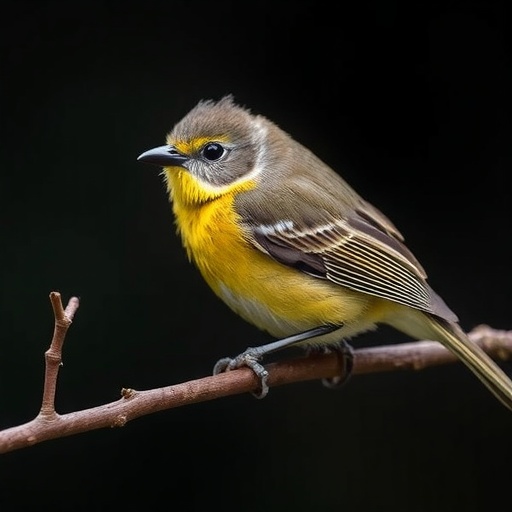
In a groundbreaking revelation from the verdant archipelagos of Japan, ornithologists have unveiled a previously unrecognized avian species, hidden in plain sight among its close relatives. This discovery exemplifies the profound impact of advanced genetic methodologies in unmasking biodiversity that traditional taxonomic approaches could not discern. The newly identified Tokara Leaf Warbler (Phylloscopus tokaraensis) was long obscured under the guise of the Ijima’s Leaf Warbler (Phylloscopus ijimae), revealing a complex narrative of cryptic speciation within these forest-dwelling songbirds.
The differentiation between these two species, despite their morphological similarities, was principally established through comprehensive genomic analyses. Researchers employed whole-genome sequencing, transcending the limitations of earlier single-gene studies. This robust approach elucidated genetic divergences significant enough to delineate species boundaries. These findings underscore the critical role of molecular biology in contemporary taxonomy, particularly for cryptic species that evade detection through phenotype alone.
The geographic distribution of these warblers is notably fragmented, confined to two distinct island chains south of Tokyo. The Ijira’s Leaf Warbler inhabits the Izu Islands, while the newly described Tokara Leaf Warbler is endemic to the Tokara Islands, located approximately 1,000 kilometers southwest. Despite their isolation, until recently, these populations were grouped taxonomically as a single species, a classification now refuted by multidisciplinary evidence integrating genomics and bioacoustics.
Bioacoustic analysis affirmed the genetic evidence by revealing distinct song patterns between populations. Avian vocalization differences, critical in mate recognition, support the argument for reproductive isolation, thereby reinforcing the species status of the Tokara Leaf Warbler. These subtle yet definitive variations in song structure illustrate the importance of ethological data in species delimitation, especially in taxa with overlapping morphological traits.
The discovery is emblematic of a broader paradigm shift in biodiversity assessment and conservation prioritization. Traditional morphological assessments have often underestimated species richness, potentially overlooking cryptic taxa facing unrecognized threats. By integrating genetic probing with behavioral observations, scientists can now more accurately identify units of biodiversity, leading to more informed conservation strategies amidst a global biodiversity crisis.
Both leaf warbler species inhabit restricted insular environments, with the Tokara Islands collectively encompassing roughly 100 square kilometers across twelve islands. This spatial confinement results in small, isolated populations susceptible to stochastic environmental perturbations, habitat degradation, and anthropogenic pressures. Genetic analyses reveal low genetic variability within both species, suggesting historical bottlenecks or founder effects, which may imperil their long-term viability.
Conservation implications of this recognition are profound. The Ijima’s Leaf Warbler is already designated Vulnerable by the International Union for Conservation of Nature (IUCN) and protected under Japan’s designation as a Natural Monument. Given their comparable rarity and vulnerability, the Tokara Leaf Warbler warrants similar conservation status and protective measures. Continuous monitoring is essential for both species to detect population trends and mitigate potential threats.
The collaborative effort behind this discovery highlights the synergy between international institutions including Uppsala University and the University of Gothenburg in Sweden, alongside prominent Japanese research organizations. This multidisciplinary consortium utilized a combination of fieldwork, museum specimen analysis, and cutting-edge molecular techniques to reach their conclusions, showcasing the power of global scientific cooperation.
This taxonomic breakthrough also revives attention toward Japan’s unique insular fauna, which has historically been underexplored yet hosts remarkable evolutionary novelties. The last bird species described in the country, the Okinawa Rail, was documented back in 1982. The revelation of the Tokara Leaf Warbler marks a significant addition to Japan’s avifauna and contributes to the global understanding of speciation processes in island systems.
Such studies set a precedent for the reevaluation of ostensibly well-known species complexes worldwide, where cryptic diversity may still remain concealed. They call for increased utilization of genome-wide data complemented by ecological and ethological evidence to refine species concepts. This integrative approach holds promise to enhance biodiversity inventories and improve conservation outcomes in the Anthropocene.
Ultimately, the discovery of the Tokara Leaf Warbler emphasizes the urgency of embracing modern scientific methodologies to confront the challenges posed by global environmental change. By recognizing and preserving cryptic biodiversity, we protect not only the ecological tapestry of our planet but also the evolutionary legacy embodied by these elusive island songbirds.
Subject of Research: Animals
Article Title: Discovering and protecting cryptic biodiversity: a case study of a previously undescribed, vulnerable bird species in Japan
News Publication Date: 17-Mar-2026
Web References: https://doi.org/10.1093/pnasnexus/pgag037
Image Credits: Per Alström, Uppsala University
Keywords: Cryptic species, biodiversity, genomics, taxonomy, conservation, island biogeography, leaf warbler, Phylloscopus tokaraensis, island endemism, songbird differentiation, bioacoustics, genetic diversity
Tags: advanced genetic methods in taxonomybiodiversity hidden by morphologycryptic speciation in birdsgenetic divergence in leaf warblersisland endemic bird species JapanIzu Islands bird populationmolecular taxonomy of songbirdsPhylloscopus tokaraensis identificationrare bird species discovery JapanTokara Islands endemic faunaTokara Leaf Warbler geneticswhole-genome sequencing in ornithology