


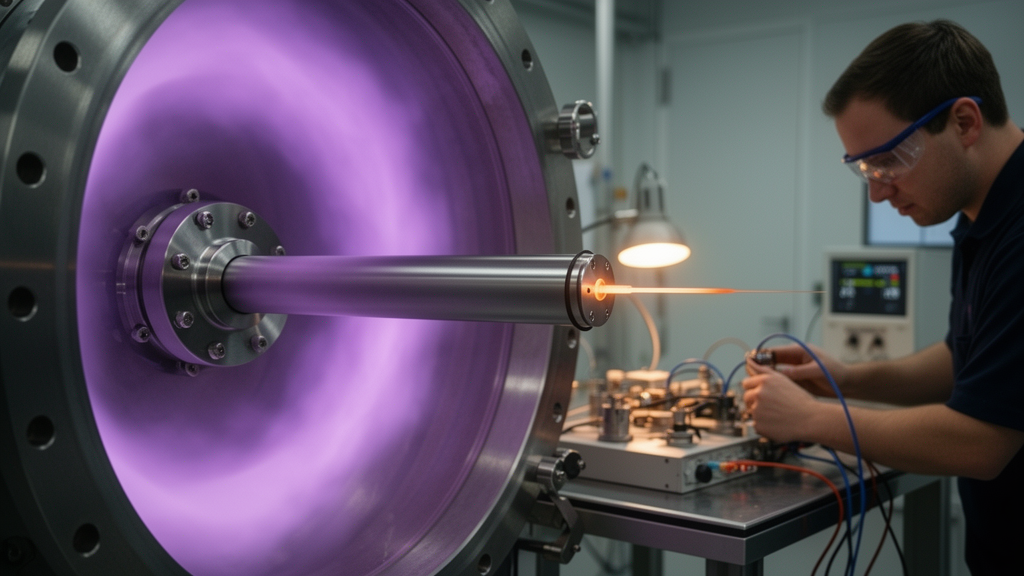
Physicists Felix Schlichting and Holger Kersten have built a single instrument that does the work of two: a retarding field energy analyzer and a passive thermal probe fused into one device they call the retarding field thermal probe. Their study, published in EPJ Techniques and Instrumentation, shows that the combined probe can measure the energy distribution of ions arriving at a surface and, at the same time, the total energy flux density deposited there, including contributions from fast neutral particles that ordinary electrical diagnostics miss entirely. The probe was tested in three very different plasma environments: an electron cyclotron resonance ion beam, a high-power impulse magnetron sputtering system, and a radio frequency capacitively coupled discharge.
The motivation comes from the sheer diversity of modern plasma applications. Thin film deposition, plasma etching and surface modification all depend sensitively on the fluxes of charged and neutral species and on the energies those species carry to a substrate. Usually, researchers deploy separate diagnostics side by side, each invasive in its own way and each with its own placement constraints. A retarding field energy analyzer determines the ion energy distribution by measuring the collector current as a function of a voltage ramp applied to a scan grid. A passive thermal probe instead measures the temperature change of a small dummy substrate, yielding a time- and energy-integrated value of the incoming energy flux density. Combining them, the authors argue, yields information neither instrument can deliver alone.
The design is elegantly simple in concept. In a conventional analyzer, a stack of three to four grids filters the incoming charged particle flux: a screen grid biased negatively keeps electrons out, a scan grid with a voltage ramp passes ions in proportion to the applied voltage, and a secondary electron repeller grid prevents ions from ejecting spurious electrons from the collector plate. In the new device, the collector plate is simply replaced by the passive thermal probe itself, an 11 millimeter copper plate with a Type K thermocouple spot-welded to its back. The probe thus simultaneously serves as the current-measuring collector of the analyzer and as the calorimetric sensor of the thermal probe.
The thermal measurement principle relies on two phases. While the plasma is on, the change in enthalpy of the probe is dominated by the incoming power from charged and neutral particles, surface processes, secondary electron emission and heat radiation. When the plasma is switched off, the probe cools, and the enthalpy change is governed solely by the outgoing power. By fitting linear slopes around the kinks between heating and cooling phases and combining the two energy balance equations, the researchers extract the incoming energy flux density from the difference of the temperature derivatives, scaled by the probe’s heat capacity and surface area.
One practical challenge was timing. A single analyzer scan takes only seconds, whereas a thermal measurement can take minutes, since with ion currents of only a few milliamperes it can take around 30 seconds to heat the probe by a few degrees. A second challenge was thermal stability: the stainless steel housing that shields the grid wiring from the plasma can itself heat up during long exposures and radiate heat onto the probe, distorting the measurement. The team solved this with a 3D-printed, water-cooled housing. Comparative tests in an argon radio frequency discharge showed that without cooling the probe temperature rose almost linearly even after the plasma and gas were switched off, whereas with cooling the temperature change during plasma operation was minimal and the probe cooled afterwards.
In the vertical ion beam experiment, with argon at a pressure of 2.6 times ten to the minus two pascals and an anode voltage of 300 volts, the peak of the measured ion energy distribution appeared at approximately 360 volts, reflecting sheath and plasma potential contributions in the source and chamber. The maximum measured ion current was roughly 30 microamperes. The energy flux density dropped at the same scan grid voltage as the ion current, reaching about 1.45 plus or minus 0.09 milliwatts per square centimeter, with a residual flux of 0.38 plus or minus 0.06 milliwatts per square centimeter remaining above 375 volts, when ions were repelled. The authors attribute this residual flux to fast neutrals created by charge exchange collisions between beam ions and background gas atoms.
That attribution was tested quantitatively. Using the known energy-dependent charge exchange cross sections, the mean free path for charge exchange at 360 electronvolts was calculated as 0.49 meters, predicting that ions should contribute 66 percent of the flux at the probe position 0.2 meters from the source. The measured value, derived from the difference between maximum and residual fluxes, was 74 plus or minus 4 percent, in good accordance with theory. The ion contribution to the energy flux density was thus 1.07 plus or minus 0.07 milliwatts per square centimeter. In a larger horizontal beam setup, where the probe sat 0.9 meters from the source and anode voltages up to 750 volts were applied, the predicted ion share fell to 32 percent and the measured share was 28 plus or minus 4 percent, again matching the model.
The magnetron and radio frequency results told a different story. In the high-power impulse magnetron sputtering system with a carbon target operated at 800 watts in argon at 0.36 pascals, the maximum energy flux density was 1.06 plus or minus 0.09 milliwatts per square centimeter, and only 0.18 plus or minus 0.03 milliwatts per square centimeter remained when all charged species were repelled, giving an ion-to-neutral ratio of 0.83 plus or minus 0.03. The charge exchange model predicted only 69 percent ion contribution, and the authors attribute the discrepancy to elastic collisions and to carbon ions and clusters from the target. In the radio frequency discharge at 13.56 megahertz and 100 watts, the flux dropped from 6.97 plus or minus 0.06 to 5.75 plus or minus 0.06 milliwatts per square centimeter when ions were blocked, meaning fast neutrals dominated the energy balance at the grounded electrode, with ions contributing only 18 percent.
The authors are candid about limitations. Exact calibration of the ion energy distribution remains future work, since precise knowledge of grid transparency and collector distance effects is still lacking, and the distributions are presently reported in arbitrary units. In the horizontal beam, breakdowns inside the chamber produced small spurious peaks in the collector current and a pronounced, unexplained high-energy feature in the distribution, indicating limits of the grid hole diameter and spacing. For environments where elastic and other collisions dominate, the individual contributions to the energy balance cannot be quantified with this probe alone and require simulation support, for example binary collision Monte Carlo methods, with the probe serving as a useful experimental link between such simulations and ex-situ examined deposited films.
Even so, the instrument opens concrete avenues. Because the collector material can be swapped, future versions could study secondary electron emission from different materials, and with suitable electronics the probe could be embedded in the driven electrode of a radio frequency plasma to investigate how the characteristic two-peaked ion energy distribution affects the energy flux density. Time-resolved measurements of single high-power impulse magnetron pulses would also become possible with faster electronics. For now, the retarding field thermal probe stands as a demonstration that two established, decades-old diagnostics can be merged into one compact device that separates the energy carried by ions from that carried by neutrals, a distinction central to understanding and tailoring plasma-surface processes.
Subject of Research: A combined retarding field thermal probe for measuring ion energy distributions and energy flux densities in process plasmas
Article Title: A retarding field thermal probe for combined plasma diagnostics
Article References: Schlichting, F., & Kersten, H. (2023). A retarding field thermal probe for combined plasma diagnostics. EPJ Techniques and Instrumentation, 10(1), Article 19. https://doi.org/10.1140/epjti/s40485-023-00106-4
Image Credits: AI Generated
DOI: 10.1140/epjti/s40485-023-00106-4
Keywords: plasma diagnostics, retarding field energy analyzer, passive thermal probe, ion energy distribution, energy flux density, charge exchange collisions, fast neutrals, magnetron sputtering, radio frequency plasma, ion beam, plasma-surface interactions, retarding
News Source: Ophelia Keating. (October 30, 2026). New Probe Combines Ion Energy Analysis and Heat Sensing in One Plasma Diagnostic. Scienmag.



