• HOME
  • NEWS
  • EXPLORE
    • CAREER
      • Companies
      • Jobs
    • EVENTS
    • iGEM
      • News
      • Team
    • PHOTOS
    • VIDEO
    • WIKI
  • BLOG
  • COMMUNITY
    • FACEBOOK
    • INSTAGRAM
    • TWITTER
Wednesday, June 24, 2026
BIOENGINEER.ORG
No Result
View All Result
  • Login
  • HOME
  • NEWS
  • EXPLORE
    • CAREER
      • Companies
      • Jobs
        • Lecturer
        • PhD Studentship
        • Postdoc
        • Research Assistant
    • EVENTS
    • iGEM
      • News
      • Team
    • PHOTOS
    • VIDEO
    • WIKI
  • BLOG
  • COMMUNITY
    • FACEBOOK
    • INSTAGRAM
    • TWITTER
  • HOME
  • NEWS
  • EXPLORE
    • CAREER
      • Companies
      • Jobs
        • Lecturer
        • PhD Studentship
        • Postdoc
        • Research Assistant
    • EVENTS
    • iGEM
      • News
      • Team
    • PHOTOS
    • VIDEO
    • WIKI
  • BLOG
  • COMMUNITY
    • FACEBOOK
    • INSTAGRAM
    • TWITTER
No Result
View All Result
Bioengineer.org
No Result
View All Result
Home NEWS Science News

New pop-up strategy inspired by cuts, not folds

Bioengineer by Bioengineer
February 24, 2017
in Science News
Reading Time: 2 mins read
0
Share on FacebookShare on TwitterShare on LinkedinShare on RedditShare on Telegram
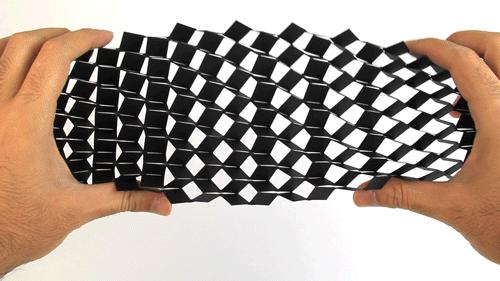
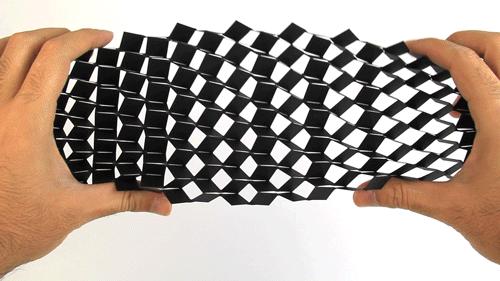
IMAGE

Credit: (Image courtesy of Ahmad Rafsanjani/Harvard SEAS)

Origami-inspired materials use folds in materials to embed powerful functionality. However, all that folding can be pretty labor intensive. Now, researchers at the Harvard John A. Paulson School of Engineering and Applied Sciences (SEAS) are drawing material inspiration from another ancient Japanese paper craft — kirigami.

Kirigami relies on cuts, rather than folds, to change the structure and function of materials.

In a new paper published in Physical Review Letters, SEAS researchers demonstrate how a thin, perforated sheet can be transformed into a foldable 3D structure by simply stretching the cut material.

"We find that applying sufficiently large amounts of stretching, buckling is triggered and results in the formation of a 3D structure comprising a well-organized pattern of mountains and valleys, very similar to popular origami folds such as the Miura-ori," said Ahmad Rafsanjani, a postdoctoral fellow at SEAS and first author of the paper.

The team found that if the material is stretched more, the temporary deformations become permanent folds. The team also found that the pop-up pattern and resulting mechanical properties of the material can be controlled by varying the orientation of the cuts.

"This study shows a robust pop-up strategy to manufacture complex morphable structures out of completely flat perforated sheets," said Katia Bertoldi, the John L. Loeb Associate Professor of the Natural Sciences at SEAS and senior author of the paper.

###

Media Contact

Leah Burrows
[email protected]
617-496-1351
@hseas

http://www.seas.harvard.edu/

############

Story Source: Materials provided by Scienmag
Share12Tweet8Share2ShareShareShare2

Related Posts

Robotic Hand That “Feels” Motion: International Study Uncovers How the Brain Detects Movement

June 24, 2026

Unveiling the Impact of TP53 Mutations in Oral Cancer: Molecular Insights and Prognostic Significance

June 24, 2026

Electric Field and Oxygen Spillover Collaborate to Control Electrode Migration in SOECs

June 24, 2026

Innovative Speckle-Based Metrology System Advances Precision Measurement of Next-Generation X-Ray Mirrors

June 24, 2026
Please login to join discussion

POPULAR NEWS

  • Saying Goodbye to PGY-6: Pediatric Fellowship Realities

    103 shares
    Share 41 Tweet 26
  • Multi-Hospital Study Reveals Long Covid Burden Is Twice as High as Current Estimates

    92 shares
    Share 36 Tweet 23
  • Detection of EDCs in Breast Milk and Infant Urine Up to Six Months Highlights Early Exposure Risks

    77 shares
    Share 31 Tweet 19
  • New Drug Candidate Developed at McMaster Shows Potential for Treating Brain Cancer

    58 shares
    Share 23 Tweet 15

About

We bring you the latest biotechnology news from best research centers and universities around the world. Check our website.

Follow us

Recent News

Robotic Hand That “Feels” Motion: International Study Uncovers How the Brain Detects Movement

Unveiling the Impact of TP53 Mutations in Oral Cancer: Molecular Insights and Prognostic Significance

Electric Field and Oxygen Spillover Collaborate to Control Electrode Migration in SOECs

Subscribe to Blog via Email

Enter your email address to subscribe to this blog and receive notifications of new posts by email.

Join 82 other subscribers
  • Contact Us

Bioengineer.org © Copyright 2023 All Rights Reserved.

Welcome Back!

Login to your account below

Forgotten Password?

Retrieve your password

Please enter your username or email address to reset your password.

Log In
No Result
View All Result
  • Homepages
    • Home Page 1
    • Home Page 2
  • News
  • National
  • Business
  • Health
  • Lifestyle
  • Science

Bioengineer.org © Copyright 2023 All Rights Reserved.