Credit: Kyoto University iCeMS
A team of researchers in Japan has developed a new platform for culturing human pluripotent stem cells that provides far more control of culture conditions than previous tools by using micro and nanotechnologies.
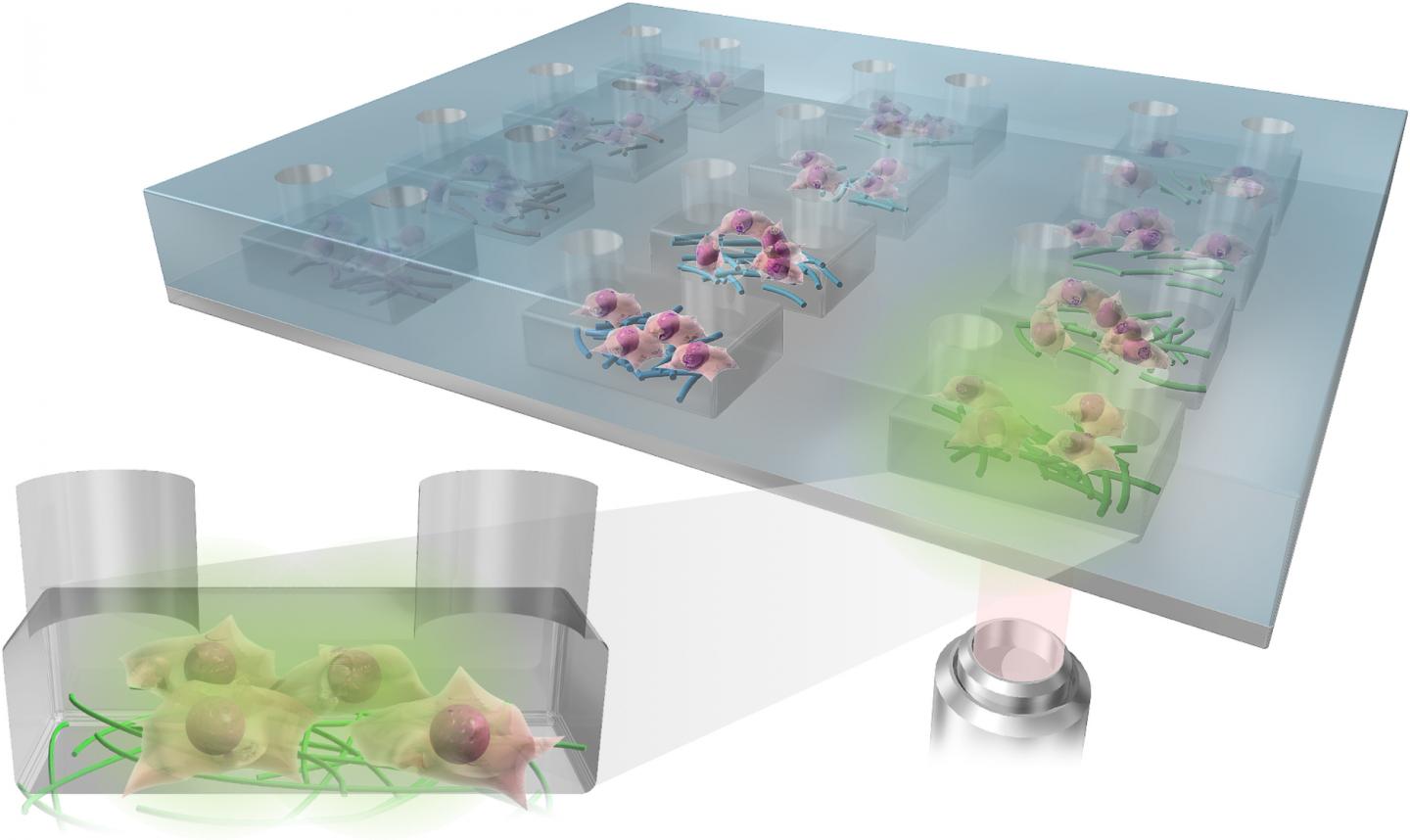
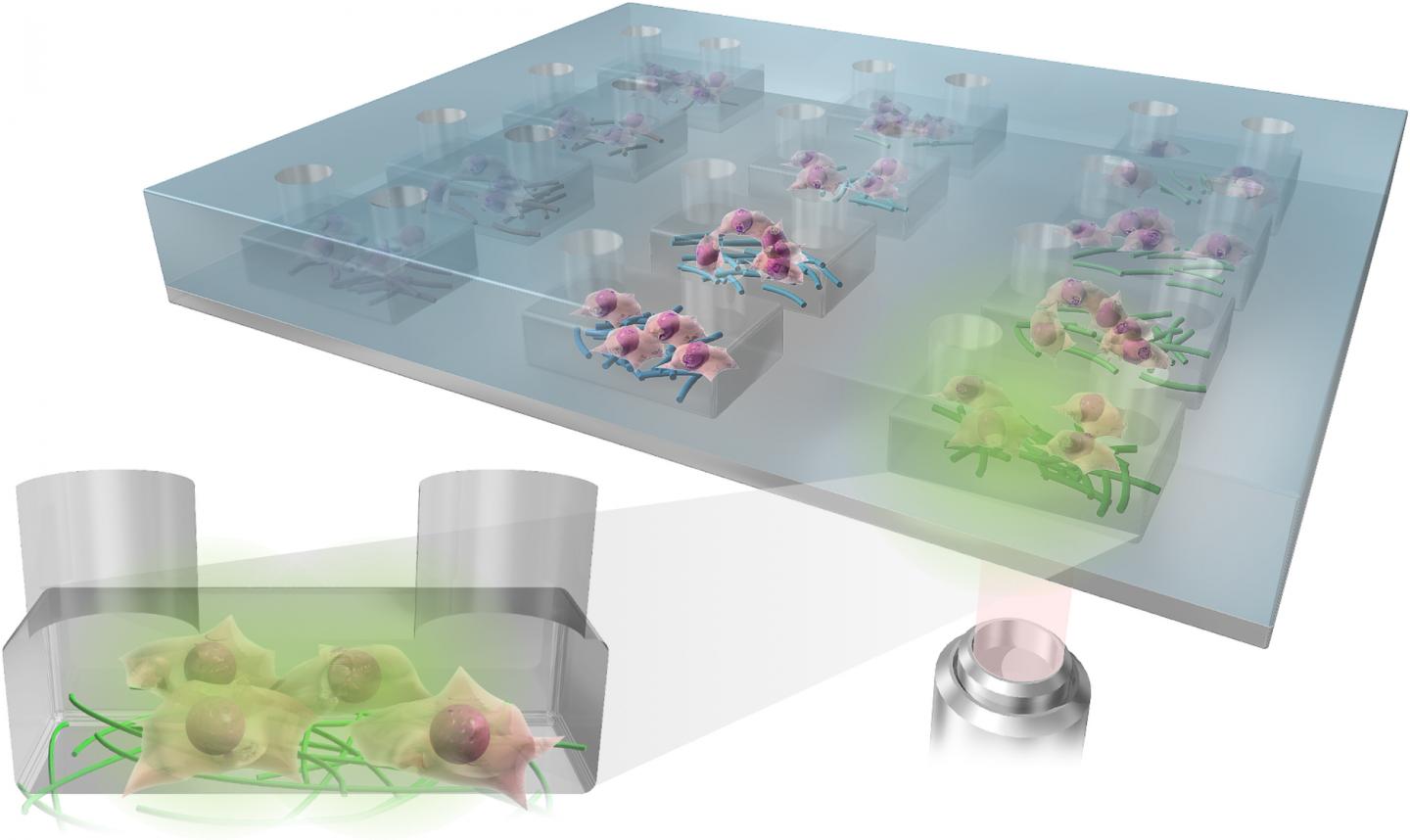
The Multiplexed Artificial Cellular Microenvironment (MACME) array places nanofibres, mimicking cellular matrices, into fluid-filled micro-chambers of precise sizes, which mimic extracellular environments.
Human pluripotent stems cells (hPSCs) hold great promise for tissue engineering, regenerative medicine and cell-based therapies because they can become any type of cell. The environment surrounding the cells plays a major role in determining what tissues they become, if they replicate into more cells, or die. However, understanding these interactions has been difficult because researchers have lacked tools that work on the appropriate scale.
Often, stem cells are cultured in a cell culture medium in small petri dishes. While factors such as medium pH levels and nutrients can be controlled, the artificial set up is on the macroscopic scale and does not allow for precise control of the physical environment surrounding the cells.
The MACME array miniaturizes this set up, culturing stem cells in rows of micro-chambers of cell culture medium. It also takes it a step further by placing nanofibres in these chambers to mimic the structures found around cells.
Led by Ken-ichiro Kamei of Kyoto University's Institute for Integrated Cell-Material Sciences (iCeMS), the team tested a variety of nanofibre materials and densities, micro-chamber heights and initial stem cell densities to determine the best combination that encourages human pluripotent stem cells to replicate.
They stained the cells with several fluorescent markers and used a microscope to see if the cells died, replicated or differentiated into tissues.
Their analysis revealed that gelatin nanofibres and medium-sized chambers that create medium seed cell density provided the best environment for the stem cells to continue to multiply. The quantity and density of neighboring cells strongly influences cell survival.
The array is an "optimal and powerful approach for understanding how environmental cues regulate cellular functions," the researchers conclude in a recently published paper in the journal Small.
This array appears to be the first time multiple kinds of extracellular environments can be mounted onto a single device, making it much easier to compare how different environments influence cells.
The MACME array could substantially reduce experiment costs compared to conventional tools, in part because it is low volume and requires less cell culture medium. The array does not require any special equipment and is compatible with both commonly used laboratory pipettes and automated pipette systems for performing high-throughput screening.
###
The paper "Microfluidic-nanofiber hybrid array for screening of cellular microenvironments" appeared on March 8, 2017 in Small, with doi: 10.1002/smll.201603104
The Institute for Integrated Cell-Material Sciences (iCeMS) at Kyoto University in Japan aims to advance the integration of cell and material sciences, both traditionally strong fields at the university, in a uniquely innovative global research environment. ICeMS combines the biosciences, chemistry, materials science and physics to create materials for mesoscopic cell control and cell-inspired materials. Such developments hold promise for significant advances in medicine, pharmaceutical studies, the environment and industry. http://www.icems.kyoto-u.ac.jp
Media Contact
Izumi Mindy Takamiya
[email protected]
81-757-539-755
@KyotoU_News
http://www.kyoto-u.ac.jp/en
############
Story Source: Materials provided by Scienmag