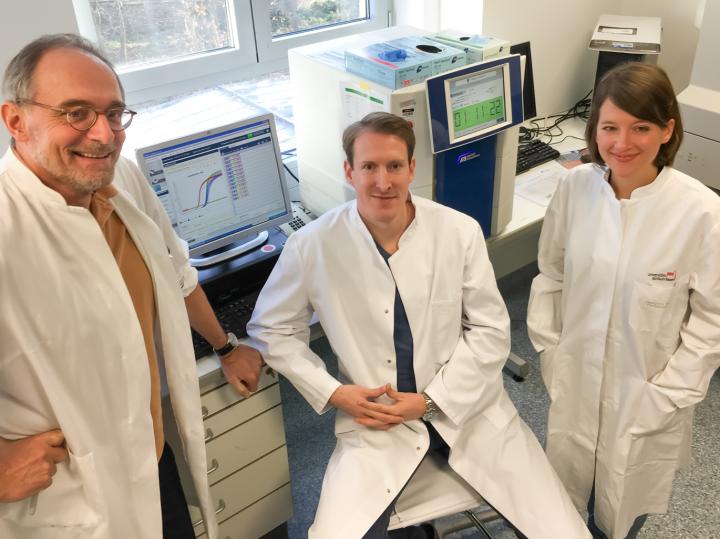
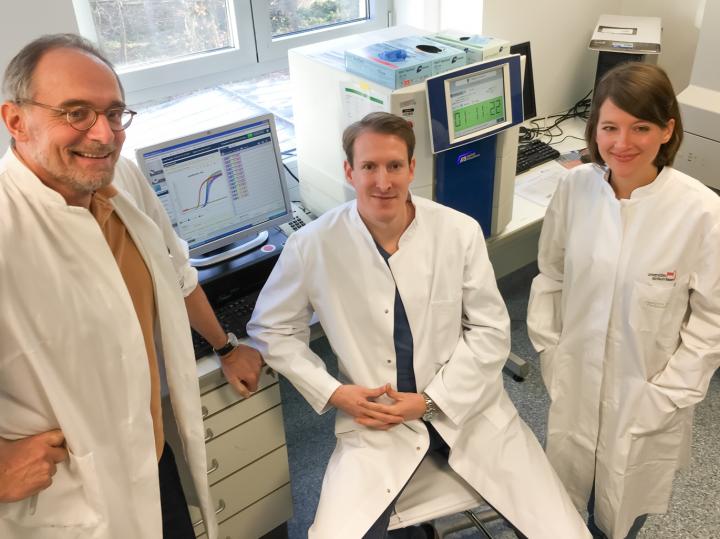
Credit: © Photo: Simon Schneider/Institute for Pathology/UKB
Testicular cancer is the most common malignant tumor disease in men between 20 and 40 years of age. It can usually be treated well. In some cases, however, the cancer hardly responds or does not respond at all to treatment. A substance that was originally destined to be an innovative contraceptive is offering new hope in these cases. An experimental drug with the cryptic name JQ1 blocks sperm maturation and was discussed to be a male contraceptive. Instead, it may be suitable for cancer therapy.
JQ1 belongs to a new class of drugs with far-reaching abilities: its members fundamentally influence which genes in the cell are active and which are not. The hereditary material DNA is similar to an extremely long strip of Morse code, on which the assembly instructions for the cellular molecules are found. To fit into the cell nuclei, this strip of Morse code is wrapped around small protein balls at regular intervals – the histones. Histones and DNA together resemble a string of pearls.
However, the histones do not only play a structural role. They also feature chemical tags – called methyl or acetyl groups. These tags signal to the synthesis machinery in the cell whether the strip of Morse code should be read at this point or not. "JQ1 inhibits those proteins that read these histone marks and thus changes the gene activity in the cell," explains Prof. Hubert Schorle from the Institute for Pathology at the University of Bonn.
The cancer cells react very sensitive to these changes: they activate a suicide program, called apoptosis. "In a testicular cancer mouse model, the tumors began to shrink after administering JQ1," explains the lead author of the study, Sina Jostes. "In contrast, healthy skin cells seem to tolerate JQ1 very well."
Especially effective in combination
Besides JQ1, other drugs that alter the marks of the histones are also known. One of these is romidepsin. The laboratory in Bonn was recently able to show that romidepsin is also very effective at fighting testicular cancer cells. Unlike JQ1, romidepsin is already approved for the treatment of patients with certain types of cancer.
"In our study, we treated mice with both JQ1 and romidepsin," explains Dr. Daniel Nettersheim, who helped in planning and performing the studies. "This way, we achieved a similar effect alike JQ1 or romidepsin treatment alone, but we could reduce the quantities of both substances. Such a combination therapy to treat testicular tumors may be much better tolerated. Chemotherapy-resistant patients could also benefit from this." However, clinical studies are now needed to move the treatment towards the clinics.
Besides scientists from the University of Bonn, the studies also involved researchers from the University of St. Gallen (Switzerland) and Harvard Medical School (USA).
###
Publications:
Sina Jostes, Daniel Nettersheim, Martin Fellermeyer, Simon Schneider, Francois Hafezi, Friedemann Honecker, Valerie Schumacher, Matthias Geyer, Glen Kristiansen and Hubert Schorle: The bromodomain inhibitor JQ1 triggers growth arrest and apoptosis in testicular germ cell tumours in vitro and in vivo; Journal of Cellular and Molecular Medicine; DOI: 10.1111/jcmm.13059
Daniel Nettersheim, Sina Jostes, Martin Fabry, Friedemann Honecker, Valerie Schumacher, Jutta Kirfel, Glen Kristiansen and Hubert Schorle: A signaling cascade including ARID1A, GADD45B and DUSP1 induces apoptosis and affects the cell cycle of germ cell cancers after romidepsin treatment; Oncotarget; DOI: 10.18632/oncotarget.11647
Media Contact
Hubert Schorle
[email protected]
49-228-287-16342
@unibonn
http://www.uni-bonn.de
############
Story Source: Materials provided by Scienmag