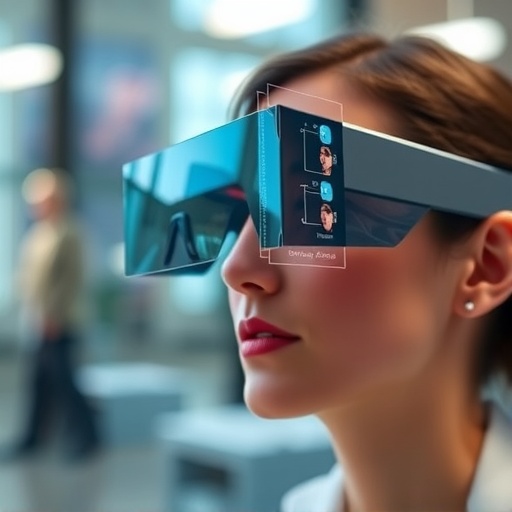
A major snag in optical see-through augmented reality (AR) is the trade-off between realism and usability. When occlusion-capable head-mounted displays block or modify real-world light to hide virtual elements behind physical objects, they can also dim the environment—making everyday tasks harder and reducing safety margins.
Researchers led by Assistant Professor Xiaodan Hu at Shibaura Institute of Technology set out to rebalance this conflict. Instead of treating hardware occlusion as the only lever, the team designed a perception-driven strategy that adapts display behavior to what users can actually see under changing lighting.
Their approach combines two optical paths: one supports pixel-level occlusion using polarized components, while the other bypasses the optical system to preserve the real world’s natural brightness. The system then adjusts the cross-angle between a polarizing beam splitter and a linear polarizer, blending the occlusion-capable and brightness-preserving views in real time.
Crucially, the blending is not arbitrary. Eye-tracking and scene analysis estimate visibility of both the surrounding environment and the virtual content, allowing the system to dynamically optimize the balance between them rather than relying on static settings.
To translate human perception into engineering constraints, the team ran user studies. One experiment with 12 participants measured contrast requirements for recognizing virtual texture details, quantifying how occlusion affects perceived clarity. A second study involved 24 participants to evaluate perception of lighting effects in the augmented scene.
These perceptual thresholds were integrated into the dynamic balancing strategy. Validation used a benchtop prototype, followed by a final user study with 12 participants across different illumination conditions.
Results showed improvements in real-world visibility while maintaining convincing appearance for virtual objects—addressing the long-standing realism-versus-visibility dilemma that has limited occlusion-capable AR adoption in practical settings.
Published online on April 8, 2026, the work appeared in IEEE Transactions on Visualization and Computer Graphics (TVCG), Volume 32, Issue 5, reinforcing the growing idea that display systems should be designed around human perception as much as optical performance.
The team’s contribution points toward future AR glasses that better preserve awareness of the surroundings while still delivering high-quality virtual augmentation, opening pathways for industrial maintenance, medical assistance, education, navigation, and remote collaboration where attention and visibility both matter.
Subject of Research: People (Human perception and user studies)
Article Title: Mask Balancing: Perception-Driven Dynamic Visibility Enhancement for Occlusion-Capable Optical See-Through Head-Mounted Displays
News Publication Date: 8-Apr-2026 (available online)
Web References: https://doi.org/10.1109/TVCG.2026.3679903
References: IEEE Transactions on Visualization and Computer Graphics (TVCG), Volume 32, Issue 5
Image Credits: Assistant Professor Xiaodan Hu from Shibaura Institute of Technology, Japan
Keywords
Virtual reality, Augmented reality, Perception-driven design, Occlusion, Optical see-through displays, Human visual perception, Eye tracking, Polarization optics, User studies, Dynamic visibility balancing
Tags: adaptive display blending in AR glassesaugmented reality head-mounted displaysbalancing virtual and real-world visibilitydynamic brightness adjustment in AR deviceseye-tracking in augmented realitylight management in AR headsetsocclusion-capable AR system designoptical see-through AR challengesperception-driven AR technologypolarized optical components for ARreal-time scene analysis in ARuser perception-based AR optimization