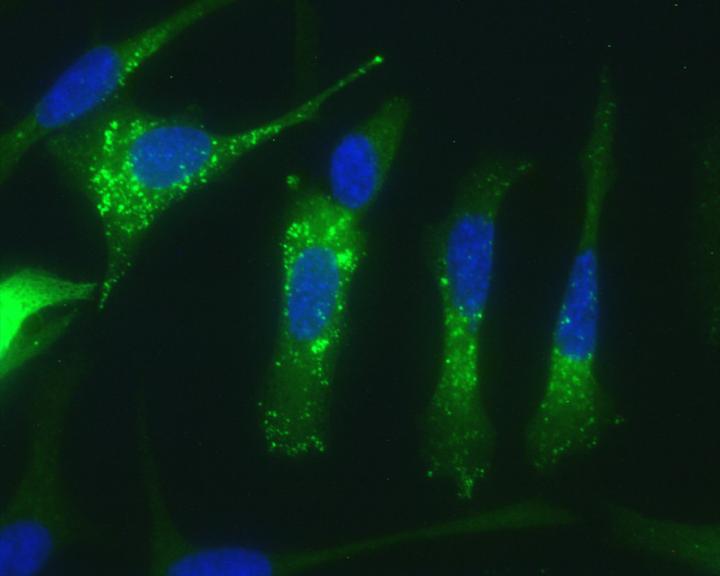
Credit: INC-UAB
A study led by the Institut de Neurociències (INc-UAB) describes a new strategy to tackle cancer, based on inducing a potent stress in tumor causing cell destruction by autophagy. The mechanism has been revealed using the new antitumor drug ABTL0812, currently in clinical trial. Results has been validated using samples from oncologic patients and published in Autophagy.
A study led by researchers from the Institut de Neurociències (INc-UAB), in collaboration with the Institute for Advanced Chemistry of Catalonia (IQAC-CSIC), describes a new mechanism by which the antitumor drug ABTL0812 induces stress in tumors, causing cell destruction by cytotoxic autophagy. This molecule is currently being tested in patients with advanced endometrial and squamous lung carcinoma, in combination with standard chemotherapy.
The findings were published in the Autophagy journal and show a new strategy to tackle cancer based on the manipulation of dihydroceramides, a group of cellular lipids. The authors also describe for the first time the detection of mRNAs of two stress-related proteins – CHOP and TRIB3- in blood samples from patients undergoing clinical trial, supporting their use as pharmacodynamic biomarkers.
The research team was coordinated by Jose Miguel Lizcano from the INC and the UAB Biochemistry and Molecular Biology Department. For the past years, this team has investigated how ABTL0812 exerts its antitumor action. This molecule was developed by the biopharmaceutical company AbilityPharma located at the UAB Research Park. AbilityPharma contacted Dr. Lizcano to uncover the antitumor mechanism of action of ABTL0812. Since then, clinical trials have advanced in parallel with research in the laboratory.
In 2016, when clinical studies began, Dr. Lizcano’s laboratory discovered that this was the first anticancer drug in trials to induce toxic autophagy in tumor cells. Now, with this drug being tested in clinical phase II, the new study shows how toxic autophagy is produced.
“Cancer cell death comes from alterations in the levels of cellular dihydroceramides, a family of cellular lipids. Elevated levels of dihydroceramides provoke a severe stress of the endoplasmic reticulum, a cellular organelle in charge of protein synthesis, resulting in the accumulation of defective proteins. As a consequence, cells activate a compensatory response, called Unfolded Protein Response (UPR). This response, when sustained in time, can induce autophagy that results in cancer cell death”, says Jose Miguel Lizcano.
The study also explains why ABTL0812 does not affect non-cancer cells: “The main advantage of this molecule lies in its specificity for tumor cells. To survive the hostile environment, cancer cells overtake it by having elevated levels of ER stress and UPR activity. Our drug provokes cancer cells to overpass the stress level in which this response has protective effects, causing their death, while healthy cells still have a wider margin”, says Pau Muñoz, researcher at the INC and first author of the article.
Researchers consider that this new mechanism of action could be used safely in the treatment of different types of cancers. In fact, the study also served to present the preliminary results on pancreatic and other biliary tract cancer models.
This work will be presented by AbilityPharma at the American Association for Cancer Research (AACR) 2020 Congress. “The description of this mechanism of action is a very important step for AbilityPharma, and shows the excellent collaboration engaged by our company and the INc-UAB. Also, it supports a broader use of ABTL0812 in other cancer paradigms, apart from endometrial and squamous lung carcinoma” explains Carles Domènech, AbilityPharma’s executive chairman.
###
The study was also performed in collaboration with researchers from the Complutense University of Madrid (UCM), the Catalan Institute of Oncology (ICO), the Vall d’Hebron Research Institute (VHIR), the Vall d’Hebron Institute of Oncology (VHIO) and the Bellvitge Biomedical Research Institute (IDIBELL).
The research was funded by grants from the Spanish Ministry for the Economy and Competitiveness (MINECO) and the European Regional Development Fund (ERDF) (RTC-2017-6261-1 and IPT-2012-0614-010000), the agency for business competitiveness ACCIÓ (Government of Catalonia), the Centre for the Development of Industrial Technology (CDTI) and the Empresa Nacional de Innovación, Sociedad Anónima (ENISA).
Media Contact
María Jesús Delgado
[email protected]
Original Source
https:/
Related Journal Article
http://dx.