Material characterization approach can pinpoint cement setting times, could lead to more environmentally friendly cement
Credit: José Ortiz-Lozano
WASHINGTON — Researchers have developed a nondestructive and noninvasive optical technique that can determine the setting times for various types of cement paste, which is used to bind new and old concrete surfaces. The new method could aid in the development of optimized types of cement with less impact on the environment.
“Our noninvasive optical method characterizes and determines the setting time of cement, which is a very important parameter for the construction industry,” said José Ortiz-Lozano, a member of the research team from Universidad Autónoma de Aguascalientes, Tecnológico Nacional de México and Centro de Investigaciones en Óptica, in Mexico. “It can also precisely assess the cement hydration process in real-time. This information is crucial for both the study of physical chemistry and the quantitative characterization of the nanomechanical properties of cement-based materials.”
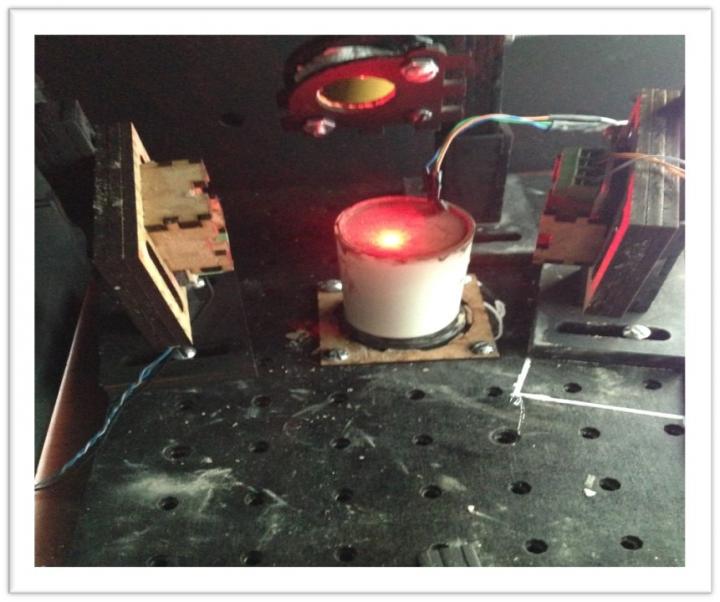
In the Optical Society’s (OSA) journal Applied Optics, the researchers describe the new method, which combines laser-based technology with an optical model to calculate the dynamic behavior of the cement paste. The researchers show that their approach can accurately calculate both the initial setting time — the time available for mixing the cement and placing it in position — and the final setting time, when the cement reaches its full strength.
“Our group is trying to enhance the performance of cement-based materials, such as cement pastes, mortars and concrete,” said Ortiz-Lozano. “New material characterization methods, such as the one we report here, can be used to improve the behavior and performance of cement by optimizing its constituents. This could lead to new types of cement that use less water and raw materials like limestone and clay, which would make them more environmentally friendly.”
Studying cement with light
Although a variety of techniques exist to study the dynamics of setting cement, they come with various drawbacks such as being destructive, invasive or influenced by human factors.
The new method uses the optical properties of cement paste to directly calculate the initial and final cement setting time by measuring the diffuse light that reflects off the cement.
As the cement sets, the diffuse light reflection changes as it reacts with water and the spaces between the cement particles change. The amount of water present and the protective surface layer at each setting stage also influence the diffuse reflection properties. The researchers combined the diffuse reflection measurements with the Kubelka-Munk model, which is used to describe diffuse reflection of opaque samples.
“This new optical method was developed using tools, components and materials common among the optical industry,” said Ortiz-Lozano. “It would be, therefore, quite simple and economic to implement in cement quality control laboratories. It can be applied to any type of cement once the appropriate calibration is performed with the Kubelka-Munk model.”
The researchers applied the new technique to six cement samples and found that the results for all the samples were repeatable and agreed well with measurement techniques commonly used today.
“This laser-based technique gives continuous and accurate assessment of cement hydration process with high repeatability and reproducibility, showing its potential for studying the physical chemistry properties of cement,” said Ortiz-Lozano.
Next, the researchers plan to acquire more data using more types of cement, mortars, concretes as well as additional water to cement ratios and cement pastes that contain chemical and/or mineral admixtures. They are also planning to perform the work required to normalize the method as a standard.
###
Paper: J. J. Soto-Bernal, G. V. Vázquez, R. Gonzálezmota, I. Rosales-Candelas, J. A. Ortiz-Lozano, H. A. De-León-Martínez, “Optical Method to Characterize and Assess Setting Evolution of Cement Pastes,” Applied Optics, 59, 13, D1-D5 (2020). Included in a forthcoming Feature Issue on Optics Theory and Practice in Iberoamerica.
DOI: https:/
About Applied Optics
Applied Optics publishes in-depth peer-reviewed content about applications-centered research in optics. These articles cover research in optical technology, photonics, lasers, information processing, sensing and environmental optics. Applied Optics is published three times per month by The Optical Society and overseen by Editor-in-Chief Ronald Driggers, University of Central Florida, USA. For more information, visit OSA Publishing.
About The Optical Society
Founded in 1916, The Optical Society (OSA) is the leading professional organization for scientists, engineers, students and business leaders who fuel discoveries, shape real-life applications and accelerate achievements in the science of light. Through world-renowned publications, meetings and membership initiatives, OSA provides quality research, inspired interactions and dedicated resources for its extensive global network of optics and photonics experts. For more information, visit osa.org.
Media Contact
Media Contact
James Merrick
[email protected]
202-416-1994
Original Source
https:/
Related Journal Article
http://dx.