• HOME
  • NEWS
  • EXPLORE
    • CAREER
      • Companies
      • Jobs
    • EVENTS
    • iGEM
      • News
      • Team
    • PHOTOS
    • VIDEO
    • WIKI
  • BLOG
  • COMMUNITY
    • FACEBOOK
    • INSTAGRAM
    • TWITTER
Friday, April 17, 2026
BIOENGINEER.ORG
No Result
View All Result
  • Login
  • HOME
  • NEWS
  • EXPLORE
    • CAREER
      • Companies
      • Jobs
        • Lecturer
        • PhD Studentship
        • Postdoc
        • Research Assistant
    • EVENTS
    • iGEM
      • News
      • Team
    • PHOTOS
    • VIDEO
    • WIKI
  • BLOG
  • COMMUNITY
    • FACEBOOK
    • INSTAGRAM
    • TWITTER
  • HOME
  • NEWS
  • EXPLORE
    • CAREER
      • Companies
      • Jobs
        • Lecturer
        • PhD Studentship
        • Postdoc
        • Research Assistant
    • EVENTS
    • iGEM
      • News
      • Team
    • PHOTOS
    • VIDEO
    • WIKI
  • BLOG
  • COMMUNITY
    • FACEBOOK
    • INSTAGRAM
    • TWITTER
No Result
View All Result
Bioengineer.org
No Result
View All Result
Home NEWS Science News

New, old science combine to make faster medical test

Bioengineer by Bioengineer
January 21, 2017
in Science News
Reading Time: 2 mins read
0
Share on FacebookShare on TwitterShare on LinkedinShare on RedditShare on Telegram
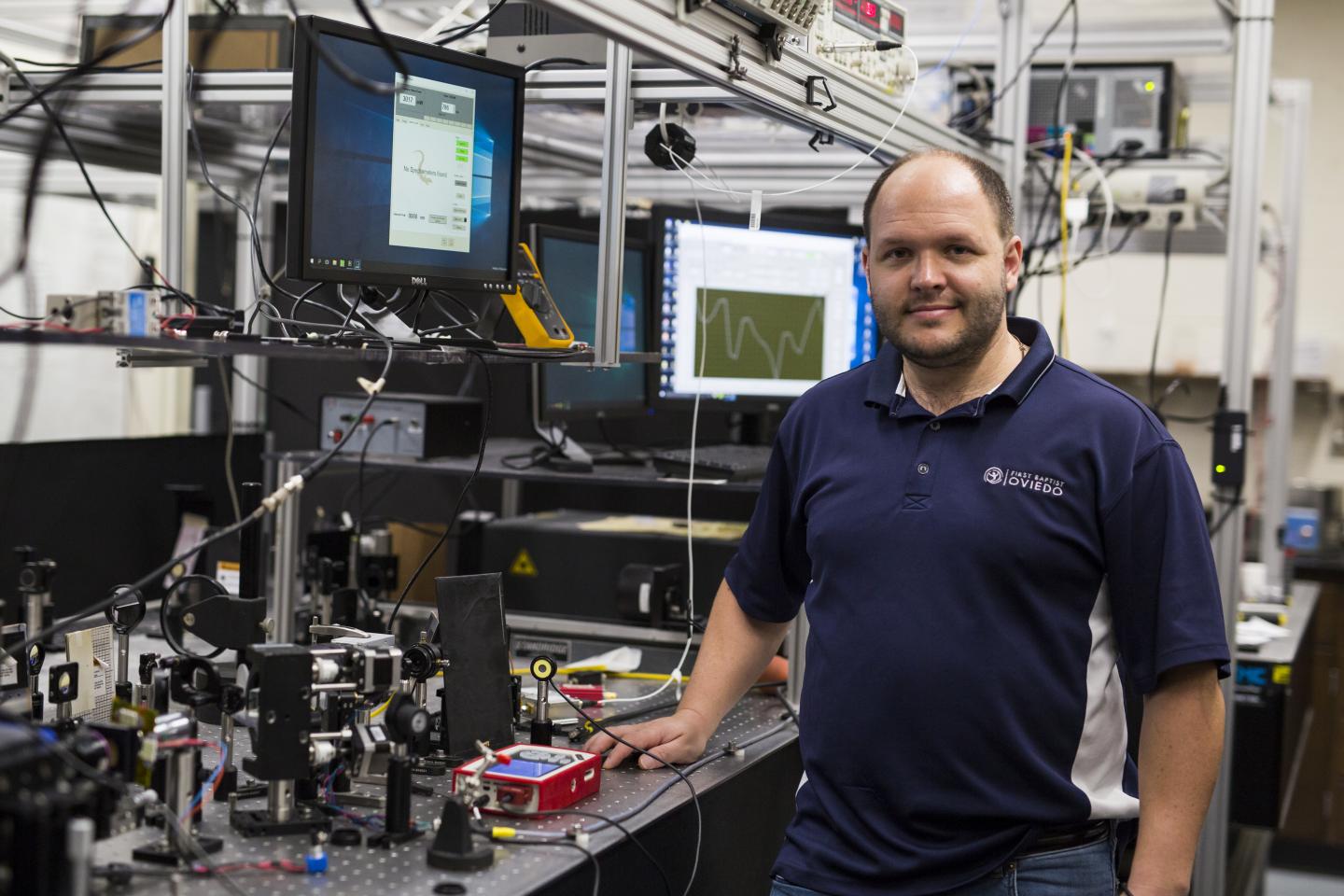
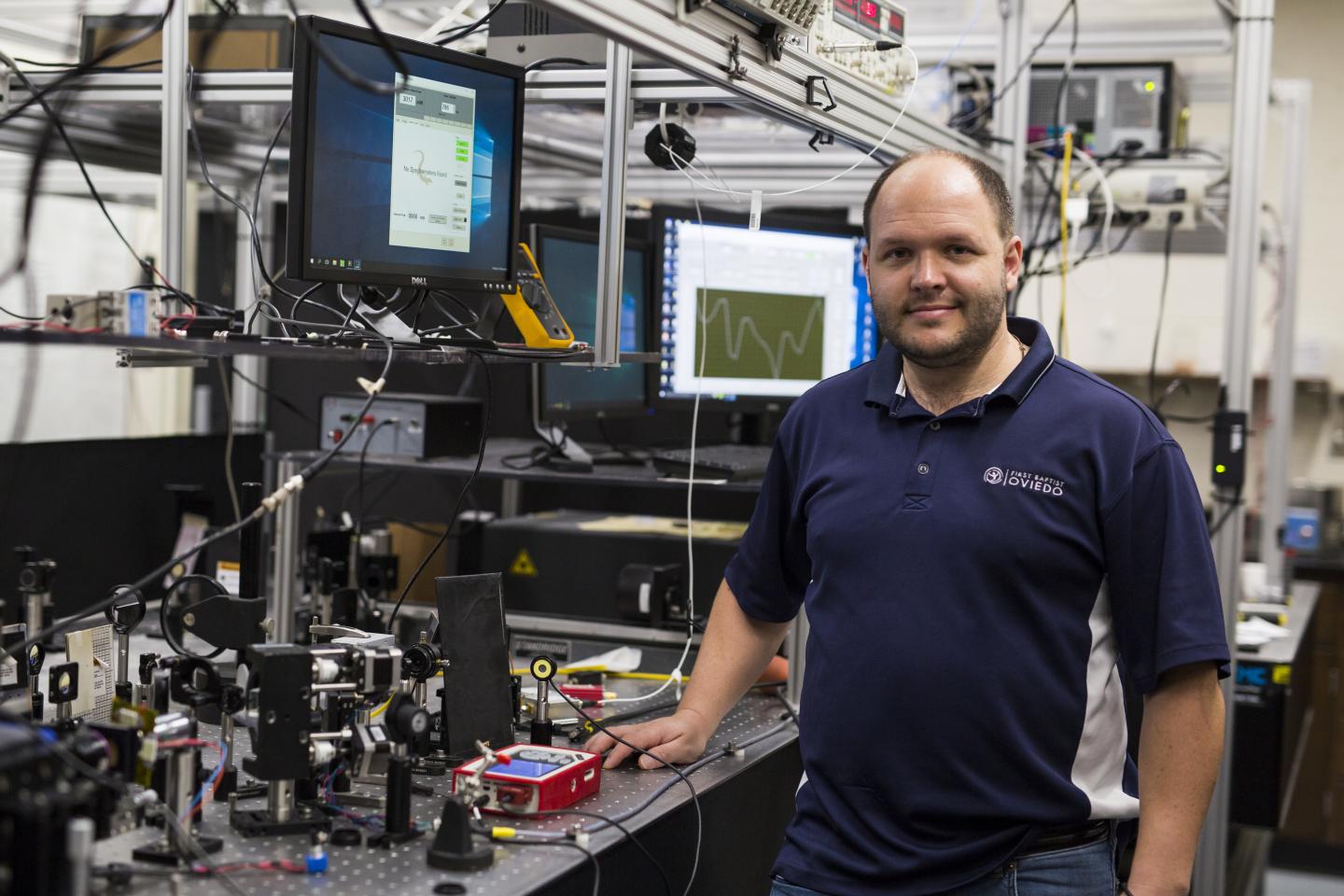
IMAGE

Credit: Courtesy University of Central Florida

A UCF researcher has combined cutting-edge nanoscience with a magnetic phenomenon discovered more than 170 years ago to create a method for speedy medical tests.

The discovery, if commercialized, could lead to faster test results for HIV, Lyme disease, syphilis, rotavirus and other infectious conditions.

"I see no reason why a variation of this technique couldn't be in every hospital throughout the world," said Shawn Putnam, an assistant professor in the University of Central Florida's College of Engineering & Computer Science.

At the core of the research recently published in the academic journal Small are nanoparticles – tiny particles that are one-billionth of a meter. Putnam's team coated nanoparticles with the antibody to BSA, or bovine serum albumin, which is commonly used as the basis of a variety of diagnostic tests.

By mixing the nanoparticles in a test solution – such as one used for a blood test – the BSA proteins preferentially bind with the antibodies that coat the nanoparticles, like a lock and key.

That reaction was already well known. But Putnam's team came up with a novel way of measuring the quantity of proteins present. He used nanoparticles with an iron core and applied a magnetic field to the solution, causing the particles to align in a particular formation. As proteins bind to the antibody-coated particles, the rotation of the particles becomes sluggish, which is easy to detect with laser optics.

The interaction of a magnetic field and light is known as Faraday rotation, a principle discovered by scientist Michael Faraday in 1845. Putnam adapted it for biological use.

"It's an old theory, but no one has actually applied this aspect of it," he said.

Other antigens and their unique antibodies could be substituted for the BSA protein used in the research, allowing medical tests for a wide array of infectious diseases.

The proof of concept shows the method could be used to produce biochemical immunology test results in as little as 15 minutes, compared to several hours for ELISA, or enzyme-linked immunosorbent assay, which is currently a standard approach for biomolecule detection.

###

Putnam collaborated with Richard J. Murdock, a 2015 UCF graduate who is now a doctoral student in the Harvard-MIT Health Science & Technology program; Soumen Das, Ankur Gupta and Sudipta Seal, all of UCF's Department of Materials Science and Engineering and the NanoScience Technology Center; and Elyse D.Z. Chase of the University of Pennsylvania.

Media Contact

Mark Schlueb
[email protected]
407-823-0221
@UCF

http://www.ucf.edu

############

Story Source: Materials provided by Scienmag

Share12Tweet8Share2ShareShareShare2

Related Posts

Geriatric Tuberculosis: Five-Year Study Insights India

April 17, 2026
Fiber-Optic Sensor Captures Precise Flight Data at Nevada Airfield

Fiber-Optic Sensor Captures Precise Flight Data at Nevada Airfield

April 17, 2026

NAT10 Drives Gallbladder Cancer via Cholesterol Metabolism

April 17, 2026

Sedentary Behavior Alters Balance Rehab in Parkinson’s

April 17, 2026
Please login to join discussion

POPULAR NEWS

  • Scientists Investigate Possible Connection Between COVID-19 and Increased Lung Cancer Risk

    61 shares
    Share 24 Tweet 15
  • NSF funds machine-learning research at UNO and UNL to study energy requirements of walking in older adults

    100 shares
    Share 40 Tweet 25
  • Boosting Breast Cancer Risk Prediction with Genetics

    47 shares
    Share 19 Tweet 12
  • Popular Anti-Aging Compound Linked to Damage in Corpus Callosum, Study Finds

    46 shares
    Share 18 Tweet 12

About

We bring you the latest biotechnology news from best research centers and universities around the world. Check our website.

Follow us

Recent News

Geriatric Tuberculosis: Five-Year Study Insights India

Fiber-Optic Sensor Captures Precise Flight Data at Nevada Airfield

NAT10 Drives Gallbladder Cancer via Cholesterol Metabolism

Subscribe to Blog via Email

Enter your email address to subscribe to this blog and receive notifications of new posts by email.

Join 79 other subscribers
  • Contact Us

Bioengineer.org © Copyright 2023 All Rights Reserved.

Welcome Back!

Login to your account below

Forgotten Password?

Retrieve your password

Please enter your username or email address to reset your password.

Log In
No Result
View All Result
  • Homepages
    • Home Page 1
    • Home Page 2
  • News
  • National
  • Business
  • Health
  • Lifestyle
  • Science

Bioengineer.org © Copyright 2023 All Rights Reserved.