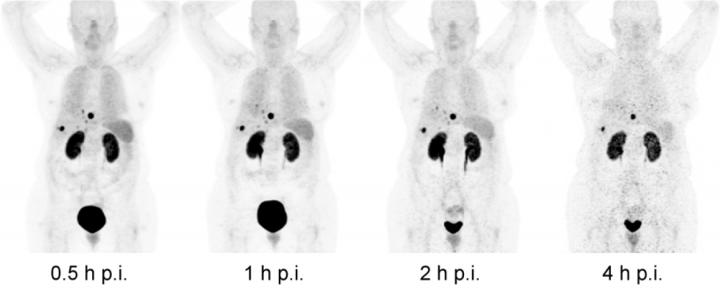
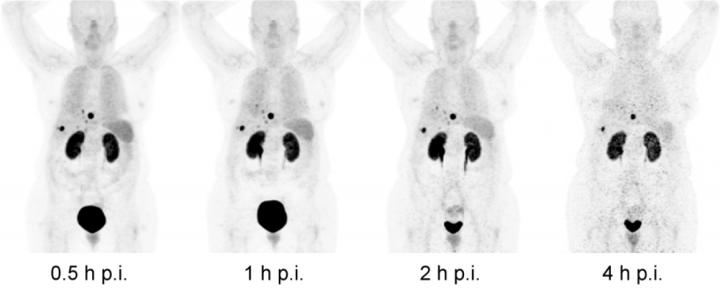
Credit: GP Nicolas et al., University Hospital Basel, Basel, Switzerland
RESTON, VA – Researchers have shown that a new nuclear medicine procedure could safely and more effectively detect cancerous gastrointestinal and pancreatic neuroendocrine tumors than current methods. The study is featured in the June issue of The Journal of Nuclear Medicine.
Neuroendocrine tumors (NETs) can occur in almost any organ, but they are most commonly observed in the pancreas and gastrointestinal tract. The average time until diagnosis is 3 to 10 years. An estimated 40 to 95 percent of cancerous gastroenteropancreatic NETs (GEP-NETs) have spread to other parts of the body (metastasized) by the time of diagnosis.
Most GEP-NETs express a high density of somatostatin receptor subtype 2 (sst2). These receptors have, therefore, become a prime target for imaging and treating these tumors. Currently, gallium-68 (68Ga)-DOTATOC/-TATE for diagnostic imaging and lutetium-177 (177Lu)-DOTATOC/-TATE for therapy are paired for "theranostic" identification and treatment of NETs.
Preclinical and preliminary clinical evidence indicates that the novel radiolabeled tracer 68Ga-OPS202, an sst antagonist with a high affinity for sst2, has the potential to perform better than an sst agonist such as 68Ga-DOTATOC because 68Ga-OPS202 binds to more sst receptor binding sites than sst agonists.
This first-in-human Phase 1/2 study, included 12 patients with well differentiated GEP-NETs. Based on total numbers of detected malignant lesions, the optimal time window for the scan was determined to be between 1 and 2 hours. The study shows that 68Ga-OPS202 is rapidly cleared from the blood, resulting in low background activity, especially in the liver and gastrointestinal tract.
"Even though the effective dose of 68Ga-OPS202 is comparable to other 68Ga-labeled somatostatin analogs, there are striking differences concerning its biodistribution and organ doses such as liver, gastrointestinal tract, pancreas, lung and spleen," explains Damian Wild, MD, PhD, University Hospital Basel in Basel, Switzerland.
He points out, "The lower organ doses and tracer uptake of 68Ga-OPS202, especially in the gastrointestinal tract and the liver, is clinically relevant, as it allows improvement of the imaging contrast (tumor-to-background ratios) and sensitivity for detecting primary tumor or liver metastases of GEP-NETs (as shown in comparison to 68Ga-DOTATOC in Phase 2 of the study, also published in the June JNM). Important for patients is that 68Ga-OPS202 was well tolerated and did not raise any safety concerns."
Wild states, "68Ga-OPS202 could be a favorable alternative to the current radiolabeled somatostatin agonists in use in the clinic for PET/CT imaging of neuroendocrine tumor patients. In addition, due to their enhanced binding properties, radiolabeled sst antagonists may open a new avenue for PET imaging and targeted radionuclide therapy in non-neuroendocrine tumor indications. In that sense 68Ga-OPS202 is the ideal theranostic companion for 177Lu-OPS201 targeted radionuclide therapy."
###
Authors of "Safety, Biodistribution, and Radiation Dosimetry of 68Ga-OPS202 in Patients with Gastroenteropancreatic Neuroendocrine Tumors: A Prospective Phase I Imaging Study" include Guillaume P. Nicolas, Andreas Bauman, Melpomeni Fani, and Damian Wild, University Hospital Basel, Basel, Switzerland; Seval Beykan and Michael Lassmann, University Hospital Würzburg, Würzburg, Germany; Hakim Bouterfa and Jens Kaufmann, OctreoPharm Sciences GmbH, Ipsen Group, Berlin, Germany; Jean Claude Reubi, University of Berne, Berne, Switzerland; Jean E.F. Rivier, Salk Institute, LaJolla, California; Helmut R. Maecke, University Hospital Freiburg, Freiburg, Germany.
Please visit the SNMMI Media Center to view the PDF of the study, including images, and more information about molecular imaging and personalized medicine. To schedule an interview with the researchers, please contact Laurie Callahan at (703) 652-6773 or [email protected]. Current and past issues of The Journal of Nuclear Medicine can be found online at http://jnm.snmjournals.org.
ABOUT THE SOCIETY OF NUCLEAR MEDICINE AND MOLECULAR IMAGING
The Society of Nuclear Medicine and Molecular Imaging (SNMMI) is an international scientific and medical organization dedicated to advancing nuclear medicine and molecular imaging, vital elements of precision medicine that allow diagnosis and treatment to be tailored to individual patients in order to achieve the best possible outcomes.
SNMMI's more than 16,000 members set the standard for molecular imaging and nuclear medicine practice by creating guidelines, sharing information through journals and meetings and leading advocacy on key issues that affect molecular imaging and therapy research and practice. For more information, visit http://www.snmmi.org.
Media Contact
Laurie F Callahan
[email protected]
@SNM_MI
http://www.snm.org
Original Source
http://www.snmmi.org/NewsPublications/NewsDetail.aspx?ItemNumber=29218 http://dx.doi.org/10.2967/jnumed.117.199737