Donwilhelmsite is important for understanding the inner structure of the earth
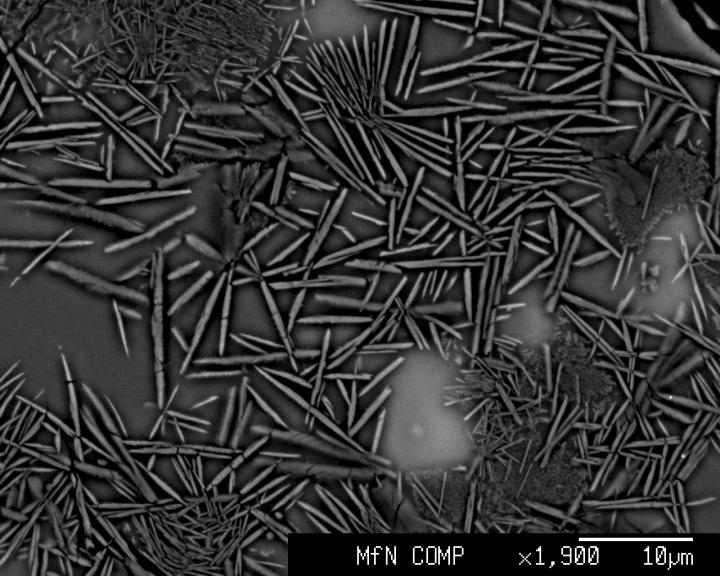
Credit: © Museum für Naturkunde Berlin, Ansgar Greshake
A team of European researchers discovered a new high-pressure mineral in the lunar meteorite Oued Awlitis 001, named donwilhelmsite [CaAl4Si2O11]. The team around Jörg Fritz from the Zentrum für Rieskrater und Impaktforschung Nördlingen, Germany and colleagues at the German Research Centre for Geoscience GFZ in Potsdam, Museum für Naturkunde Berlin, Natural History Museum Vienna, Institute of Physics of the Czech Academy of Science, Natural History Museum Oslo, University of Manchester, and Deutsches Zentrum für Luft und Raumfahrt Berlin published their findings in the scientific journal “American Mineralogist“.
Besides the about 382 kilograms of rocks and soils collected by the Apollo and Luna missions, lunar meteorites allow valuable insights into the formation of the Moon. They are ejected by impacts onto the lunar surface and subsequently delivered to Earth.
Some of these meteorites experienced particularly high temperatures and pressures. The extreme physical conditions often led to shock melting of microscopic areas within these meteorites. These shocked areas are of great relevance as they mirror pressure and temperature regimes similar to those prevailing in the Earth’s mantle. Therefore, the microscopic shock melt areas are natural crucibles hosting minerals that are otherwise naturally inaccessible at the Earth’s surface. Minerals like wadsleyite, ringwoodite, and bridgmanite, constitute large parts of the Earth’s mantle. Theses crystals were synthesized in high-pressure laboratory experiments. As natural minerals they were first described and named based on their occurrences in meteorites.
The new mineral donwilhelmsite is the first high-pressure mineral found in meteorites with application for subducted terrestrial sediments. It is mainly composed of calcium, aluminum, silicon, and oxygen atoms. Donwilhelmsite was discovered within shock melt zones of the lunar meteorite Oued Awlitis 001 found in 2014 in the Western Sahara. This meteorite is compositionally similar to rocks comprising the Earth’s continents. Eroded sediments from these continents are transported by wind and rivers to the oceans, and subducted into the Earth’s mantle as part of the dense oceanic crust. While being dragged deeper into the Earth mantle the pressure and temperature increases, and the minerals transform into denser mineral phases. The newly discovered mineral donwilhelmsite forms in 460 to 700 kilometre depth. In the terrestrial rock cycle, donwilhelmsite is therefore an important agent for transporting crustal sediments through the transition zone separating the upper and lower Earth’s mantle.
This pan-European collaboration was essential to obtain the lunar meteorite, recognize the new mineral, understand its scientific relevance, and to determine the crystal structure of the tiny, the thousands part of a millimeter thick, mineral crystal with high accuracy. “At the GFZ, we used transmission electron microscopy to investigate microstructural aspects of the samples,” says Richard Wirth from the section “Interface Geochemistry”. “Our investigations and the crystal structure analyses of the colleagues from the Czech Republic once again underline the importance of transmission electron microscopy in the geosciences”.
The new mineral was named in honor of the lunar geologist Don E. Wilhelms, an American scientist involved in landing site selection and data analyses of the Apollo space missions that brought to Earth the first rock samples from the Moon. Part of the meteorite Oued Awlitis 001, acquired by crowdfunding initiative „Help us to get the Moon!”, is on display at the Natural History Museum Vienna.
###
Media Contact
Dr. Richard Wirth
[email protected]
Original Source
https:/
Related Journal Article
http://dx.