• HOME
  • NEWS
  • EXPLORE
    • CAREER
      • Companies
      • Jobs
    • EVENTS
    • iGEM
      • News
      • Team
    • PHOTOS
    • VIDEO
    • WIKI
  • BLOG
  • COMMUNITY
    • FACEBOOK
    • INSTAGRAM
    • TWITTER
Monday, July 13, 2026
BIOENGINEER.ORG
No Result
View All Result
  • Login
  • HOME
  • NEWS
  • EXPLORE
    • CAREER
      • Companies
      • Jobs
        • Lecturer
        • PhD Studentship
        • Postdoc
        • Research Assistant
    • EVENTS
    • iGEM
      • News
      • Team
    • PHOTOS
    • VIDEO
    • WIKI
  • BLOG
  • COMMUNITY
    • FACEBOOK
    • INSTAGRAM
    • TWITTER
  • HOME
  • NEWS
  • EXPLORE
    • CAREER
      • Companies
      • Jobs
        • Lecturer
        • PhD Studentship
        • Postdoc
        • Research Assistant
    • EVENTS
    • iGEM
      • News
      • Team
    • PHOTOS
    • VIDEO
    • WIKI
  • BLOG
  • COMMUNITY
    • FACEBOOK
    • INSTAGRAM
    • TWITTER
No Result
View All Result
Bioengineer.org
No Result
View All Result
Home NEWS Science News Chemistry

New microcomb device advances photonic technology

Bioengineer by Bioengineer
June 21, 2023
in Chemistry
Reading Time: 2 mins read
0
Yang He Cleanroom
Share on FacebookShare on TwitterShare on LinkedinShare on RedditShare on Telegram

A new tool for generating microwave signals could help propel advances in wireless communication, imaging, atomic clocks, and more.
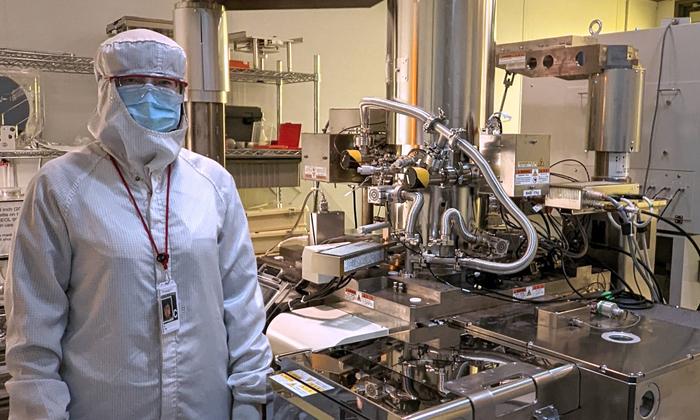
Yang He Cleanroom

Credit: University of Rochester

A new tool for generating microwave signals could help propel advances in wireless communication, imaging, atomic clocks, and more.

Frequency combs are photonic devices that produce many equally spaced laser lines, each locked to a specific frequency to produce a comb-like structure. They can be used to generate high-frequency, stable microwave signals and scientists have been attempting to miniaturize the approach so they can be used on microchips.

Scientists have been limited in their abilities to tune these microcombs at a rate to make them effective. But a team of researchers led by University of Rochester’s Qiang Lin, professor of electrical and computer engineering and optics, outlined a new high-speed tunable microcomb in Nature Communications.

“One of the hottest areas of research in nonlinear integrated photonics is trying to produce this kind of a frequency comb on a chip-scale device,” says Lin. “We are excited to have developed the first microcomb device to produce a highly tunable microwave source.”

The device is a lithium niobate resonator that allows users to manipulate the bandwidth and frequency modulation rates several orders-of-magnitude faster than existing microcombs.

“The device provides a new approach to electro-optic processing of coherent microwaves and opens up a great avenue towards high-speed control of soliton comb lines that is crucial for many applications including frequency metrology, frequency synthesis, RADAR/LiDAR, sensing, and communication,” says Yang He ’20 (PhD), who was an electrical and computer engineering postdoctoral scholar in Lin’s lab and is the first author on the paper.

Other coauthors from Lin’s group include Raymond Lopez-Rios, Usman A. Javid, Jingwei Ling, Mingxiao Li, and Shixin Xue.

The project was a collaboration between faculty and students at Rochester’s Department of Electrical and Computer Engineering and Institute of Optics as well as the California Institute of Technology. The work was supported in part by the Defense Threat Reduction Agency, the Defense Advanced Research Projects Agency, and the National Science Foundation.


Journal

Nature Communications

DOI

10.1038/s41467-023-39229-3

Article Title

High-speed tunable microwave-rate soliton microcomb

Article Publication Date

12-Jun-2023

Share12Tweet8Share2ShareShareShare2

Related Posts

SwRI and SMU Partner to Advance Solid-State Battery Technology

SwRI and SMU Partner to Advance Solid-State Battery Technology

July 13, 2026
Blue Light and Chemistry Simplify Complex Drug Production Steps

Blue Light and Chemistry Simplify Complex Drug Production Steps

July 10, 2026

New Discovery Promises Brighter, More Energy-Efficient Digital Displays

July 10, 2026

New Crystalline 3D Frameworks Linked by Spiroborates Developed

July 10, 2026

POPULAR NEWS

  • Detection of EDCs in Breast Milk and Infant Urine Up to Six Months Highlights Early Exposure Risks

    77 shares
    Share 31 Tweet 19
  • New Drug Candidate Developed at McMaster Shows Potential for Treating Brain Cancer

    58 shares
    Share 23 Tweet 15
  • KTU Researchers Explore Ultrasound’s Role in Enhancing Blood Flow Beyond Diagnostics

    53 shares
    Share 21 Tweet 13
  • Experimental Therapy Simultaneously Destroys Prostate Tumor Cells and Reactivates Antitumor Immunity

    46 shares
    Share 18 Tweet 12

About

We bring you the latest biotechnology news from best research centers and universities around the world. Check our website.

Follow us

Recent News

Genes Operate According to Exact Switching Rules

Vegetarian Diet Linked to Lower Risk of Esophageal Cancer

New Technology Advances Precision Lung Cancer Therapy

Subscribe to Blog via Email

Enter your email address to subscribe to this blog and receive notifications of new posts by email.

Join 85 other subscribers
  • Contact Us

Bioengineer.org © Copyright 2023 All Rights Reserved.

Welcome Back!

Login to your account below

Forgotten Password?

Retrieve your password

Please enter your username or email address to reset your password.

Log In
No Result
View All Result
  • Homepages
    • Home Page 1
    • Home Page 2
  • News
  • National
  • Business
  • Health
  • Lifestyle
  • Science

Bioengineer.org © Copyright 2023 All Rights Reserved.