• HOME
  • NEWS
  • EXPLORE
    • CAREER
      • Companies
      • Jobs
    • EVENTS
    • iGEM
      • News
      • Team
    • PHOTOS
    • VIDEO
    • WIKI
  • BLOG
  • COMMUNITY
    • FACEBOOK
    • INSTAGRAM
    • TWITTER
Friday, May 15, 2026
BIOENGINEER.ORG
No Result
View All Result
  • Login
  • HOME
  • NEWS
  • EXPLORE
    • CAREER
      • Companies
      • Jobs
        • Lecturer
        • PhD Studentship
        • Postdoc
        • Research Assistant
    • EVENTS
    • iGEM
      • News
      • Team
    • PHOTOS
    • VIDEO
    • WIKI
  • BLOG
  • COMMUNITY
    • FACEBOOK
    • INSTAGRAM
    • TWITTER
  • HOME
  • NEWS
  • EXPLORE
    • CAREER
      • Companies
      • Jobs
        • Lecturer
        • PhD Studentship
        • Postdoc
        • Research Assistant
    • EVENTS
    • iGEM
      • News
      • Team
    • PHOTOS
    • VIDEO
    • WIKI
  • BLOG
  • COMMUNITY
    • FACEBOOK
    • INSTAGRAM
    • TWITTER
No Result
View All Result
Bioengineer.org
No Result
View All Result
Home NEWS Science News Biology

New method uses artificial intelligence to study live cells

Bioengineer by Bioengineer
December 7, 2020
in Biology
Reading Time: 3 mins read
0
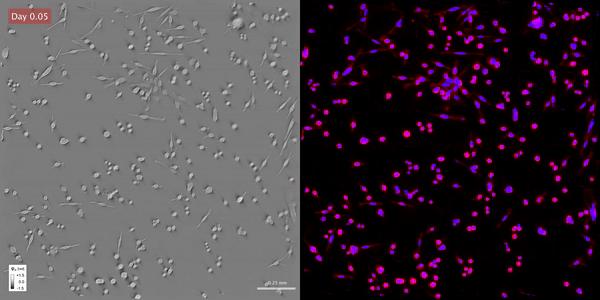
IMAGE
Share on FacebookShare on TwitterShare on LinkedinShare on RedditShare on Telegram

IMAGE

Credit: Popescu group.

Researchers at the University of Illinois Urbana Champaign have developed a new technique that combines label-free imaging with artificial intelligence to visualize unlabeled live cells over a prolonged time. This technique has potential applications in studying cell viability and pathology.

The study “Phase imaging with computational specificity (PICS) for measuring dry mass changes in sub-cellular compartments” was published in Nature Communications.

“Our lab specializes in label-free imaging, which allows us to visualize cells without using toxic chemicals,” said Gabriel Popescu, a professor of electrical and computer engineering and the director of the Quantitative Light Imaging Laboratory at the Beckman Institute for Advanced Science and Technology. “However, we cannot measure specific attributes of the cell without using toxic fluorescent dyes. We have solved that problem in this study.”

“We had this idea that computational methods could estimate what the sample would look like without actually killing the cells,” said Mikhail Kandel, a graduate student in the Popescu group.

The researchers first imaged the cells over several days using their non-destructive label-free technique. At the end of the experiment, they stained the samples and used deep learning, which is a subset of machine learning, to learn where the fluorescence dyes would be located. “This let us estimate the stain in our initial movies without actually staining the cells,” Kandel said.

“Although AI has been used in the past to create one type of imaging from a different type of staining, we were able to program it to analyze the images in real time,” Popescu said. “Using deep learning, we were able to look at cells that had never been tagged with any dye, and the algorithm was able to precisely locate different parts of the cell.”

“Another advantage of the technique is that we can perform experiments over the span of many days. The cells remain alive even after more than a week,” said Yuchen He, a graduate student in the Popescu group. “This cannot be done with fluorescent dyes since the chemical toxicity might kill the cells.”

“This study highlighted the potential of AI-based techniques to learn complicated models such as the concentration of specific dyes, which goes beyond the capabilities of the naked eye,” Kandel said. “The more we can teach our method to recognize patterns, the more kinds of experiments can be performed without resorting to killing the cells.”

The researchers are now trying to adapt deep learning algorithms across different cell lines and biological samples. “Training deep learning models requires a large amount of data because we want to ensure that they work well in different scenarios. Fortunately, our imaging instruments make it easy for us to generate the needed training data in an efficient fashion,” He said.

“These deep learning algorithms can be used for several applications,” Popescu said. “We can assess the cell viability over a long time without labeling the cells, we can differentiate between different cell types in diseases, and we can study different cellular processes.”

###

EDITOR’S NOTE: The study “Phase imaging with computational specificity (PICS) for measuring dry mass changes in sub-cellular compartments” can be found at https://doi.org/10.1038/s41467-020-20062-x.

Media Contact
Ananya Sen
[email protected]

Original Source

https://beckman.illinois.edu/about/news/article/2020/12/07/new-method-uses-artificial-intelligence-to-study-live-cells

Related Journal Article

http://dx.doi.org/10.1038/s41467-020-20062-x

Tags: BiologyCell BiologyMolecular Biology
Share12Tweet8Share2ShareShareShare2

Related Posts

Supercomputer Simulations Uncover How Bacterial Enzyme Pumps Sodium Ions, Opening Doors to Novel Antibiotics — Biology

Supercomputer Simulations Uncover How Bacterial Enzyme Pumps Sodium Ions, Opening Doors to Novel Antibiotics

May 15, 2026
New Astrobiology Special Collection Highlights Emerging Evidence Supporting Land-Based Origins of Life — Biology

New Astrobiology Special Collection Highlights Emerging Evidence Supporting Land-Based Origins of Life

May 14, 2026

Revolutionizing Textiles: Engineered Protein Fibers Pave the Way for Sustainable, Recyclable Fabrics

May 14, 2026

URI Master’s Student Emilio Pedroza Lopez Awarded Prestigious NSF Graduate Research Fellowship

May 14, 2026
Please login to join discussion

POPULAR NEWS

  • Research Indicates Potential Connection Between Prenatal Medication Exposure and Elevated Autism Risk

    843 shares
    Share 337 Tweet 211
  • New Study Reveals Plants Can Detect the Sound of Rain

    729 shares
    Share 291 Tweet 182
  • Salmonella Haem Blocks Macrophages, Boosts Infection

    62 shares
    Share 25 Tweet 16
  • Breastmilk Balances E. coli and Beneficial Bacteria in Infant Gut Microbiomes

    58 shares
    Share 23 Tweet 15

About

We bring you the latest biotechnology news from best research centers and universities around the world. Check our website.

Follow us

Recent News

Scientists Create Ceramic Implants That Replicate Natural Bone Through 3D Printing

Paraprobiotics Mitigate BPA-Induced Damage to Male Fertility Linked to Plastic Exposure

Digital Health Fear Patterns in Older Cancer Patients

Subscribe to Blog via Email

Enter your email address to subscribe to this blog and receive notifications of new posts by email.

Join 82 other subscribers
  • Contact Us

Bioengineer.org © Copyright 2023 All Rights Reserved.

Welcome Back!

Login to your account below

Forgotten Password?

Retrieve your password

Please enter your username or email address to reset your password.

Log In
No Result
View All Result
  • Homepages
    • Home Page 1
    • Home Page 2
  • News
  • National
  • Business
  • Health
  • Lifestyle
  • Science

Bioengineer.org © Copyright 2023 All Rights Reserved.