Credit: Troye Fox
For a drug to intervene in cells or entire organs that are not behaving normally it must first bind to specific protein receptors in the cell membranes. Receptors can change their molecular structure in a multitude of ways during binding – and only the right structure will “unlock” the drug’s therapeutic effect.
Now, a new method of assessing the actions of medicines by matching them to their unique protein receptors has the potential to greatly accelerate drug development and diminish the number of drug trials that fail during clinical trials.
The method, developed by research teams from the University of Wisconsin-Milwaukee and the University of Glasgow, reduces the time and labor of finding the protein receptors “with the right response” to drug candidates by several orders of magnitude.
“It opens up a huge playing field for finding drug targets and drug stratification,” said Valerica Raicu, UW-Milwaukee professor of physics. “Using this method, we can characterize how each receptor responds differently to various drug candidates.”
The study appears today in the journal Nature Methods.
The researchers’ method tracks a chemical process called oligomerization that occurs when a receptor exists as a single subunit, but then shifts to a multi-structure – an oligomer – in the presence of the ligand (drug compound), or vice versa.
“We used to think of these receptors as binary,” said Raicu, who is lead author on the paper. “They were either activated by the compound or not. But now we are beginning to understand that, depending on the ligand, the same receptor can produce many different responses.”
The researchers first tested the method using fused florescent proteins produced by UW-Milwaukee assistant professor Ionel Popa. Then they validated the method on a receptor for a growth factor where malfunction is often linked to cancer – the epidermal growth factor receptor (EGF). Activation of the receptor, resulted in the generation of larger oligomers, as anticipated.
The team then applied their method to a member of the G protein-coupled receptor (GPCR) family, a group of proteins that are targeted by a wide range of medicines.
The effect of the association between ligands and receptors was shown in a matter of hours, compared to months using current technologies.
“This new method of characterizing protein interactions will be important in the stratification of different medicines that target the same receptor,” said Graeme Milligan, Gardiner Chair of Biochemistry at the University of Glasgow. “It will allow us to understand why some drug candidates are effective while others are not and can potentially be applied to different classes of proteins that are targets in the treatment of many diseases.”
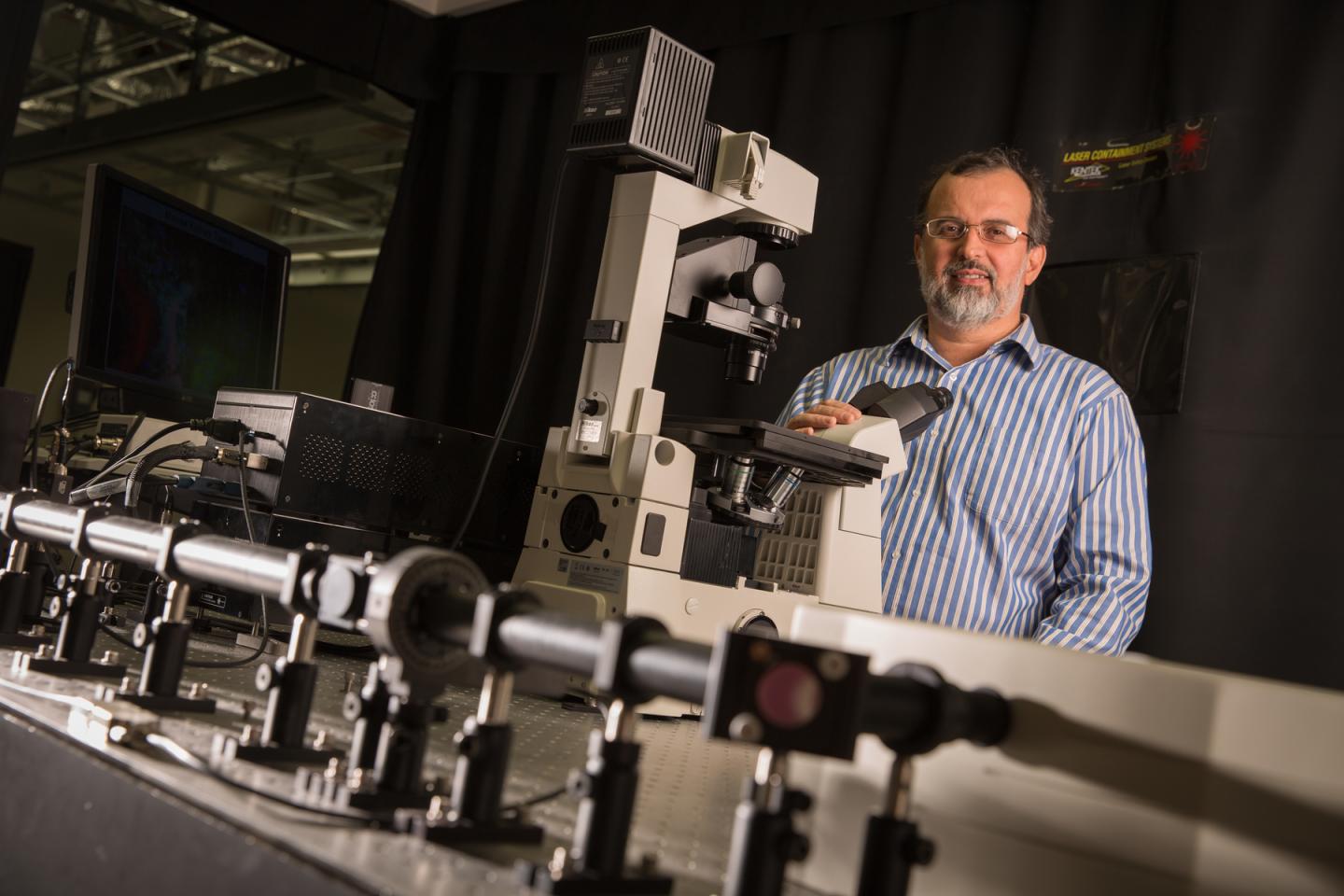
The Raicu lab uses fluorescence-based imaging in order to see protein receptors in oligomeric states under various environmental conditions. Using single- or two-photon excitation microscopy, the researchers can produce a kind of roadmap of the various kinds of protein receptor oligomers in the absence or presence of ligands (or drugs) that bind to them.
Researchers image protein-receptor molecules by attaching florescent tags. This way, single-molecule protein receptors give off light when they pass under a laser and are excited, and those bursts are recorded with a camera. Receptor oligomers give off a more intense burst of light and those are also photographed.
“Now you can graph the intensity and the number of bursts,” said Raicu, “and see how many are associated into oligomers – how big they are – and where they are in the sample. After adding the ligand, you can see whether it promotes association of single molecules of receptor proteins into oligomers, or the breakdown of oligomers into the former.”
###
Media Contact
Valerica Raicu
[email protected]