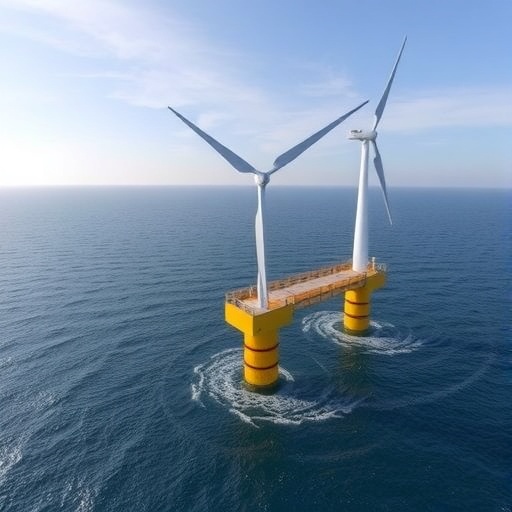
Morocco’s Atlantic coast could become the testing ground for a new generation of offshore wind development, according to a detailed engineering study of a proposed wind farm near Essaouira. Using three decades of atmospheric and ocean data, high-fidelity turbine simulations and open-source economic models, researchers found that a 5-megawatt monopile turbine could produce about 16.6 gigawatt-hours of electricity annually at the selected site. That output corresponds to a capacity factor of 37.9 percent—meaning the turbine would generate, on average, nearly 38 percent of its theoretical maximum output over a year. The study estimates a levelized cost of energy of about $94 per megawatt-hour, suggesting that Morocco’s strong Atlantic winds could help offset the high cost of building and maintaining turbines at sea. But the analysis also identifies a critical engineering vulnerability: roughly 70 percent of the structure’s 25-year fatigue damage accumulates at the base of the monopile foundation, where wind, waves and currents combine to produce relentless cyclic loading.
The result is significant because Morocco is seeking to expand renewable electricity while developing industries that could consume large quantities of clean power, including seawater desalination, green hydrogen and ammonia production. Offshore wind could provide a powerful complement to the country’s existing solar and onshore wind resources, particularly because wind conditions can remain favorable during periods when solar generation declines. The Atlantic coast is considered one of Africa’s richest offshore wind regions, but turning a promising wind map into a bankable project requires much more than estimating a turbine’s output from a simple power curve. Developers must understand how the seabed, wind climate, waves, currents and turbine control system interact over decades. The new assessment attempts to bring those elements together in a preliminary “pre-qualification” framework for a proposed 1,000-megawatt Essaouira offshore wind farm, a project capacity publicly highlighted during the Third United Nations Ocean Conference. The researchers stress that their work is an engineering assessment, not a final construction approval or investment-grade feasibility study.
To characterize the site, the team combined bathymetric information from the EMODnet Bathymetry consortium with hourly ERA5 reanalysis data produced by the European Centre for Medium-Range Weather Forecasts. Bathymetry describes the shape and depth of the seabed, which determines whether a foundation can be installed safely and economically. At the selected location, approximately 31.56 degrees north and 9.74 degrees west, the seabed slopes relatively smoothly away from the coast. The representative water depth was about 20.4 meters, within the range generally considered suitable for fixed monopile foundations. These foundations are large steel tubes driven or drilled into the seabed, supporting the tower and turbine above the water. The ERA5 record covered 30 years, from 1996 to 2024 in the study’s site analysis, and included wind speeds at 10 and 100 meters, air temperature, surface pressure, significant wave height, wave period and wind and wave directions. The long time span is useful for estimating typical climate conditions, although reanalysis data can smooth local extremes and cannot replace measurements from a dedicated offshore monitoring campaign.
The researchers modeled the National Renewable Energy Laboratory’s widely used 5-megawatt reference turbine, a machine with an 87.6-meter hub height, a rotor-and-nacelle mass of roughly 350 tonnes and a rated wind speed of 11.4 meters per second. Wind speeds from the reanalysis dataset were adjusted to hub height using a logarithmic wind-profile relationship, which describes how friction near the sea surface causes wind speed to increase with elevation. The calculation also corrected the turbine input for changing air density, because colder or higher-pressure air contains more mass and can produce more aerodynamic force at the same wind speed. Wind and wave conditions were grouped into representative environmental “clusters” using k-means classification, a statistical method that reduces thousands of weather states to a manageable set of typical combinations. Each cluster was then simulated using OpenFAST, an open-source aero-hydro-servo-elastic model. Its modules calculate rotor aerodynamics, wave-induced hydrodynamics, structural vibrations and control-system behavior simultaneously, allowing the turbine to respond dynamically rather than treating it as a static object.
Each OpenFAST run lasted 720 seconds, with the first 120 seconds discarded to remove start-up and initialization effects. The remaining 10 minutes were used to calculate power output and structural loads. Turbulent winds were generated with the Kaimal spectrum, a standard mathematical representation of the distribution of atmospheric gusts across frequencies. Irregular waves were generated using the Joint North Sea Wave Project spectrum, with a peak-enhancement factor of 3.3 to represent a sharper concentration of wave energy around the peak period. Six independent random seeds were used for the wind and wave simulations, producing different realizations of the same statistical sea state. The model also represented a directional mismatch between wind and waves: the dominant wave direction was set about 45 degrees from the dominant wind direction. That detail matters because offshore structures do not experience wind and wave loading as two perfectly aligned forces. Non-collinear loading can change the pattern of bending, vibration and fatigue in the tower and foundation.
Fatigue is the gradual accumulation of microscopic damage caused by repeated stress cycles, even when every individual load remains below the steel’s ultimate strength. To estimate it, the team converted simulated stress histories into cycles using rainflow counting, an algorithm widely used to identify load reversals in materials subjected to irregular vibration. The resulting stress ranges were corrected for the influence of mean stress using the Goodman relation and compared with S–N curves, which describe how many cycles a welded steel detail can endure at a given stress amplitude. The researchers applied the Category C fatigue class from DNV guidelines to the monopile base, tower base and tower top. They then used Miner’s rule, which assumes that damage accumulates linearly as the fraction of life consumed in each stress cycle, to combine short-term damage across the probability distribution of wind and wave conditions over a 25-year service life. The method found a cumulative fatigue damage value of approximately 0.70 at the monopile base, 0.17 at the tower base and 0.013 at the tower top. A value below one indicates that the simplified design remains within the assumed fatigue-life criterion, although local stress concentrations and unmodeled extreme events could reduce that margin.
The concentration of damage at the monopile base follows basic structural mechanics. Wind pushes against the rotor high above the sea, creating an overturning moment that is transmitted down through the tower. Waves and currents apply additional forces directly to the submerged foundation, particularly near the mudline where the monopile enters the seabed. The combination produces large cyclic bending stresses at the base, while the tower top experiences far smaller structural loads. In a representative case with a wind speed of 11 meters per second, a significant wave height of 3 meters and a peak wave period of 13 seconds, the analysis found that axial stress was the dominant component at the tower base. For a circular cross-section, the normal stress can be expressed as the axial force divided by the cross-sectional area plus bending contributions that vary around the circumference. The greatest stress occurred at the angular positions aligned with the dominant bending direction. This is why foundation design, weld details, scour protection and seabed characterization will be central to any future Moroccan offshore project, even if the turbine itself performs well aerodynamically.
The energy assessment produced a Weibull wind-speed distribution with a shape parameter of 2.19 and a scale parameter of 8.69 meters per second. Weibull distributions are commonly used in wind engineering because they provide a compact description of how often different wind speeds occur. The researchers integrated the simulated power curve with that distribution to estimate annual production. The resulting 16.6 gigawatt-hours per turbine is equivalent to an average output of about 1.9 megawatts from a machine rated at 5 megawatts. Across a 1,000-megawatt farm, a simple multiplication would imply an output on the order of 3.3 terawatt-hours per year before accounting for wake losses, electrical losses, availability, curtailment and other farm-level effects. The study’s economic model estimated total capital costs at $2,688 per kilowatt and annual operating costs at $97.2 per kilowatt. Those figures include turbine and foundation equipment, development, installation, grid connection, maintenance, insurance and administrative expenses. The projected $94-per-megawatt-hour LCOE therefore reflects both the favorable wind resource and the substantial expense of offshore infrastructure.
The study also tested how sensitive its conclusions were to uncertain assumptions. Correcting a possible 5 percent underestimation of wind speed in ERA5 increased the modeled monopile fatigue damage by 16.8 percent, from 0.2964 to 0.3463 in the representative environmental cluster. Mean electrical power increased by 5.4 percent. In contrast, replacing the conservative onshore turbulence model used in the baseline case with an offshore-specific turbulence model reduced calculated fatigue damage by nearly 33 percent while increasing mean power by only 1.2 percent. The researchers also found that fatigue estimates stabilized when environmental conditions were divided into about 20 clusters; using fewer than 10 clusters tended to overestimate damage because broad bins inflated the range of stress cycles. The economic results were most sensitive to financing assumptions. Changing the fixed charge rate from 6 to 9 percent shifted the LCOE from $77.30 to $102.40 per megawatt-hour. A 10 percent change in capital cost produced an LCOE range of $87.33 to $100.67 per megawatt-hour, while changes in annual energy production and operating costs had narrower effects.
The authors emphasize that the results should be treated as a preliminary design screen rather than a guarantee of commercial performance. ERA5’s spatial resolution may miss localized wind jets and underestimate severe storms, while the study lacked long-term measurements from the proposed site to validate the extrapolated wind profile. The analysis focused on normal operating conditions, designated DLC 1.2, and did not include every transient, fault, extreme wind or extreme wave load case required for a complete certification assessment. It also used a uniform stress-concentration factor of one, which may underestimate the effect of weld geometry and other local details, especially at the monopile base. Future work will need offshore measurement campaigns, higher-resolution turbulence models, detailed geotechnical investigations, location-specific stress-concentration factors, multiple design load cases and combined uncertainty analyses. Even with those limitations, the framework offers a potentially valuable route for Morocco’s emerging offshore wind industry. Because it relies on open-source tools such as OpenFAST and WISDEM, local manufacturers, universities and developers could adapt it to other sites and turbine designs. If later measurements confirm the modeled wind climate, the Atlantic coast could provide not only electricity but also a foundation for a broader clean-energy system built around hydrogen, desalination and low-carbon industrial production.
Subject of Research: Site-specific structural fatigue, energy yield and techno-economic feasibility of a 5 MW monopile offshore wind turbine near Essaouira, Morocco.
Article Title: Morocco’s Atlantic Winds Could Power a New Offshore Energy Frontier—but the Seabed Holds the Key
Article References: Hersbach et al., “The ERA5 global reanalysis,” Quarterly Journal of the Royal Meteorological Society (2020); OpenFAST Development Team, OpenFAST v3.1.0 (2022); Jonkman et al., “Definition of a 5-MW Reference Wind Turbine for Offshore System Development,” NREL (2009); DNV GL, DNVGL-RP-C203: Fatigue Design of Offshore Steel Structures (2016); EMODnet Bathymetry Consortium, EMODnet Bathymetry (2023).
Image Credits: AI Generated
Keywords: Morocco, Essaouira, offshore wind, renewable energy, monopile foundations, fatigue damage, OpenFAST, ERA5, green hydrogen, levelized cost of energy
Tags: 5MW monopile turbine performanceAtlantic coast wind farm developmentfatigue damage at wind turbine foundationshigh-fidelity offshore wind modelingMoroccan Atlantic metocean conditionsoffshore wind capacity factorOffshore wind energy in Moroccooffshore wind project economicsoffshore wind turbine simulationoffshore wind vulnerability to cyclic loadingrenewable energy expansion in Moroccorenewable energy levelized cost analysisseawater desalination and green hydrogen production