Credit: University of Basel, Department of Physics/Swiss Nanoscience Institute
Scientists have developed a new method of characterizing graphene's properties without applying disruptive electrical contacts, allowing them to investigate both the resistance and quantum capacitance of graphene and other two-dimensional materials. Researchers from the Swiss Nanoscience Institute and the University of Basel's Department of Physics reported their findings in the journal Physical Review Applied.
Graphene consists of a single layer of carbon atoms. It is transparent, harder than diamond and stronger than steel, yet flexible, and a significantly better conductor of electricity than copper. Since graphene was first isolated in 2004, scientists across the world have been researching its properties and the possible applications for the ultrathin material. Other two-dimensional materials with similarly promising fields of application also exist; however, little research has been carried out into their electronic structures.
No need for electrical contacts
Electrical contacts are usually used to characterize the electronic properties of graphene and other two-dimensional materials. However, these can significantly alter the materials' properties. Professor Christian Schönenberger's team from the Swiss Nanoscience Institute and the University of Basel's Department of Physics has now developed a new method of investigating these properties without applying contacts.
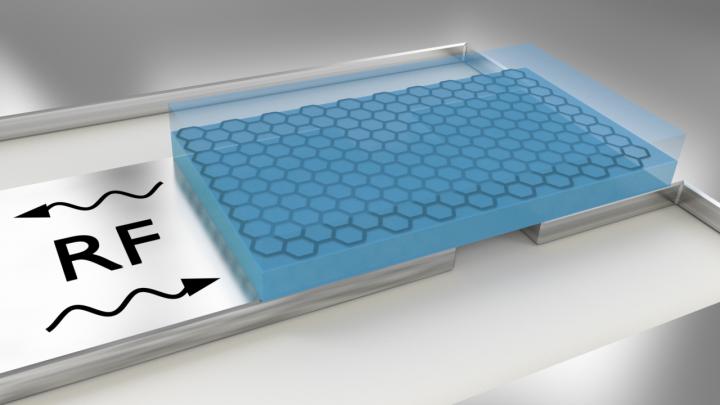
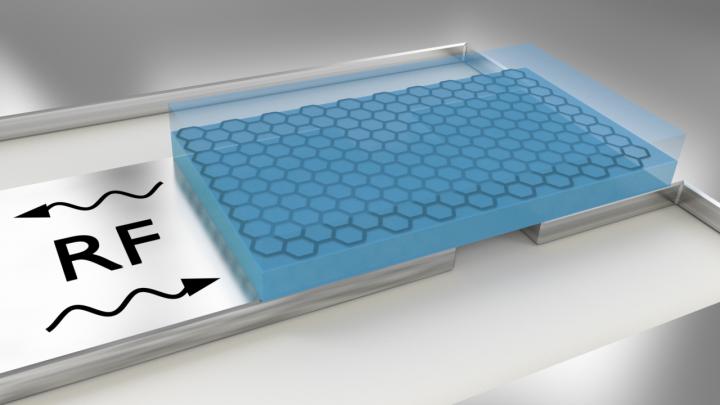
To do this, the scientists embedded graphene in the isolator boron nitride, placed it on a superconductor and coupled it with a microwave resonator. Both the electrical resistance and the quantum capacitance of the graphene affect the quality factor and resonance frequency of the resonator. Although these signals are very weak, they can be captured using superconducting resonators.
By comparing the microwave characteristics of resonators with and without encapsulated graphene, the scientists can determine both the electrical resistance and quantum capacitance. "These parameters are important in the determination of graphene's exact properties and in the identification of limiting factors for its application," explains Simon Zihlmann, a PhD student in Schönenberger's group.
Also suitable for other two-dimensional materials
The boron nitride-encapsulated graphene served as a prototype material during the method's development. Graphene integrated into other materials can be investigated in the same way. In addition, other two-dimensional materials can also be characterized without the use of electrical contacts; for example, the semiconductor molybdenum disulfide, which has applications in solar cells and optics.
###
Originalbeitrag
V. Ranjan, S. Zihlmann, P. Makk, K. Watanabe, T. Taniguchi, and C. Schönenberger
Contactless Microwave Characterization of Encapsulated Graphene p-n Junctions
Physical Review Applied (2017) | doi: 10.1103/PhysRevApplied.7.054015
Further information
Professor Christian Schönenberger, University of Basel, Department of Physics / Swiss Nanoscience Institute, tel. +41 61 207 36 90, email: [email protected]
Media Contact
Olivia Poisson
[email protected]
@UniBasel_en
http://www.unibas.ch/
############
Story Source: Materials provided by Scienmag