Using photoionization as an ultrafast, optical shutter, slow visible-light cameras can measure femtosecond extreme ultraviolet laser pulses
Credit: Los Alamos National Laboratory
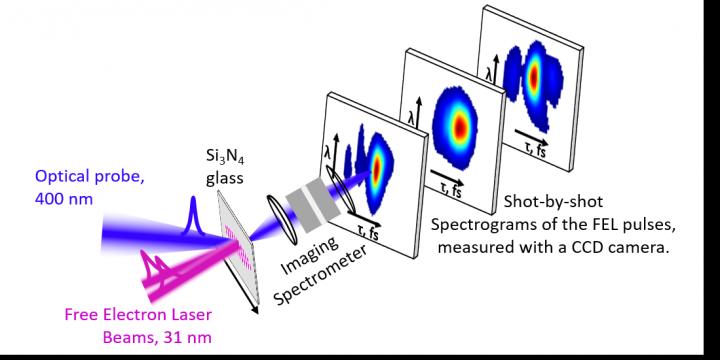
LOS ALAMOS, N.M., April 14, 2021–New research shows how to measure the super-short bursts of high-frequency light emitted from free electron lasers (FELs). By using the light-induced ionization itself to create a femtosecond optical shutter, the technique encodes the electric field of the FEL pulse in a visible light pulse so that it can be measured with a standard, slow, visible-light camera.
“This work has the potential to lead to a new online diagnostic for FELs, where the exact pulse shape of each light pulse can be determined. That information can help both the end-user and the accelerator scientists,” said Pamela Bowlan, Los Alamos National Laboratory’s lead researcher on the project. The paper was published April 12, 2021 in Optica. “This work also paves the way for measuring x-ray pulses or femtosecond time-resolved x-ray images.”
Free electron lasers, which are driven by kilometer-long linear accelerators, emit bursts of short-wavelength light lasting one quadrillionth of a second. As a result, they can act as strobe lights for viewing the fastest events in nature–atomic or molecular motion–and therefore promise to revolutionize our understanding of almost any kind of matter.
Measuring such a vanishingly rapid burst of ionizing radiation has previously proved challenging. But while electronics are too slow to measure these light pulses, optical effects can be essentially instantaneous. Squeezing all of the energy of a continuous laser into short pulses means that femtosecond laser pulses are extremely bright and have the ability to modify a material’s absorption or refraction, creating effectively instantaneous “optical shutters.”
This idea has been widely used for measuring visible-light femtosecond laser pulses. But the higher-frequency extreme ultraviolet light from FELs interacts with matter differently; this light is ionizing, meaning that it pulls electrons out of their atoms. The researchers showed that ionization itself can be used as a “femtosecond optical shutter” for measuring extreme ultraviolet laser pulses at 31 nanometers.
“Ionization typically changes the optical properties of a material for nanoseconds, which is 10,000 times slower than the FEL pulse duration,” Bowlan said. “But the duration of the rising edge of ionization, determined by how long it takes the electron to leave the atom, is significantly faster. This resulting change in the optical properties can act as the fast shutter needed to measure the FEL pulses.”
###
The paper: “All-optical single shot complete electric field measurement of extreme ultraviolet free electron laser pulses.” Optica, April 2021. DOI: https:/
Participants: Los Alamos researchers on this project were William K. Peters, Travis Jones, Anatoly Efimov, and Pamela Bowlan
Funding: This work was performed at the FERMI Free Electron Laser in Trieste, Italy, in collaboration with Emanuele Pedersoli, Laura Foglia, Riccardo Mincigrucci, Ivaylo Nikolov, Miltcho B. Danailov, Flavio Capotondi, and Filippo Bencivenga and with Rick Trebino from Georgia Tech. This work was funded under the Los Alamos Laboratory Directed Research and Development (LDRD) grant 20180242ER. Travis Jones was supported by the African American Partnership Program.
About Los Alamos National Laboratory
Los Alamos National Laboratory, a multidisciplinary research institution engaged in strategic science on behalf of national security, is managed by Triad, a public service oriented, national security science organization equally owned by its three founding members: Battelle Memorial Institute (Battelle), the Texas A&M University System (TAMUS), and the Regents of the University of California (UC) for the Department of Energy’s National Nuclear Security Administration.
Los Alamos enhances national security by ensuring the safety and reliability of the U.S. nuclear stockpile, developing technologies to reduce threats from weapons of mass destruction, and solving problems related to energy, environment, infrastructure, health, and global security concerns.
Media Contact
Charles Poling
cpoling@lanl.gov
Original Source
https:/
Related Journal Article
http://dx.