• HOME
  • NEWS
  • EXPLORE
    • CAREER
      • Companies
      • Jobs
    • EVENTS
    • iGEM
      • News
      • Team
    • PHOTOS
    • VIDEO
    • WIKI
  • BLOG
  • COMMUNITY
    • FACEBOOK
    • INSTAGRAM
    • TWITTER
Saturday, June 27, 2026
BIOENGINEER.ORG
No Result
View All Result
  • Login
  • HOME
  • NEWS
  • EXPLORE
    • CAREER
      • Companies
      • Jobs
        • Lecturer
        • PhD Studentship
        • Postdoc
        • Research Assistant
    • EVENTS
    • iGEM
      • News
      • Team
    • PHOTOS
    • VIDEO
    • WIKI
  • BLOG
  • COMMUNITY
    • FACEBOOK
    • INSTAGRAM
    • TWITTER
  • HOME
  • NEWS
  • EXPLORE
    • CAREER
      • Companies
      • Jobs
        • Lecturer
        • PhD Studentship
        • Postdoc
        • Research Assistant
    • EVENTS
    • iGEM
      • News
      • Team
    • PHOTOS
    • VIDEO
    • WIKI
  • BLOG
  • COMMUNITY
    • FACEBOOK
    • INSTAGRAM
    • TWITTER
No Result
View All Result
Bioengineer.org
No Result
View All Result
Home NEWS Science News Chemistry

New method for quicker and simpler production of lipidated proteins

Bioengineer by Bioengineer
October 15, 2019
in Chemistry
Reading Time: 2 mins read
0
IMAGE
Share on FacebookShare on TwitterShare on LinkedinShare on RedditShare on Telegram

IMAGE

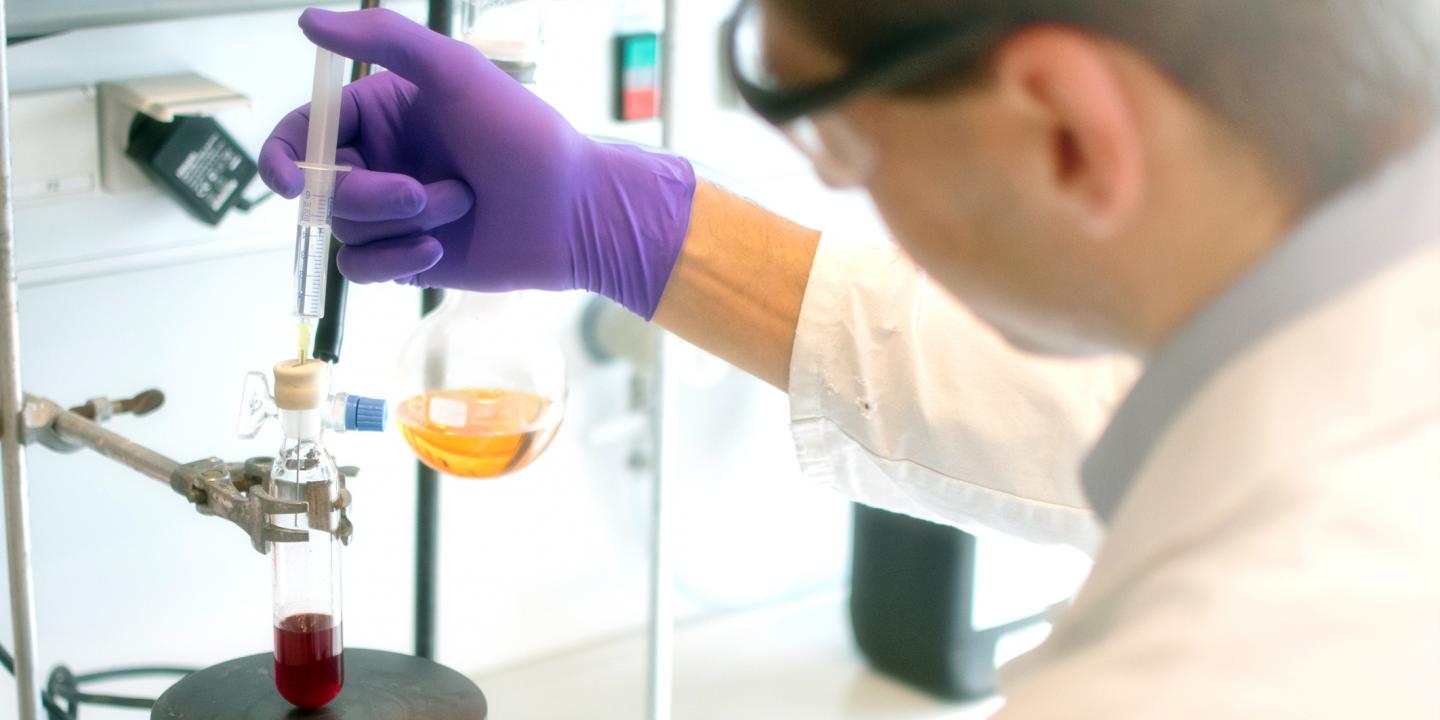
Credit: © TU Graz/ORGC

Some of the body’s proteins are not just made up of amino acids, they are also ‘decorated’ with lipid chains, which significantly influence the biological functions of the protein. An example is the Ras protein, which plays a role in the development of many types of cancers and is only active and cancer-causing if it is able to bind to the cell membrane with the help of a ‘lipid anchor’.

Fundamental research as a basis for medical progress

Gaining a better understanding of these processes in the human body can greatly accelerate the development of new medicines and cancer therapies. However, the methods of investigation employed up to now have proven very time-consuming and costly. Rolf Breinbauer from TU Graz’s Institute of Organic Chemistry and Christian Becker from the Institute of Biological Chemistry at the University of Vienna have come up with a much simpler and direct method of introducing lipids into protein, which they recently published in the Journal of the American Chemical Society (JACS).

A noble metal for protein modification

The researchers used the noble metal palladium as a catalyst for attaching lipids to proteins. BIPHEPHOS a type of ligand, plays a crucial role in the process, explains Breinbauer: “We tested a total of 50 different ligands. BIPHEPHOS was kind of the ‘missing link’. It has the selectivity needed for palladium to facilitate the lipidation of the sulphurous amino acid cysteine.”

Protein chemist Christian Becker applied what they had learned to proteins, with equally successful results: “The outstanding selectivity of the new catalyst and the robust reaction facilitate the rapid modification of numerous cysteine-containing peptides and proteins for use in biomedical research.”

Medical application

Decorating proteins with pharmaceuticals and other molecules for targeted delivery into the body and for keeping them active is an approach commonly used in medicine today. The method developed by Breinbauer and Becker could now be used to accurately and efficiently introduce such molecules into proteins. Breinbauer is confident that their method will soon be adopted because “the reagents we used are very easy to manufacture or can be purchased.”

###

Original publication: https://pubs.acs.org/doi/10.1021/jacs.9b08279

This research project is a stand-alone project funded by the Austrian Science Fund (FWF) and is part of the Human & Biotechnology Field of Expertise (FoE), one of five research focuses at TU Graz, as well as the Biology and Medical Chemistry research focus of the Faculty of Chemistry at the University of Vienna.

Media Contact
Rolf Breinbauer
[email protected]
43-031-687-332-400

Related Journal Article

http://dx.doi.org/10.1021/jacs.9b08279

Tags: BiochemistryCell BiologyChemistry/Physics/Materials SciencesPharmaceutical SciencesPharmaceutical/Combinatorial ChemistryResearch/Development
Share13Tweet8Share2ShareShareShare2

Related Posts

AI and Physics Collaborate to Design Advanced Hydrogen Storage Materials

June 25, 2026

International Team Including Dresden Scientists Develops Novel Designer Proteins for Advanced Study of Living Tissue

June 25, 2026

New Study Uncovers Key Factors Driving Water Chemistry in Nanoscale Environments

June 25, 2026

Plasma Technology Extends Catalyst Lifespan in Hydrogen Production

June 24, 2026
Please login to join discussion

POPULAR NEWS

  • Saying Goodbye to PGY-6: Pediatric Fellowship Realities

    103 shares
    Share 41 Tweet 26
  • Multi-Hospital Study Reveals Long Covid Burden Is Twice as High as Current Estimates

    92 shares
    Share 36 Tweet 23
  • Detection of EDCs in Breast Milk and Infant Urine Up to Six Months Highlights Early Exposure Risks

    77 shares
    Share 31 Tweet 19
  • New Drug Candidate Developed at McMaster Shows Potential for Treating Brain Cancer

    58 shares
    Share 23 Tweet 15

About

We bring you the latest biotechnology news from best research centers and universities around the world. Check our website.

Follow us

Recent News

Tracking Lanthanide-Labeled Microplastics in Plants

POSTECH Researchers Slash Cost of Reconstituted Cell-Free Systems by 95%

AI and Physics Collaborate to Design Advanced Hydrogen Storage Materials

Subscribe to Blog via Email

Success! An email was just sent to confirm your subscription. Please find the email now and click 'Confirm' to start subscribing.

Join 82 other subscribers
  • Contact Us

Bioengineer.org © Copyright 2023 All Rights Reserved.

Welcome Back!

Login to your account below

Forgotten Password?

Retrieve your password

Please enter your username or email address to reset your password.

Log In
No Result
View All Result
  • Homepages
    • Home Page 1
    • Home Page 2
  • News
  • National
  • Business
  • Health
  • Lifestyle
  • Science

Bioengineer.org © Copyright 2023 All Rights Reserved.