Geotechnical researchers investigating open-pit dimension-stone operations have formulated the Marble Rock System, a preliminary rock mass classification framework designed specifically to assess bench stability in marble quarries. Traditional rock mass classification schemes, including the Rock Mass Rating, the Norwegian Geotechnical Institute Q-system, and the Geological Strength Index, were historically calibrated against civil tunnelling projects and mining excavations across diverse lithologies. Consequently, these general-purpose indices display substantial technical limitations when applied to the extraction benches of dimension-stone quarries. Standard frameworks fail to quantify the severe strength degradation associated with secondary mineralogical alteration, allocate insufficient weight to structural discontinuities compared to intact rock strength, and lack integrated mechanisms to evaluate kinematic block detachment hazards at the quarry bench scale. To address these deficiencies, the newly developed index incorporates six site-specific geomechanical parameters whose individual weightings were formally established using multi-criteria decision analysis calibrated by experienced field practitioners.
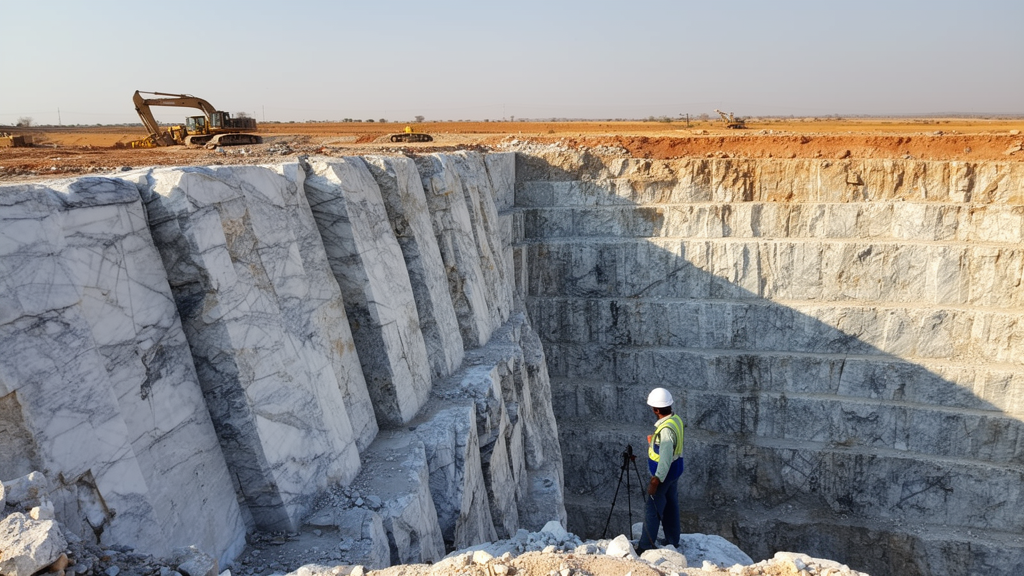
The empirical foundation of the classification framework is rooted in field investigations conducted across the southern Rajasthan Marble Belt in northwestern India. Geologically, this mining district is situated within the Precambrian metasedimentary sequence of the Aravalli Supergroup. Regional tectonic processes subjected the original carbonate sediments to amphibolite-facies metamorphism, recrystallizing limestone into medium- to coarse-grained calcite marble units. In localized structural zones, subsequent retrograde metamorphism produced pervasive serpentinization and dolomitization along major tectonic shear planes. The extraction operations across this belt function as open-pit bench quarries characterized by working bench heights ranging between 3 and 8 meters, with face inclinations maintained between 70 and 80 degrees. Detailed lithostratigraphic profiling established that commercial extraction concentrates in an exploitation interval designated as Zone II, situated between 4 and 12 meters below the ground surface, where structural defect distributions and alteration patterns govern geomechanical bench behavior.
Primary field investigations focused on three distinct production sites chosen to capture regional lithological and structural diversity: the Morwad quarry, the JK Arora quarry, and the Rishabhdev quarry. Laboratory and field measurements revealed pronounced contrasts in rock mass competence across these operations. The Morwad site extracts dolomitic marble displaying a mean intact uniaxial compressive strength of 44 megapascals, with measured station values spanning 34.5 to 55.6 megapascals, accompanied by moderate jointing frequency. The JK Arora quarry exploits massive white marble possessing an intermediate mean intact strength of 52 megapascals, ranging from 43.9 to 60.2 megapascals, but exhibits polished joint surfaces that induce elevated kinematic risks of planar sliding. The Rishabhdev quarry yields the highest intact compressive competence, averaging 102 megapascals with individual tests spanning from 67.0 to 153.3 megapascals. However, Rishabhdev is intersected by dense bands of retrograde serpentinization where cohesion loss dominates stability despite superior intact rock strength.
To characterize the structural geometry of the rock masses, geomechanical data were assembled from 45 bench-face scanline stations established in accordance with International Society for Rock Mechanics guidelines, with 15 stations mapped per quarry. Each station encompassed a minimum 10-meter scanline recording discontinuity frequency, structural orientation via Brunton compass, aperture, surface roughness, infill mineralogy, and static water seepage. Discontinuity poles plotted on equal-area lower-hemisphere stereographic projections identified four dominant joint sets at each quarry. At Morwad, steeply dipping westward and northward joint sets generate wedge failure geometries. At JK Arora, moderately southeast-dipping planes intersecting near-vertical north-south joints produce critical wedge hazards along north-facing walls. At Rishabhdev, serpentinized foliation planes aligned sub-parallel to quarry faces represent principal planar sliding hazards. Parallel Geological Strength Index evaluations conducted by independent observers demonstrated an inter-rater discrepancy of 4.2 plus or minus 2.1 units.
The resulting Marble Rock System is structured around six independently quantifiable geomechanical parameters designated M1 through M6, completely excluding non-engineering aesthetic criteria such as color uniformity or commercial grade. Parameter M1 measures intact uniaxial compressive strength from specimens tested within 48 hours of excavation to capture intact bridge shear capacity. Parameter M2 measures chemical alteration and weathering, employing X-ray fluorescence magnesium content as a proxy for serpentinization. This alteration converts original calcite into talc and antigorite, decreasing rock cohesion by 30 to 60 percent and depressing internal friction angles to between 10 and 15 degrees. Parameter M3 encodes block geometry through Rock Quality Designation and fracture frequency, derived from drill core or volumetric estimates. Parameter M4 assesses joint spacing and condition, encompassing roughness and infill state. Parameter M5 categorizes static groundwater seepage into dry, damp, dripping, or flowing states without asserting transient coupling, while parameter M6 evaluates kinematic block stability disposition.
Weighting factors for the six geomechanical parameters were calculated using the Analytical Hierarchy Process based on a six-by-six pairwise comparison matrix evaluated by five experienced geotechnical practitioners utilizing the standard nine-point Saaty scale. The mathematical evaluation demonstrated an exceptionally low consistency ratio of 0.002, safely beneath the formal 0.10 threshold required to confirm analytical consistency. The normalized weighting distribution allocated 28.3 percent of the total rating to joint frequency and Rock Quality Designation (M3), and an identical 28.3 percent to joint spacing and surface condition (M4). Parameter M6 received 16.4 percent of the weight, whereas intact strength (M1), alteration state (M2), and groundwater conditions (M5) were each assigned 9.0 percent. Consequently, structural discontinuity characteristics (M3 and M4) combine to command 56.6 percent of the total classification weight, reflecting field observations showing that all observed bench instabilities were structurally governed.
A notable statistical feature of the primary field database is that parameter M6 exhibited zero empirical variance across all 45 survey stations. This occurred because every active bench face evaluated during field surveys yielded kinematically favorable structural assessments under Markland stereographic kinematic criteria. Despite its lack of statistical variation within this specific regional dataset, the research team retained parameter M6 within the core mathematical framework as an architecturally essential component for wider deployment. Parametric sensitivity simulations demonstrated that adjusting the M6 score across its full theoretical range from 0 to 16 points can alter the cumulative Marble Rock System rating by up to 16 points. For stations situated adjacent to classification thresholds, this variation is sufficient to cross two distinct stability classes. Retaining M6 prevents structural distortion when evaluating quarry sites presenting adverse structural orientations.
The cumulative rating rubric for the Marble Rock System establishes a maximum possible score of 99 points calculated from unrounded normalized analytical hierarchy weights, with rounded values presented for field operational convenience. Classification boundaries defining five distinct stability classes, spanning from Class A representing very good rock mass conditions down to Class E indicating very poor stability, were defined through leave-one-out sensitivity analyses applied across the primary scanline records. The authors explicitly emphasized that these class thresholds reflect empirical score distributions within the metamorphic terrane rather than back-analyzed slope failure probabilities. Consequently, assigning an excavation face to an intermediate class provides an indicative geomechanical competence grouping rather than a validated mathematical probability of physical bench collapse, distinguishing the preliminary conceptual tool from mature engineering classification manuals.
Statistical validation against conventional geotechnical indices demonstrated that the Marble Rock System aligns logically with recognized rock mechanics frameworks. Pearson correlation matrices computed on primary field observations revealed that parameters M3 and M4 exhibit the strongest correlation with total score, yielding correlation coefficients of 0.78 and 0.71 respectively at significance levels below 0.001. Ordinary least-squares linear regression against the Rock Mass Rating produced the relationship RMR equals 0.937 multiplied by MRS plus 4.4, with a coefficient of determination of 0.569 across 150 total records. This moderate correlation is consistent with published correspondences between slope indices in carbonate environments. Furthermore, rock mass deformability modulus estimated via the Hoek-Diederichs formulation exhibited an exponential relationship with the system score, described by Erm equals 0.193 multiplied by the exponential of 0.0656 times MRS, achieving a strong determination coefficient of 0.908.
To explore machine learning as an operational field scoring aid, four supervised classification algorithms were implemented: Random Forest, Extra Trees, Support Vector Machines with radial basis function kernels, and an Artificial Neural Network comprising two hidden layers of 64 and 32 units utilizing rectified linear activation. The primary field dataset of 45 records was expanded for algorithmic training by generating 105 synthetic records using Gaussian noise augmentation with a standard deviation set to five percent of each parameter’s range. The composite 150-record dataset exhibited a severe binary class distribution consisting of 138 Class C records and 12 Class B records, with no representations of Classes A, D, or E. Synthetic Minority Over-sampling Technique was applied strictly within training folds during stratified cross-validation to mitigate this 92-to-8 imbalance while preserving independent test integrity.
Comparative evaluation between training configurations demonstrated that noise augmentation did not distort classifier learning behavior. On primary field records alone evaluated under five-fold stratified cross-validation, the Random Forest model achieved an accuracy of 0.977 plus or minus 0.039, the Extra Trees model achieved 0.956 plus or minus 0.044, the Support Vector Machine attained 0.956 plus or minus 0.044, and the Artificial Neural Network reached 0.890 plus or minus 0.033. Under ten-fold cross-validation on the augmented 150-record dataset, accuracies were 0.980 for Random Forest, 0.973 for Extra Trees, 0.973 for Support Vector Machines, and 0.893 for the Neural Network. Minimal accuracy differences ranging from 0.001 to 0.017 confirmed dataset consistency. Permutation feature importance across 50 iterations identified parameter M3 as the dominant predictive feature, followed in sequence by intact strength M1, joint condition M4, groundwater M5, and alteration M2.
Notwithstanding strong classification metrics, the investigators framed all machine learning findings as exploratory operational tools rather than scientific validations of the underlying system. Because a baseline classifier predicting Class C universally would obtain 92 percent accuracy on the imbalanced dataset, high test scores primarily reflect class distribution rather than universal discriminatory power. Monte Carlo uncertainty simulations running 5,000 iterations at a five percent input error level established a 90 percent confidence interval spanning approximately 10 score points. Complete generalizability across diverse commercial marble provinces remains unproven. Consequently, the research team outlined a seven-priority development roadmap requiring multi-region data collection exceeding 200 primary stations across Italy, Turkey, and the Himalayas, numerical back-analysis of historical bench failures, unmanned aerial vehicle photogrammetric joint characterization, transient hydromechanical groundwater modeling, and comprehensive validation across all five geomechanical stability classes.
Subject of Research: Geomechanical rock mass classification for bench stability in dimension-stone marble quarries
Article Title: Development, statistical validation, and machine learning prediction of bench stability for a marble-specific rock mass classification system with analytical hierarchy process-derived parameter weighting: a case study for Rajasthan Quarries, India
Article References: Sinha, S., Tripathi, A. K., Avchar, A., & Kumar, M. (2026). Development, statistical validation, and machine learning prediction of bench stability for a marble-specific rock mass classification system with analytical hierarchy process-derived parameter weighting: a case study for Rajasthan Quarries, India. Journal of Engineering and Applied Science, 73(1), Article 467. https://doi.org/10.1186/s44147-026-01308-9
Image Credits: AI Generated
DOI: 10.1186/s44147-026-01308-9
Keywords: Marble Rock System, Rock Mass Classification, Bench Stability, Southern Rajasthan Marble Belt, Analytical Hierarchy Process, Geomechanical Characterization, Retrograde Serpentinization, Uniaxial Compressive Strength, Rock Quality Designation, Markland Kinematic Analysis, Random Forest Classifier, Deformability Modulus, Discontinuity Mapping, Dimension Stone Quarrying, Rock Mass Rating, Geological Strength Index, Geotechnical Engineering
News Source: Denise Maddox. (November 18, 2026). New Marble Rock System Evaluates Bench Stability Across Three Rajasthan Quarries. Scienmag.