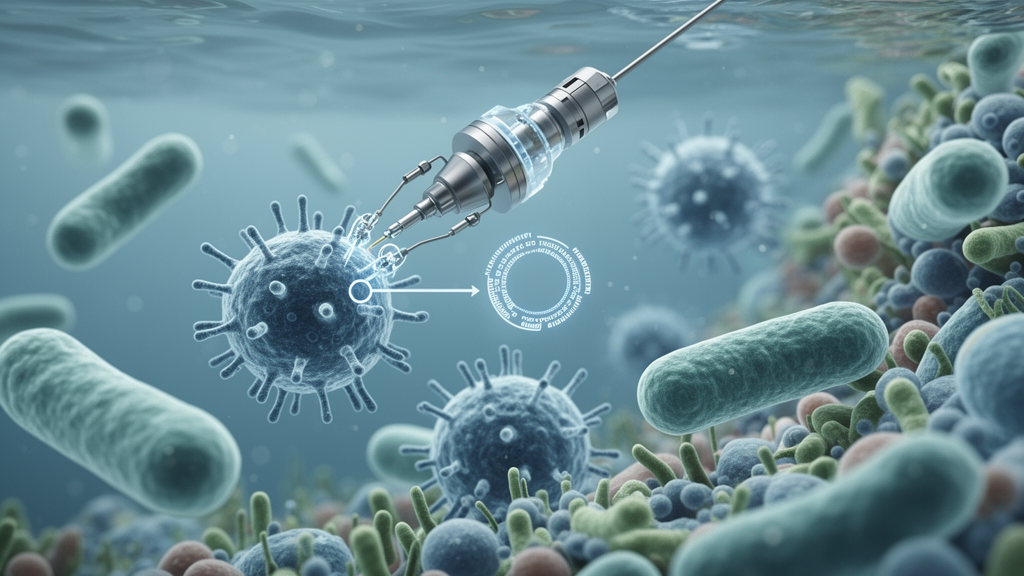
Targeting bacterial mating structures with plasmid-dependent phages induces selective shifts in plasmid populations without altering overall bacterial abundance or taxonomic composition in wastewater microbiomes. Researchers evaluated this biological approach across domestic and hospital wastewater communities to determine whether these specialized viruses could curb conjugative plasmids, which serve as primary drivers for the horizontal dissemination of antibiotic resistance.
Conjugative plasmids facilitate horizontal gene transfer and spread resistance traits, making their persistence in wastewater systems a critical environmental concern. Plasmid-dependent phages specifically infect bacteria carrying these conjugative elements by binding to the mating structures encoded by the plasmids themselves. To assess their real-world impact, investigators tested three distinct phages—PRD1, Lu221, and Hgal1—against wastewater microbiomes using serial cultivation alongside metagenomic sequencing at 24-hour and 48-hour intervals.
In control cultures grown without phage supplementation, microbial communities consistently converged toward assemblages dominated by Enterobacterales. This unhindered progression caused an overall reduction in community diversity, coupled with an enrichment of extended-spectrum beta-lactamase-producing bacteria and conjugative plasmids harboring antibiotic resistance genes.
Introducing the phages yielded mixed survival kinetics depending on the specific viral treatment. Infectious titers remained sustained over time in both cocktail treatments and resident-phage exposures, whereas titers of the phage PRD1 exhibited a steady decline during cultivation. Despite evidence of active viral infection, the phages produced minimal detectable changes in the total abundance of bacteria, broader taxonomic structures, or phenotypic antibiotic resistance levels.
Metagenomic analyses uncovered source-specific and treatment-specific variations restricted primarily to conjugative plasmid systems, particularly within the MPF_F and MPF_T mating-pair formation types. The phage PRD1 triggered transient increases in conjugative plasmids, while resident phages stimulated the enrichment of MPF_F systems specifically in hospital-derived communities.
The observed selective pressures were strictly confined to plasmid-level dynamics and failed to translate into detectable community-wide changes. Researchers concluded that while plasmid-dependent phages actively influence plasmid populations, their evolutionary and ecological effects remain decoupled from broader community outcomes under high-turnover wastewater conditions.
Subject of Research: Plasmid-dependent phage selective pressure on wastewater conjugative plasmids
Article Title: Effect of plasmid-dependent phages on the plasmid load of bacterial communities from domestic and hospital wastewater
Article References: Parra, B., Arriagada-Moreno, V., He, Z., Nesme, J., Smets, B. F., Rivera, D., & Dechesne, A. (2026). Effect of plasmid-dependent phages on the plasmid load of bacterial communities from domestic and hospital wastewater. Microbial Ecology. https://doi.org/10.1007/s00248-026-02896-y
Image Credits: AI Generated
DOI: 10.1007/s00248-026-02896-y
Keywords: microbial ecology, plasmid-dependent phages, conjugative plasmids, antibiotic resistance, horizontal gene transfer, domestic wastewater, hospital wastewater, bacteriophages, metagenomic sequencing, Enterobacterales, ESBL, MPF_F, MPF_T, PRD1, Lu221, Hgal1, wastewater microbiome, bacterial communities
News Source: Morgan Morrow. (November 20, 2026). Specialized Phages Shift Wastewater Plasmids Without Altering Broader Bacterial Communities. Scienmag.