Credit: Credits: NASA
As Artemis astronauts lift off from NASA’s Kennedy Space Center, Florida, new ground systems will provide them with the communications links needed to ensure safety and mission success.
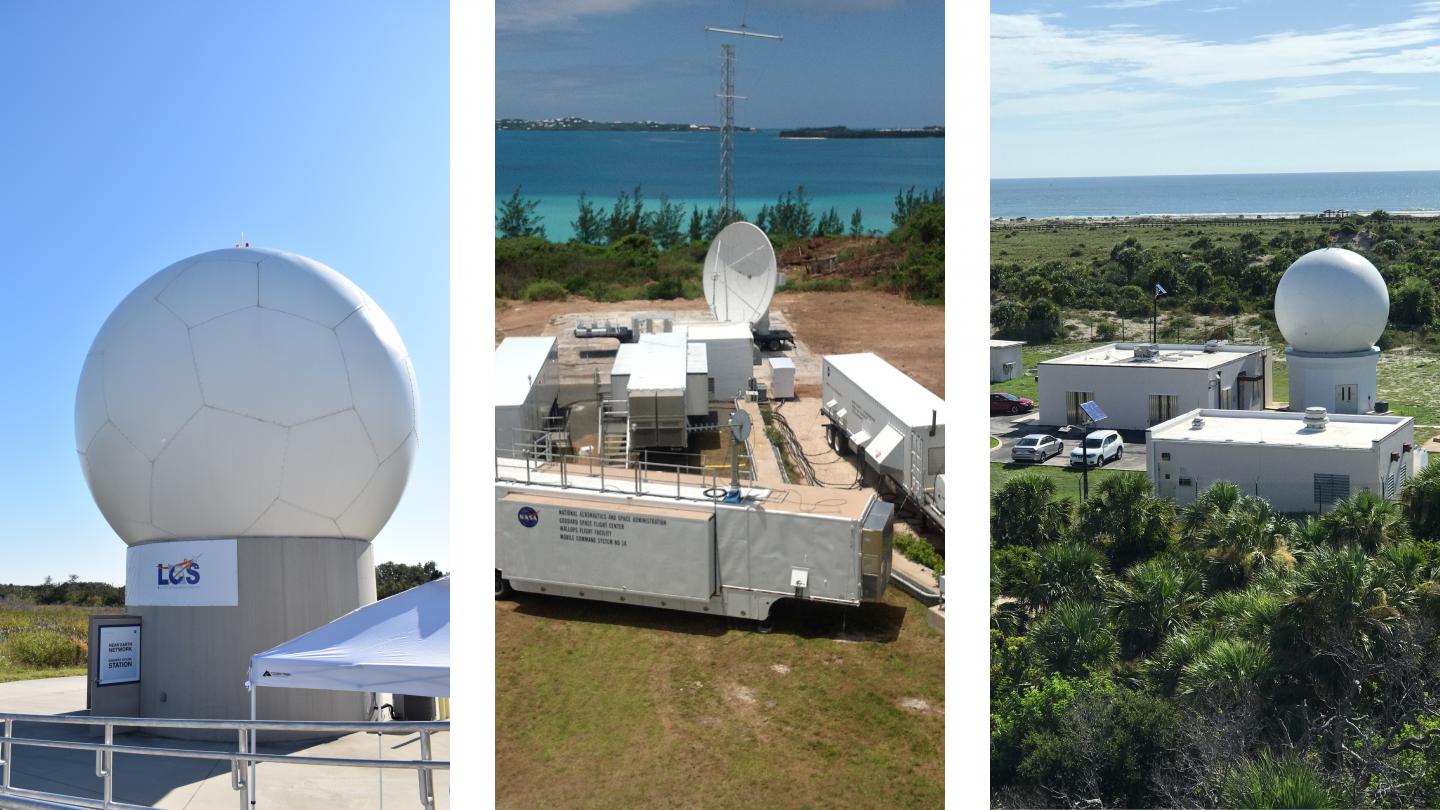
On Robert H. Goddard Road at Kennedy, a small dome housing a 20-foot antenna rises from the surrounding wetlands. This new ground station is the Kennedy Uplink Station, one of three that comprise the Near Earth Network’s Launch Communications Segment, managed by NASA’s Goddard Space Flight Center in Greenbelt, Maryland. The station is a product of interagency and inter-center collaboration that improves efficiencies, reduces costs and will enable NASA’s Artemis missions to the Moon.
Managers and support staff of the Launch Communications Segment held a ribbon cutting ceremony at the Kennedy Uplink Station on Tuesday, November 19. There, leadership from Goddard and Kennedy celebrated the critical role this segment will play in NASA’s journey forward to the Moon, Mars and beyond.
“It’s an exciting time to be involved in human spaceflight,” said Kennedy Center director Robert D. Cabana. “The capabilities provided by the Launch Communications Segment – this collaborative effort of Kennedy and Goddard – show how the Artemis missions empower us all to explore as one.”
Goddard commissioned the Launch Communications Segment to support the Orion spacecraft and the Space Launch System (SLS), which will be the most powerful rocket in the world. The Kennedy station, alongside companion stations Ponce De Leon (also in Florida) and Bermuda, will facilitate communications for launch of Artemis missions to the Moon.
During initial phases of launch, the Kennedy Uplink Station and Ponce De Leon will provide uplink and downlink communications between Artemis astronauts and mission controllers, giving them the data necessary to ensure crew safety. In the final phases of ascent, the Bermuda station will downlink high data rate telemetry from SLS while Orion data is communicated via the constellation of Tracking and Data Relay Satellites in geosynchronous orbit, about 22,000 miles overhead.
Each station in the Launch Communications Segment provides a complementary view of Orion and SLS during launch. For the space shuttle, all three data streams were sent to end users even though data from one station was always better than the others at different times during the flight. This made operations more complex.
Now, the segment merges data from the three stations into one clear stream to mission controllers, simplifying operations and reducing costs.
In the era of the space shuttle, the Merritt Island Launch Annex (MILA) facilitated launch communications for crewed missions launching from Kennedy. MILA needed a lot of operator involvement to provide communications between the space shuttle and mission control, requiring around 50 full-time employees to support launches.
In contrast, computers now autonomously handle most complicated networking functions. Supervision of routine operations is handled remotely. Thanks to these technological advancements, just a handful of on-site employees will be needed to operate the Launch Communications Segment during the Artemis missions.
Ultimately, project engineers expect that the automation and remote capabilities will save the agency tens of millions of dollars in operating costs over its lifetime.
While MILA was located outside the grounds of Kennedy, through a collaborative agreement between Goddard and Kennedy, the Kennedy Uplink Station is now located within Kennedy’s campus. This streamlines operations, further optimizing operating costs.
The advanced technology at the Kennedy Uplink Station also dramatically reduces its physical footprint when compared to MILA, which was comprised of 13 buildings over 16 acres. Kennedy Uplink Station needs only a 700 square foot prefabricated shelter and antenna with a protective dome to perform similar functions.
“MILA was a huge facility – it even had its own security force,” said Dave McCormick, operations manager for the Launch Communications Segment. “By moving within Kennedy’s campus, we’re reducing everything from the energy footprint to the number of personnel needed onsite.”While the Artemis missions are the primary customer for the Launch Communications Segment, the team will be able to support launches of all stripes, from government to commercial missions.
“We are a part of Kennedy’s transformation into a multi-user spaceport,” said Chris Roberts, development manager for the Launch Communications Segment. “Our hope is to accelerate development of a public and private space economy around the center.”
###
Media Contact
Danny Baird
[email protected]
Original Source
https:/